


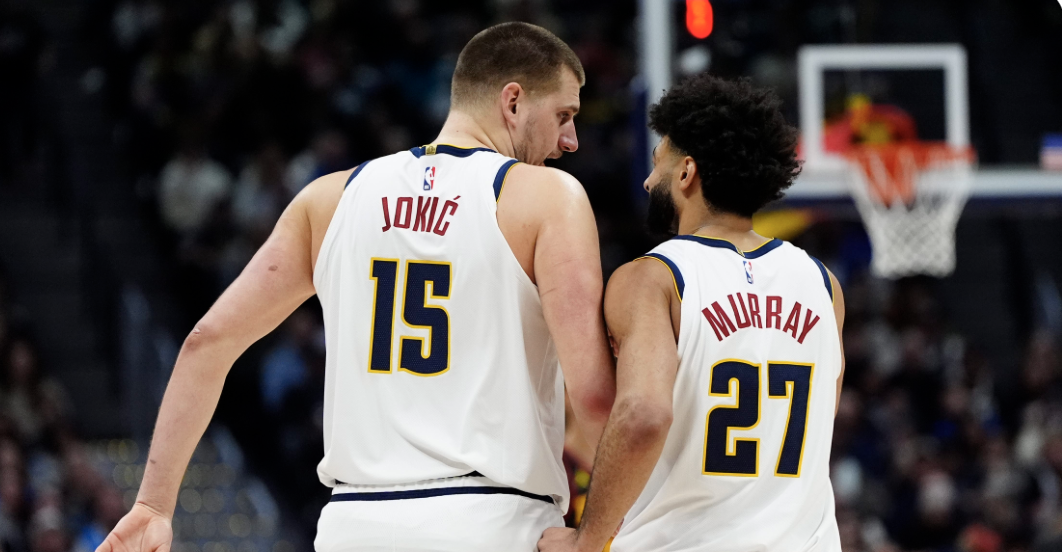



One statistic casts Denver’s offense in a slightly different light: Jamal Murray has assisted Nikola Jokić 1,086 times, while the Serbian center has assisted Murray 1,001 times. Although Jokić is one of the greatest passers in NBA history, he has more often been on the receiving end of the final pass in his partnership with the Canadian point guard. Not by much, but still. And that distribution of roles is one reason their two-man game has remained so difficult for opposing defenses to contain.


In Denver’s 116-108 win over New Orleans on November 14, they became the first teammates to assist each other at least 1,000 times in both directions since the NBA began tracking such statistics in the 1997-98 season. Jokić finished with 26 points, 10 assists, and eight rebounds, while Murray added 23 points and nine assists.
Over 10 years together, Jokić and Murray have recorded 2,087 assists to each other while developing one of the NBA’s most effective two-man games. These days, it almost feels inevitable that Jokić and Murray will find a solution when matched up against two defenders. Their early attempts, however, were far less successful.
It All Started Long Before Denver
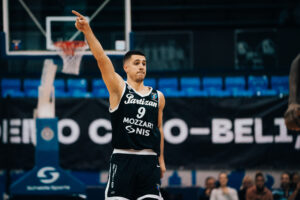
They first played together in April 2014 at the annual Nike Hoop Summit in Portland. Jokić, then a young center playing for Mega Vizura, and Murray, a 17-year-old Canadian guard, were members of the international team facing a selection of American prospects. Their teammates included Karl-Anthony Towns, Clint Capela, and Trey Lyles, while the Americans eventually won 84-73.
One first-quarter possession from that game is particularly interesting. Denver Gazette journalist Tyler King revisited the play in May 2023. Jokić set a screen for Murray, then immediately repositioned himself to set a second one, allowing Murray to change direction. Two defenders followed the Canadian, leaving Jokić open for a perimeter shot. He missed, but the sequence already contained elements of the offense that would become Denver’s most reliable weapon years later.
Jokić was selected with the 41st pick in the NBA Draft a few months later, while Murray arrived in Denver two years afterward as the seventh overall selection. Only then did they have the opportunity to work together every day.
In an analysis published by The Ringer in June 2023, American journalist Michael Pina uncovered a statistic that perhaps best illustrates how far they had to come. Their first NBA pick-and-roll together came against Portland on October 29, 2016. Murray used Jokić’s screen and passed him the ball, but the Serbian center missed a midrange jumper. Their next 14 pick-and-roll possessions that directly resulted in a shot also failed to produce a basket.
It wasn’t until their 16th attempt, a little more than two weeks later against Phoenix, that they finally scored. At that stage, both players were still finding their place in the NBA. Murray was a backup guard learning to run an offense at the highest level, while Jokić was gradually becoming the central figure in Denver’s system.
Their Chemistry First Developed Away From the Ball
Chris Finch, now Minnesota’s head coach and a Denver assistant during the 2016-17 season, later explained to The Ringer that their understanding initially developed through off-ball movement. Murray would often give Jokić the ball at the top of the key, then cut behind the defense or use screens to get open again. Over time, they learned each other’s tendencies: when Murray wanted the ball, the angles he preferred when driving, how much space Jokić needed to shoot, and when a pass had to arrive.
In their first season together, they recorded just 63 assists to each other, or 3.2 per 36 minutes played together. By 2018-19, that number had risen to 270 assists, averaging 5.2 per 36 minutes. According to an analysis by John Schuhmann for the NBA’s official website, that rate had reached 6.8 assists by early March 2026, more than double their first-season average.
When Jokić sets a screen for Murray at the top of the key, the defense has to make several decisions in a very short time. If the opposing center stays back in drop coverage, Murray has room to pull up from midrange, one of the strongest parts of his offensive game. If the big man steps up more aggressively, Jokić can pop into space around the free-throw line, where he has time to shoot or make the next pass.
Switching creates problems of its own. A smaller defender ends up guarding Jokić, who can exploit the size mismatch in the post, while Murray gets an opportunity to attack a slower defender. If the defense stops the initial action, Jokić can change the angle and set another screen, allowing Murray to attack again. As Finch explained, the two gradually learned how to keep a possession alive after the initial pick-and-roll had been contained, taking advantage of the defense’s new positioning.
Reversing the Roles Creates a Different Problem
Denver also frequently uses a reverse version of the action, with Murray screening for Jokić. The Serbian center handles the ball, forcing the defense to decide whether to switch or try to keep its original matchups. Murray can pop out for a shot, while Jokić has an opportunity to attack a slower or physically weaker defender, depending on how the defense responds.
This action was particularly effective during the 2023 Western Conference finals against the Los Angeles Lakers. According to data analyzed by Zach Kram for The Ringer, Denver scored an impressive 1.67 points per possession when Murray’s screen for Jokić led directly to a shot. The sample size was small, but it illustrated how much trouble the Lakers had finding an answer. During the same series, their conventional pick-and-roll, with Jokić screening for Murray, produced 1.28 points per possession when the action directly resulted in a shot.
According to Pina’s analysis, Jokić and Murray had run 1,048 pick-and-roll possessions together in the playoffs since 2019, through Game 3 of the 2023 NBA Finals. During their championship run, they averaged 19.7 such actions per game, more than any other duo.
Murray Assisting Jokić More Often Is Not an Accident
That also helps explain why Murray has assisted Jokić more often than the other way around. Jokić is also exceptional at catching passes in scoring positions, something that often gets overlooked because of his playmaking. He has excellent hands, knows how to find space after setting a screen, and poses a scoring threat from almost anywhere inside the three-point line. When the defense commits extra attention to Murray, finding Jokić with a pass is often the best option.
During Denver’s championship season, the Jokić-Murray pick-and-roll also benefited from Aaron Gordon’s cuts to the basket and the shooting of players such as Michael Porter Jr. and Kentavious Caldwell-Pope. Any defender who leaves his assignment to provide extra help against Jokić or Murray creates space elsewhere on the floor, allowing their two-man action to generate opportunities for teammates who aren’t directly involved.
The longest interruption to their time together came in April 2021, when Murray tore the anterior cruciate ligament in his knee. He missed the remainder of that season and the entire following campaign, leaving Denver without one of the foundations of its offense for two consecutive playoff runs.
Jokić won back-to-back MVP awards during that period, proving he could dominate even without his most important perimeter teammate. Still, Denver chose to wait for Murray to make a full recovery rather than break up the duo around which it had spent years building its offense. That decision paid off in the 2022-23 season, when the Nuggets won the first NBA championship in franchise history.
Their Best Game Came on the Biggest Stage
Game 3 of the Finals against Miami was especially memorable. Jokić and Murray became the first teammates to record 30-point triple-doubles in the same NBA Finals game. Jokić finished with 32 points, 21 rebounds, and 10 assists, while Murray contributed 34 points, 10 rebounds, and 10 assists.
After winning the championship, Murray shared a revealing detail from Game 5 of the Finals. He had to urge Jokić to shoot when he was open rather than continue looking for teammates. The Canadian guard is often the one encouraging Denver’s best player to be more aggressive as a scorer. Another interesting moment came in March 2026, when Jokić became the first center in NBA history to reach 6,000 regular-season assists during a game against Dallas. Fittingly, his milestone assist came on a pass to Murray for a layup. The Serbian finished with 23 points, 21 rebounds, and 19 assists, while Murray scored 53 points.
Speaking in February 2026 about the possibility of spending the rest of his career alongside Murray, Jokić emphasized how much it meant to know exactly what his teammate was capable of doing. He explained that Murray could hardly surprise him on the court anymore and that he felt no need to change the way Murray played. After so many seasons together, Jokić recognizes when Murray is looking for his shot, while Murray knows when the Serbian center wants the ball.
And, here we are… Ten years after they first took the court together in Denver, Jokić and Murray have reached 2,087 assists to each other. Their teammates have changed, opposing defenses have adjusted, and their own offensive roles have evolved. By now, opponents know very well what the two are trying to accomplish. The problem is that knowing what is coming often isn’t enough to stop them.