




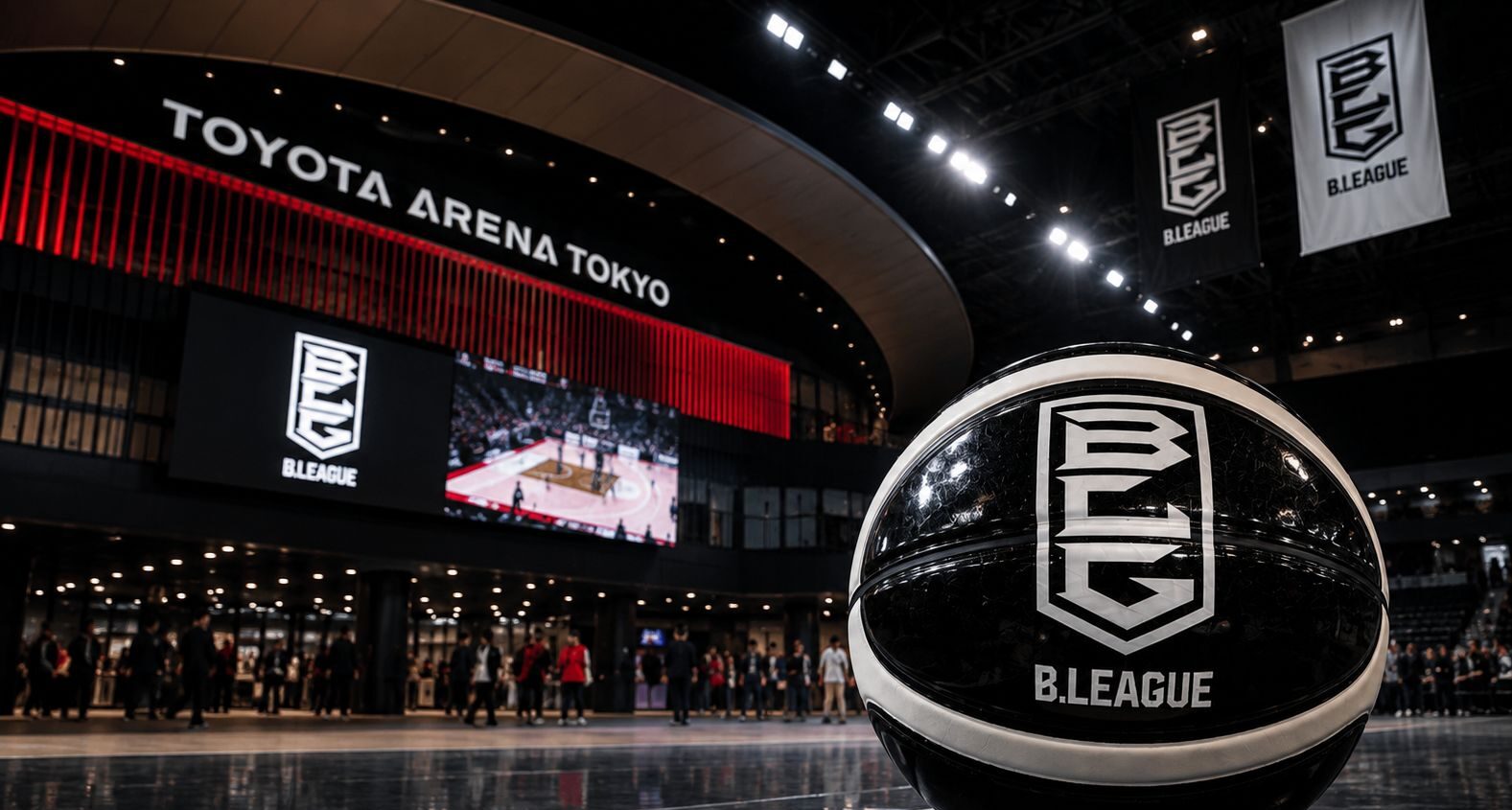

“We want to be the No.2 local league in the world at some point.”


When Nao Okamoto utters those words, there is little hesitation in his voice. Sitting alongside B.LEAGUE Commissioner Shinji Shimada during the International Media Press Conference, “A Review of B.LEAGUE’s 10th Anniversary and Our International Strategy for the New Season and Beyond,” the league’s Executive Officer for International Business is fully aware that such a statement invites immediate comparisons with the EuroLeague, the NBA, and every other major basketball competition on the planet.
Yet as the discussion unfolds, it becomes increasingly clear that the B.LEAGUE is asking to be judged by an entirely different set of standards.
For nearly two hours, Shimada and Okamoto rarely spoke about championships, marquee signings or even wins and losses.
Instead, they repeatedly returned to attendance figures, sponsorship portfolios, arena developments, business revenues, fan demographics, regional revitalization, international partnerships and youth development. Basketball, in their vision, is only one component of a much broader ecosystem that blends sport, entertainment, tourism, infrastructure and community development into what they believe can become the world’s most sustainable professional basketball league.

It is a philosophy that challenges many of the assumptions underpinning modern professional basketball.
Rather than relying on billionaire owners willing to absorb annual losses, rather than pursuing an endless race for increasingly expensive superstars, and rather than measuring success exclusively through trophies, the B.LEAGUE has chosen to build its future around long-term financial stability, diversified commercial income and deep local engagement.
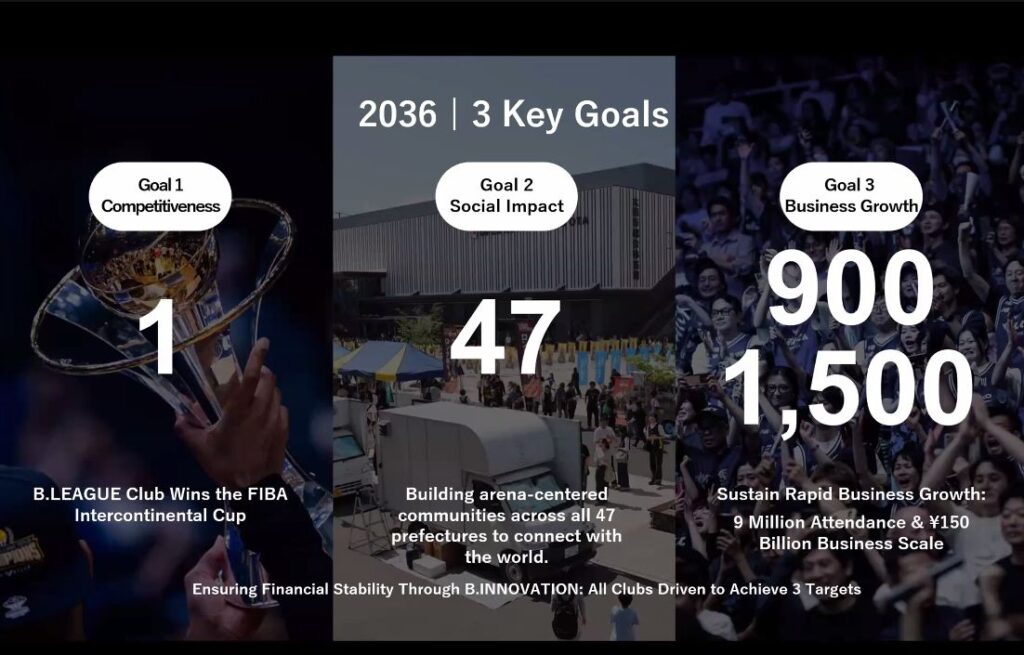
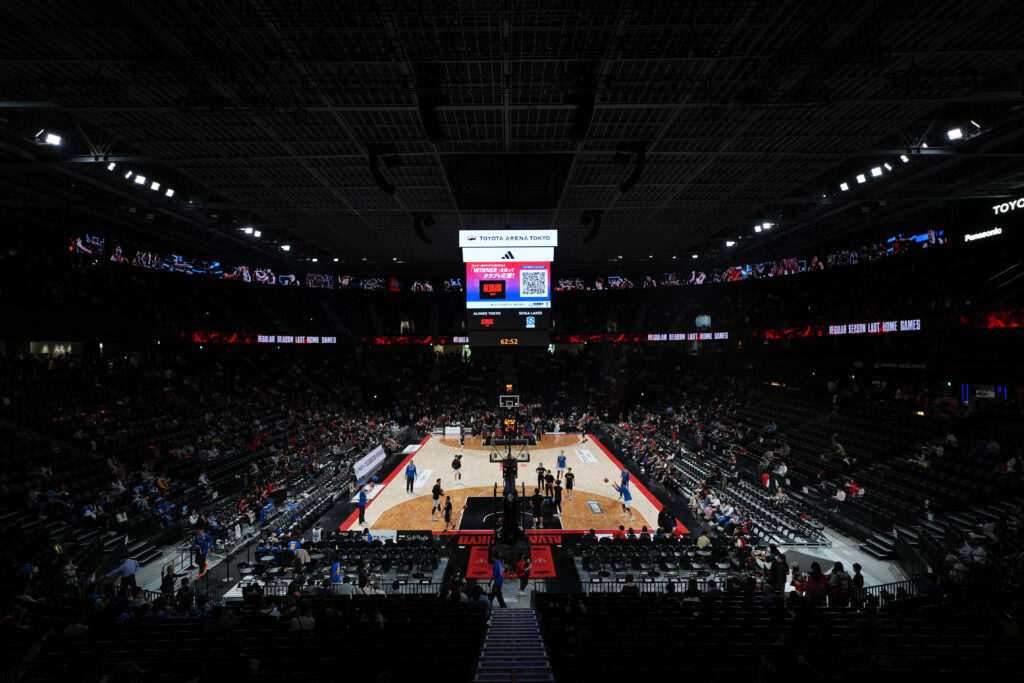
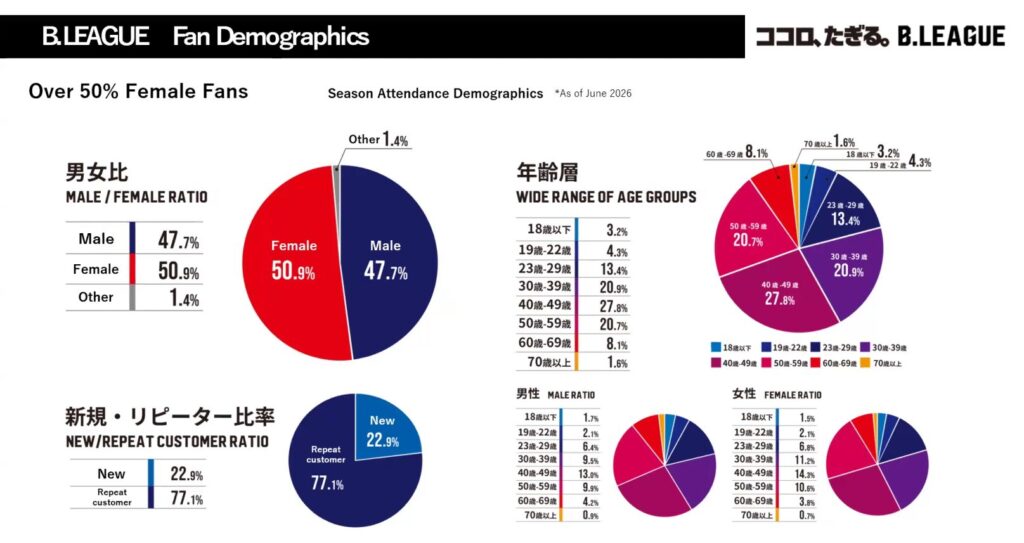
The league already counts 55 clubs nationwide, generated approximately ¥70 billion (~ €384 million) in combined league and club revenues during the 2025-26 season, attracted 4.8 million spectators across B1 and B2, and expects those figures to eventually reach ¥150 billion (~€824 million) and 9 million spectators respectively by 2036.
Those numbers are not just presented as ambitious projections buried inside a business presentation. They are the foundation upon which every strategic decision now being made by Japanese basketball is based.
“We’ve officially said we want to be No.2 in the world after the NBA, but we don’t compete with anyone,” Okamoto explained. “We compete with ourselves in terms of numbers.”
That qualification is perhaps the single most important sentence uttered during the press conference.
From the outside, the B.LEAGUE’s repeated references inevitably lead observers toward comparisons with the EuroLeague. Okamoto himself acknowledges that those comparisons are imperfect.
“Of course, there’s no apple-to-apple comparison because the EuroLeague is a regional league while we are a domestic league from the Far East. But in terms of business and athletic performance, we want to be No.2 in the world.”
The distinction matters because the B.LEAGUE has no intention of copying the European model. If anything, Shimada and Okamoto presented an alternative blueprint for how a domestic basketball competition can achieve international relevance without sacrificing financial discipline or its national identity.
Building a league before building champions
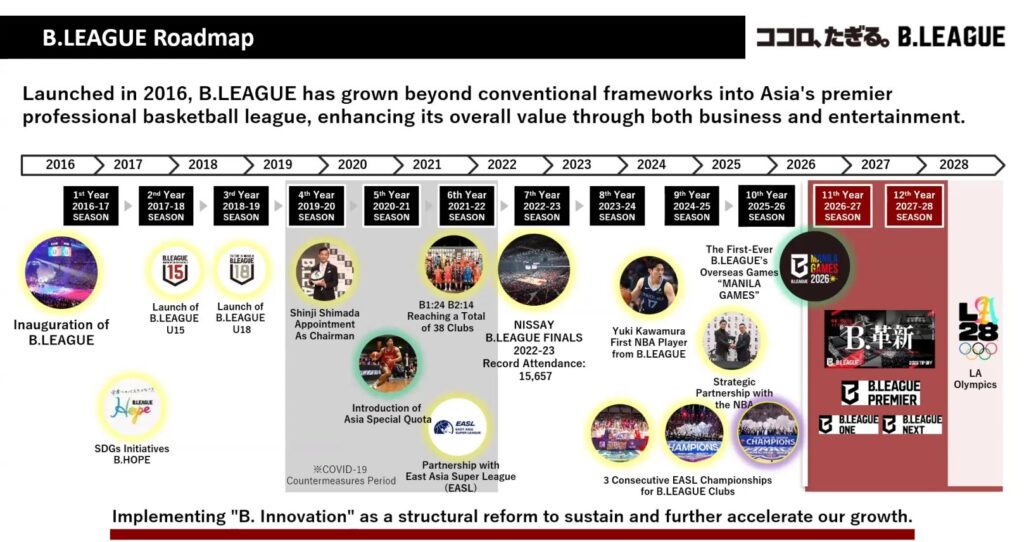
Perhaps the strongest impression left by the presentation was that almost every significant reform introduced over the last decade has originated not from basketball considerations alone but from business logic.
That philosophy reached its most visible expression through the B.Innovation Project, launched during the COVID-19 pandemic, when many leagues around the world were simply trying to survive. Rather than postponing structural reforms, the B.LEAGUE used the crisis to fundamentally rethink how its clubs should operate.
Instead of encouraging organizations to chase short-term sporting success at any cost, the league challenged them to become stronger businesses and to rely on marketing, sponsorships, community engagement, arena development, and digital strategy.
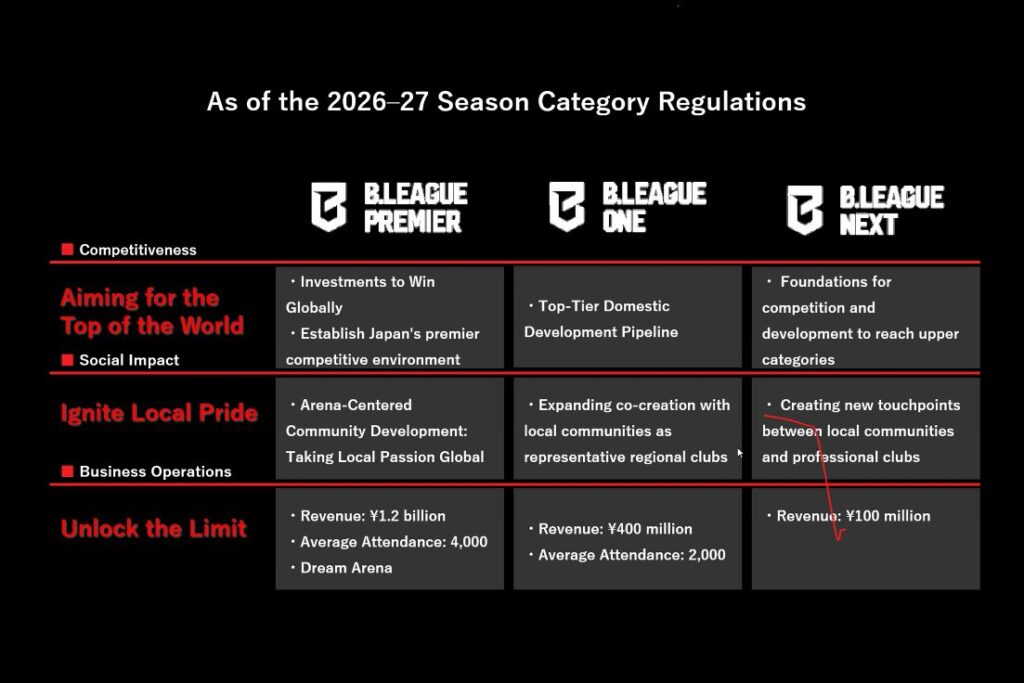
Every club was expected to improve across all those areas before even thinking about admission into the new B.Premier, the top division that will officially launch from the 2026-27 season alongside B.LEAGUE One and B.LEAGUE Next.
Initially, expectations were modest.
“When we launched the project during COVID, many thought only 8-10 teams would qualify for the B.Premier,” Shimada recalled.
What happened instead surprised even league officials: “When applications opened, 26 clubs reached the required standards.”
That result represented far more than a successful licensing process.
It demonstrated that clubs across Japan had embraced a fundamentally different understanding of professional basketball, investing simultaneously in commercial growth, sponsorship acquisition, ticketing, branding and fan engagement. Every successful applicant had been forced to think less like a sports team and more like a sustainable entertainment company.
The requirements themselves illustrate the scale of that transformation.
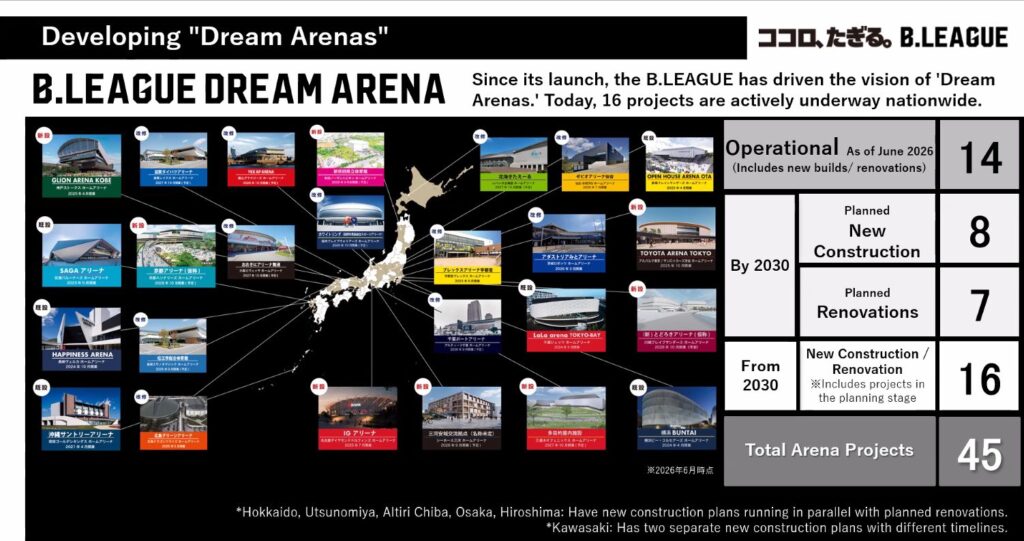
Admission into B.Premier is determined not simply by performances on the court but by a combination of sporting ambition and commercial strength. Clubs must generate at least ¥1.2 billion (the equivalent of €6.6 million) in annual revenue, average 4,000 spectators per home game, while also meeting stringent arena standards under the league’s Dream Arena initiative.
The second tier, B.One, requires ¥400 million (€2.2 million) in revenue and average crowds of 2,000, while B.Next clubs must reach ¥100 million (€550.000).
For basketball traditionalists accustomed to promotion and relegation being determined exclusively by results, the system appears almost revolutionary. Yet Shimada and Okamoto repeatedly argued that long-term sporting excellence cannot exist without equally robust commercial foundations.
That thinking extends to the league’s new salary cap system.
Beginning with B.Premier, clubs will operate within an annual salary range between ¥500 million (€2.75 million) and ¥800 million (€4.4 million), while a carefully designed Star Player Clause allows one designated player earning at least ¥150 million (€823.500) annually to count as only ¥150 million against the salary cap regardless of his actual salary.
The mechanism deliberately balances two competing objectives. The first is to maintain competitive balance across 26 B.Premier clubs. The second is to ensure Japanese basketball remains capable of attracting internationally recognized players.
“We do understand that the cap might make it harder to attract certain high-salary players, but at this point, financial sustainability is our priority,” Okamoto explained.
Few league executives around the world voluntarily admit they are willing to sacrifice access to star players in exchange for financial stability. For the B.LEAGUE, however, that trade-off is central to its identity.
A different economic philosophy
Throughout the presentation, Okamoto repeatedly contrasted the Japanese model with what has become common practice elsewhere in world basketball.
“Our clubs are not funded by a rich owner. We don’t fund it by one single person who loves basketball.”
Instead, he described a league deliberately constructed around diversified commercial income: corporate sponsors, ticket sales, merchandise, hospitality, regional governments, community partnerships, and tourism. Each revenue stream reduces dependence on any single benefactor while strengthening the relationship between clubs and their local communities.
Few organizations embody that philosophy better than the Ryukyu Golden Kings. Rather than pointing to championships, Okamoto focused on their economic model.
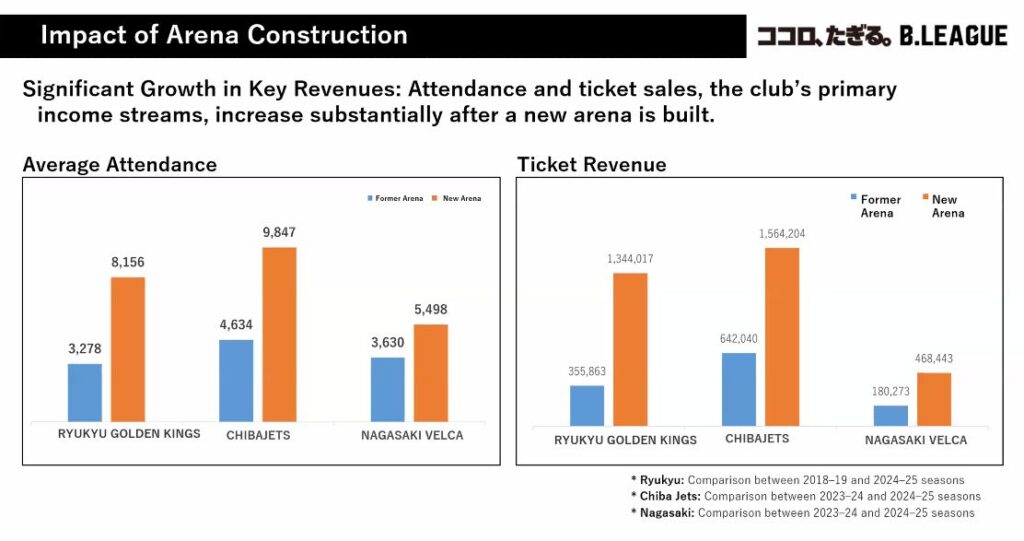
The Okinawa-based club worked with approximately 700 sponsors during the 2023-24 season, filled its 8,000-seat arena throughout a 30-game regular season, and became a case study in what the league now calls risk sharing.
“We are sharing the risk with many sponsors and many fans,” he explained. “That makes our model highly sustainable.”
The word “sustainable” surfaced constantly throughout the press conference. It underpins virtually every major initiative the league has introduced over the past several years. Rather than spending aggressively to compete with richer international competitions, the B.LEAGUE is attempting something arguably more difficult: building an ecosystem capable of continuously generating new revenues while remaining financially disciplined.
That philosophy explains why Shimada and Okamoto speak far more enthusiastically about attendance than transfer budgets. Today, the league attracts approximately 4.8 million spectators annually, but that figure is viewed merely as another milestone rather than an endpoint.
By 2036, the objective is to reach 9 million spectators, expand total business activity to ¥150 billion, establish arena-centred communities in all 47 Japanese prefectures, construct or renovate dozens of modern venues and eventually see a B.LEAGUE representative lift the FIBA Intercontinental Cup.
Exporting the league’s product throughout Asia and the world
Many leagues speak about globalization as an abstract aspiration. The B.LEAGUE, by contrast, has produced a remarkably detailed roadmap stretching well into the next decade, identifying target markets, commercial priorities, development programs, media strategies, international competitions and even the precise number of NBA players it expects to produce.
Rather than asking how Japanese basketball can become internationally relevant, the league has already begun behaving as if that relevance is inevitable. The numbers presented during the International Media Press Conference illustrate how aggressively that international footprint has expanded over the past few years.
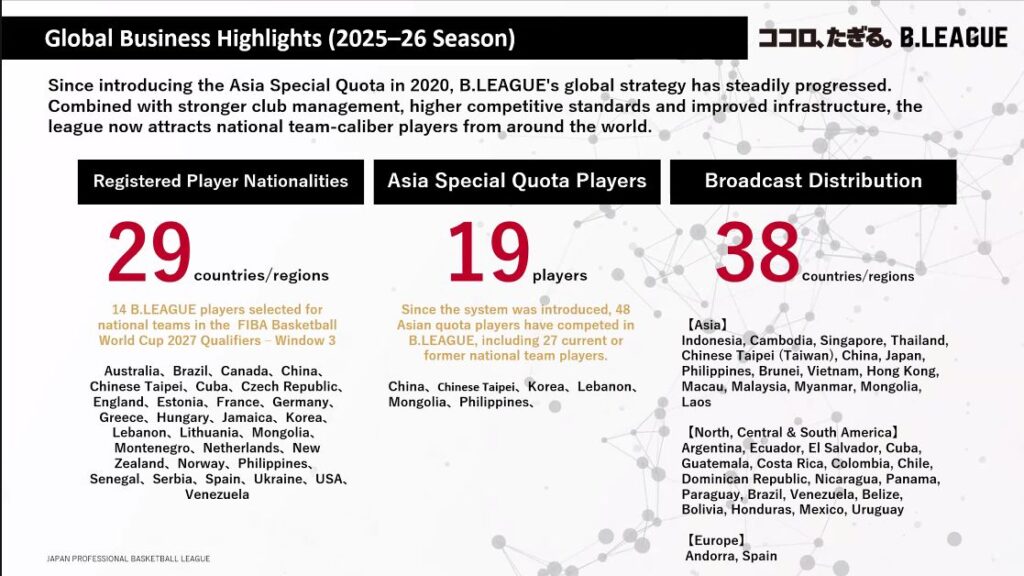
Today, the B.LEAGUE features players representing 29 different countries and regions, broadcasts its games in 38 countries and territories, has introduced 19 Asia Special Quota players, regularly participates in both the East Asia Super League and the Basketball Champions League Asia, has established formal partnerships with the NBA, Australia’s National Basketball League, and FIBA competitions, while simultaneously creating entirely new initiatives such as B.LEAGUE United and the Global Invitational.
But how does a domestic Japanese basketball league become an internationally recognized basketball ecosystem?
Asia comes first
One misconception surrounding the B.LEAGUE’s global ambitions is that it immediately seeks to challenge the NBA or the EuroLeague for international attention.
Nothing Shimada or Okamoto said during the press conference supports that interpretation. Instead, both executives consistently emphasized a much more pragmatic approach.
Asia comes first, while Europe and North America can wait. The reasoning is straightforward.
Unlike Europe, where basketball already competes against the deeply established EuroLeague and dozens of powerful domestic championships, or the United States, where the NBA dominates virtually every aspect of professional basketball, Asia still presents enormous opportunities for growth.
Several countries possess passionate basketball audiences but lack domestic leagues with comparable commercial resources, arena infrastructure or international visibility.
For Okamoto, that creates a natural starting point.
“We focus on countries where basketball is popular and where the level of competition is close to that of the B.LEAGUE,” he explained. “This helps drive attention once top players from those countries come to Japan.”
Basketball as an instrument of regional economic policy
The philosophy extends far beyond recruiting better basketball players. Every international signing is viewed simultaneously as a sporting decision, a marketing opportunity and a media strategy.
The Philippines, South Korea, Taiwan, Indonesia, China, Lebanon and several other Asian nations have therefore become priority markets not only because they produce talented players but because they already possess passionate basketball cultures capable of generating television audiences, sponsorship opportunities and tourism.
The league’s Asia Special Quota perfectly illustrates that thinking. Rather than limiting international recruitment to traditional import players, the B.LEAGUE deliberately expanded opportunities for Asian athletes, allowing clubs to recruit players whose influence extends well beyond the court.
South Korean international Lee Hyun-jung, Filipino stars such as Dwight Ramos, AJ Edu, Kiefer Ravena, Thirdy Ravena, Ray Parks Jr., Jamie Malonzo and Mike Phillips, along with players from Chinese Taipei and elsewhere, have become essential pieces of the league’s internationalization strategy.
Their value is measured not only through points and rebounds but also through television ratings, social media engagement and tourism.
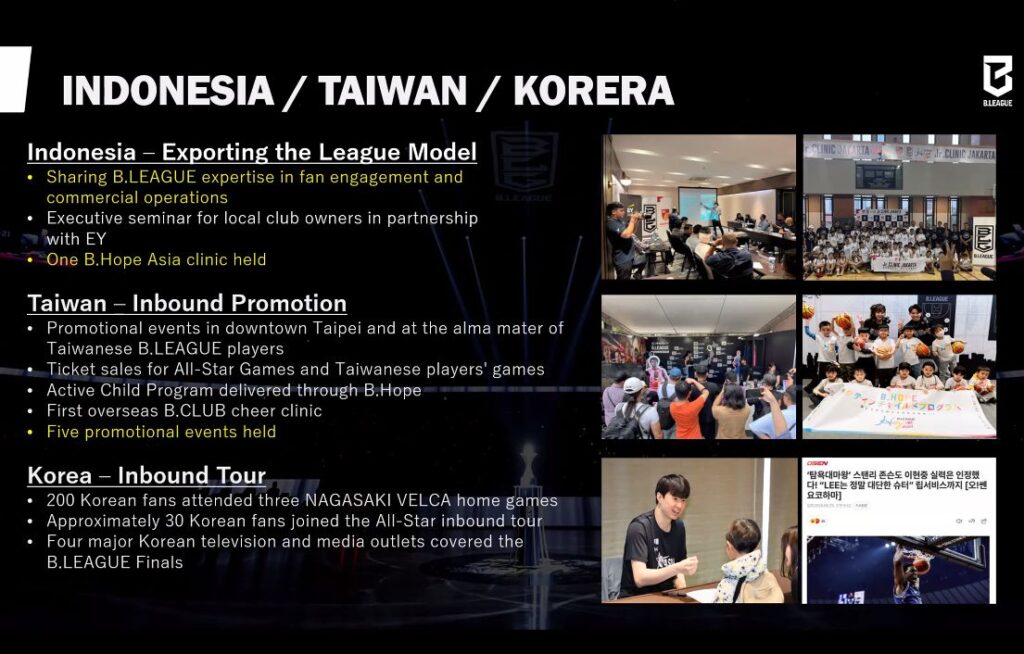
Okamoto offered perhaps the clearest example. After Nagasaki signed Lee Hyun-jung, basketball was no longer the only beneficiary.
“There are many tourists from Korea last year because of Hyun-jung Lee,” he explained. “Since Nagasaki and Korea are very close, there are a couple of hundred tourists all the way from Korea to Japan to watch the game. So it revitalized the local community, not only by the power of the Japanese fans, but non-Japanese fans like Korea support that.”
That anecdote perfectly encapsulates how differently the B.LEAGUE measures success. For many professional leagues, a foreign signing is considered successful if he improves the team’s chances of winning. For the B.LEAGUE, success increasingly includes attracting hotel bookings, airline passengers, restaurant customers and overseas media coverage.
Why the Philippines matters more than anywhere else
No international market occupies a more prominent place within the B.LEAGUE’s expansion strategy than the Philippines.
While Europe often dominates discussions surrounding international basketball, nearly every roadmap presented by Shimada and Okamoto placed the Philippines at the center of the league’s overseas ambitions. That priority is reflected in almost every measurable indicator.
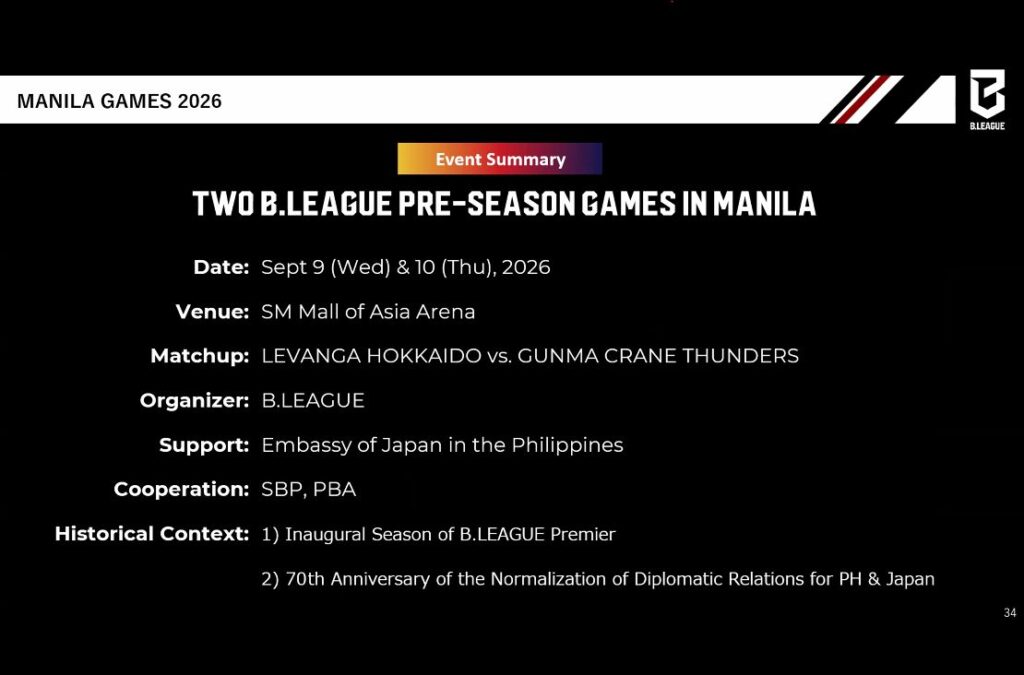
The B.LEAGUE Manila Games 2026, featuring Levanga Hokkaido and Gunma Crane Thunders, will become the league’s first overseas home games.
Tagalog-language social media platforms have been developed specifically for Filipino audiences.
Local community events, B.Hope initiatives (corporate social responsibility and Asian community-outreach programs run by the B.LEAGUE aiming to promote social values like gender equality, youth athletic development, and cultural exchange across Asia) and fan festivals have accompanied promotional activities throughout the country.
According to figures presented during the conference, the league has already generated approximately 520,000 Facebook followers in the Philippines, while 282 media organizations covered its activities surrounding the Manila Games. Internal research presented by the league also suggested 65.1% brand awareness among the target audience.
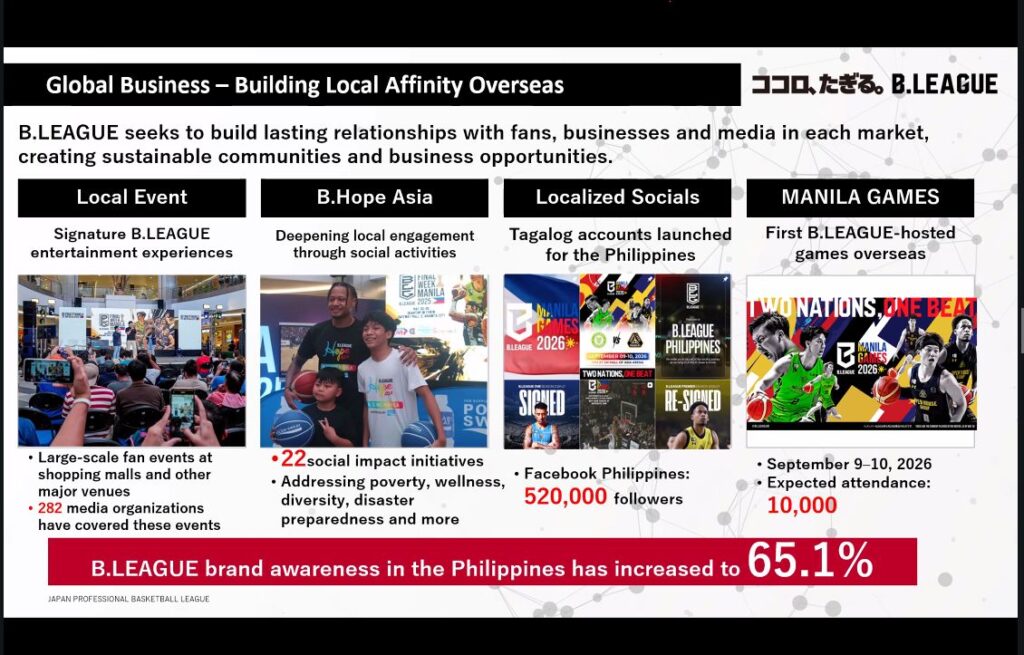
Those numbers explain why the Philippines has effectively become the B.LEAGUE’s international laboratory. The league’s commitment to Filipino talent has become increasingly evident.
It’s not a coincidence that no less than 10 Filipino players are expected to compete in Japan during the 2026-27 season, more than any other foreign nationality. Rather than treating them simply as imports, the B.LEAGUE increasingly views them as ambassadors connecting two basketball cultures. That philosophy will be showcased during the upcoming Manila Games.
Throughout the press conference, Shimada and Okamoto repeatedly argued that international audiences should not evaluate the B.LEAGUE solely through its level of competition. Instead, they hope overseas fans experience the league as a complete entertainment product: music, family activities, food festivals, anime collaborations, merchandise, cheerleading performances, and interactive fan experiences.
The Manila Games therefore are intended to function as a demonstration of the entire B.LEAGUE ecosystem.
Exporting players: The NBA target without becoming a feeder league
Perhaps no issue better illustrates the complexity of the B.LEAGUE’s long-term strategy than its relationship with the NBA.
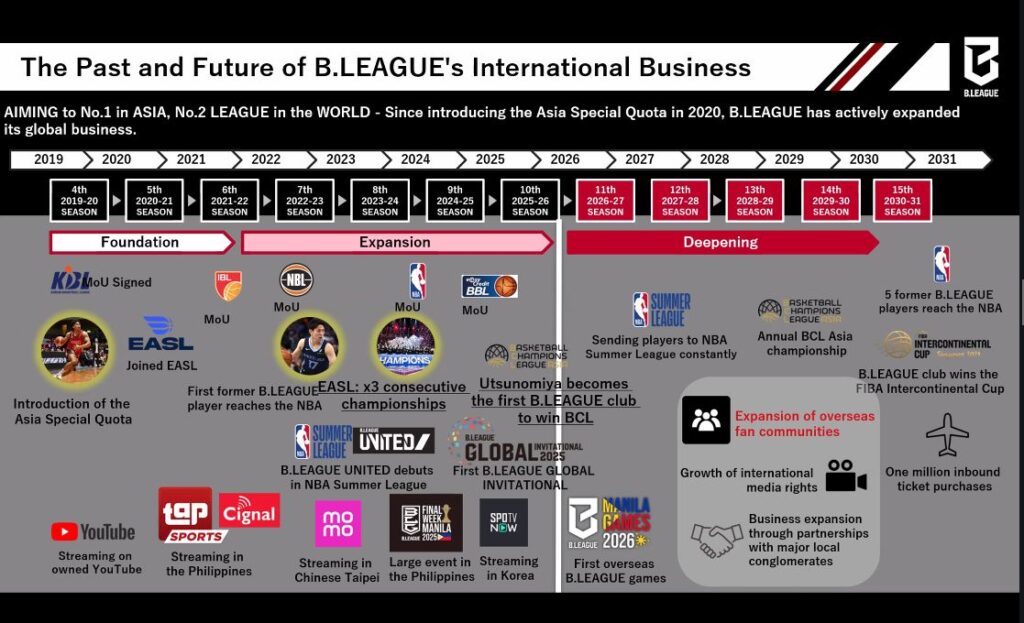
On one hand, Japanese basketball has publicly committed to producing five NBA players by 2030. On the other, Shimada and Okamoto consistently reject the idea that the B.LEAGUE should become merely another developmental league supplying talent to North America.
The emergence of Yuki Kawamura has provided the first proof that the pathway can work. Beginning his professional career in the B.LEAGUE before reaching the NBA, Kawamura has become the league’s flagship success story.
Yet Okamoto is careful not to present that objective as exclusively Japanese.
“We have officially launched the career mid-term goal to say we send five NBA players by 2030,” he explained. “Yuki is one.”
“We not just focus on Japanese players. Whoever plays in the B.LEAGUE, we really hope they improve to reach the NBA. A Philippine player is not an exception. We’re open to any player from any nationality.”
That statement fundamentally changes how the league defines success as the 5-player target is not based on passports, but rather on the B.LEAGUE ecosystem itself. If a Filipino, South Korean or Taiwanese player develops into an NBA-caliber talent while competing in Japan, the league considers that achievement equally valuable. It is an open interpretation of player development—one that reflects the increasingly international identity the B.LEAGUE hopes to build.
International competition as a development tool
If exporting the B.LEAGUE experience across Asia represents one pillar of the league’s international strategy, strengthening the quality of basketball itself represents the other. Throughout the International Media Press Conference, Okamoto repeatedly returned to an idea that has become almost a mantra inside the league’s headquarters: Japanese basketball will only continue to grow if its players, coaches and clubs consistently expose themselves to stronger international competition.
That conviction explains why the B.LEAGUE has invested so heavily in initiatives that extend far beyond its domestic calendar.
The league now treats participation in the East Asia Super League, the Basketball Champions League Asia, friendly tournaments against overseas clubs and even NBA Summer League scrimmages not as optional marketing exercises, but as essential components of player development.
“We have the East Asia Super League, we have BCL Asia and other international competitions,” Okamoto explained. “We need more opportunities like these.”
His reasoning reflects a philosophy that differs markedly from leagues content with domestic excellence. Decision-makers in the Japanese league know that traveling abroad and facing different styles of basketball is an experience that can make teams stronger and raise the overall level of basketball in Asia.
B.LEAGUE United: Bringing the international game to Japan’s best prospects
That principle has already become institutionalized through B.LEAGUE United, perhaps the league’s most ambitious basketball development project. Created as part of the league’s objective of producing five NBA players by 2030, B.LEAGUE United brings together many of Japan’s most promising young players before sending them abroad to compete against elite opposition.
This summer alone, the project sent a representative squad to Australia, where it faced Southeast Melbourne Phoenix and Melbourne United, while previous editions also included scrimmages against NBA Summer League teams in Las Vegas.
Former Chicago Bulls assistant Damien Cotter, who worked directly with Yuki Kawamura during the 2025-26 NBA season, was appointed head coach specifically because of his experience developing players within both the NBA and international basketball.
The league wants Japanese prospects to experience NBA-level environments long before they become NBA players. That intervention has become necessary since most of the Japanese players don’t have overseas playing experience.
Rather than encouraging its best young players to leave permanently, the B.LEAGUE has attempted to bring international basketball to them. Players continue enjoying the financial security, facilities and stability offered by the domestic league while simultaneously acquiring the international experience traditionally available only through overseas transfers.
More than cooperation: Building a league the NBA can understand
The NBA inevitably occupies a central position within that strategy.
The relationship between the two organizations has deepened considerably over recent years, evolving from occasional cooperation into what both sides increasingly describe as a strategic partnership.
Yet perhaps the most striking aspect of the B.LEAGUE’s NBA ambitions is that they extend far beyond simply producing players. The league’s executives repeatedly stressed that Japan is attempting to build an entire basketball ecosystem structurally compatible with North American professional sports:
- A closed top division
- Commercial licensing requirements
- Salary caps
- Star player exceptions
- Arena standards
- Centralized business criteria
- Long-term franchise planning
- Heavy emphasis on fan experience
Those characteristics increasingly resemble the blueprint many observers expect the NBA to pursue elsewhere around the world.
Even the league’s governance reflects that evolution. Beginning with the launch of B.Premier, Shinji Shimada’s official title changed from Chairman to Commissioner, deliberately aligning the league with terminology commonly used by major North American professional competitions.
According to the league, the change reflects both its commitment to diversity and inclusion and its desire to strengthen its international identity.
From the Philippines to Europe: A market-by-market expansion
That ambition extends into the commercial sphere. The B.LEAGUE now distributes broadcasts across 38 countries and territories, while international business strategies have been tailored separately for different regions.
Indonesia focuses primarily on exporting the B.LEAGUE operational model. Taiwan emphasizes marketing partnerships; South Korea combines player recruitment with sports tourism; The Philippines functions as both a commercial and basketball showcase; Europe represents a longer-term opportunity; The United States remains the most difficult market of all.
Okamoto offered perhaps the clearest assessment of that challenge.
“The U.S. and Europe are the most challenging markets for us.”
He acknowledged the obvious reasons.
“You guys have strong content like the NBA and EuroLeague already. And especially in Europe, football is the most popular sport. So not only are we competing with other leagues, we’re competing with different sports.”
Hence, the B.LEAGUE’s international expansion model remains incremental rather than revolutionary. Even broadcasting rights follow that logic.
The Philippines and Chinese Taipei already receive B.LEAGUE coverage largely because local stars create natural audience interest. Spain has emerged as another early success thanks to its established basketball culture, while France has been identified as an attractive market due to its enthusiasm for Japanese anime and manga.
Every international initiative is expected to generate measurable commercial returns. That philosophy also explains why foreign investment occupies a surprisingly modest role within the league’s long-term plans.
Okamoto confirmed that overseas investors have expressed interest in purchasing B.LEAGUE clubs, yet Japanese regulations require them to establish companies inside Japan before doing so.

Why Japan refuses to enter a basketball arms race
Even more revealing, however, was his attitude toward aggressive financial expansion.
“If we want to bring in ex-NBA players, we’d have to lift our salary cap. But that’s not what we want.”
At a time when leagues across the world often compete by increasing payrolls, the B.LEAGUE continues prioritizing competitive balance over headline-grabbing recruitment. The salary cap, in other words, is not viewed as an obstacle to growth but as one of the reasons growth remains sustainable.
Still, many of the league’s objectives remain ambitious.
- Doubling annual attendance from 4.8 million to 9 million will require basketball to continue attracting entirely new audiences rather than simply retaining its current supporters.
- Growing business activity from approximately ¥70 billion to ¥150 billion demands continued commercial expansion across all 55 clubs, alongside the successful opening of dozens of new arenas
- Producing five NBA players assumes that Yuki Kawamura becomes the beginning of a trend rather than an isolated success story.
- Winning the FIBA Intercontinental Cup within a 10-year framework requires Japanese clubs eventually competing with the very best organizations from Europe and the Americas.
The 2036 test: When ambition has to become reality
By 2036, the B.LEAGUE management envisions arena-centred communities across all 47 prefectures, one million inbound ticket purchases from overseas visitors, continued participation in international competitions, stronger overseas fan communities, and Japanese clubs capable of consistently competing against the world’s best.
Whether every objective is ultimately achieved, the B.LEAGUE has evolved into one of the world’s most ambitious sports business projects, combining infrastructure, community development, tourism, international partnerships and basketball under a single long-term vision. It strives to create a distinctly Japanese model for professional basketball, one built around sustainability rather than speculation, regional identity rather than centralization, and long-term institutional growth rather than short-term competitive advantage.
Whether that model ultimately delivers the world’s second-most influential basketball league remains an open question. What no longer seems open for debate is that Japanese basketball has stopped thinking of itself as merely a domestic competition.
And after spending time listening to Shimada and Okamoto outline that vision, it becomes much easier to understand why the rest of the basketball world is beginning to pay attention.