










Some stories go far beyond a contract, a marketing deal or a business decision. And even if they take 35 years to become official, they can still strike an emotional chord with those who lived through them —or with those who inherited the story through the memories passed down by their elders.


Since September 11, Baloncesto Fuenlabrada, one of Spain’s historic clubs and currently competing in Primera FEB —the country’s second tier— after spending as many as 25 seasons in the ACB, has officially become Partizan de Fuenlabrada.

The name change immediately catches the eye and inevitably raises questions about the connection between the Madrid-based club and the Serbian basketball giant. What is now a sporting, business and branding partnership actually has its roots in a story of solidarity, sporting success and lasting gratitude between a small city south of Madrid and a team in need of a home.
In 1991, the Balkan War had completely altered the landscape of European basketball. International restrictions prevented Partizan Belgrade from playing its European games at home, and the Serbian club needed to find somewhere from which it could compete in the European Cup. The solution, of all places, was more than 2,000 kilometers from Belgrade: Fuenlabrada.
The Madrid suburb was then a young city with little basketball tradition. But it had just opened the Fernando Martín arena that September, and its mayor, José Quintana, played a decisive role in helping Partizan find a second home there. Years later, Quintana explained that there was also something symbolic about the choice: it was a young team for a young city.
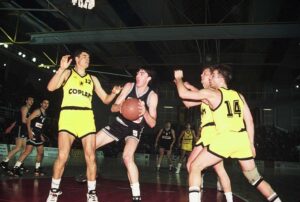
What initially appeared to be little more than a logistical solution soon became something much deeper.
Partizan played its home games in Fuenlabrada during the 1991-92 European Cup season. Coached by a 31-year-old Željko Obradović and featuring an extraordinarily young roster, the team would go on to write one of the most remarkable chapters in European basketball history. Sasha Djordjevic, Predrag Danilovic, Nikola Loncar, Ivo Nakić, Željko Rebrača… A generation forced to play away from home while their country was being torn apart by war, yet one that ultimately became European champion for the first —and so far only— time in the club’s history.
Throughout that journey, culminating in Sasha Djordjevic’s iconic three-pointer in Istanbul, the Fernando Martín became their refuge. And the people of Fuenlabrada did more than simply lend them an arena: they adopted the team as their own.
Some of the scenes that unfolded are difficult to imagine through today’s eyes. When Joventut or Estudiantes went to the Fernando Martín to face Partizan, the stands would be filled with support for the Serbian visitors.
“But we’re the Spanish team,” players from the visiting sides would point out.
“Yeah, but we’re Partizan fans,” the supporters would reply.

The bond became so strong that the players themselves still remember it as one of the most important experiences of their careers. Sasha Djordjevic explained that, after those first months of uncertainty and the harsh reality of war, his relationship with the people of Fuenlabrada grew into something far beyond friendship. “The court was our salvation,” he once said.
Predrag Danilovic, meanwhile, described those months as one of the most beautiful experiences of his life. They did not feel like foreigners. They felt at home.
And while Partizan found a temporary home in Fuenlabrada, the team also found an opportunity to make history. It happened on April 16, 1992, in Istanbul. Partizan defeated Joventut in the European Cup final. With three seconds remaining, Djordjevic hit an unforgettable three-pointer over Tomás Jofresa. Danilovic was named MVP. And Željko Obradović became a European champion in his first season as a head coach.
Partizan had conquered Europe from its Fuenlabrada exile, forever tying the Spanish city to one of the greatest achievements in the history of the Serbian club. That is why, even after Partizan returned to Belgrade, the relationship never disappeared.
Anniversaries, reunions, visits and memories kept alive a story that had grown beyond basketball. Over the past five years, even the preseason games between the two clubs have become something of a tradition, played both in Serbia and Spain. In fact, the two teams faced each other this weekend in Belgrade, in a three-team tournament also featuring Turkish side Beşiktaş.

In Belgrade, they never forgot what that Spanish city had done for them. And in Fuenlabrada, they never forgot the team that had turned the Fernando Martín into one of the stages of its European triumph.
Now, 35 years later, that story has taken a step that would have been unimaginable in 1991: Baloncesto Fuenlabrada has officially become Partizan de Fuenlabrada.
According to the Spanish club, this is not merely a change of name. It is the result of a shared project encompassing institutional, sporting, social, business and branding initiatives. The two clubs have already begun working together on player development, taking advantage of the high level of Madrid’s youth basketball system, one of the most competitive development environments in Europe, if not the most of all.
The ‘Fuenla’, as the Spanish club has traditionally been known, will retain its day-to-day sporting activity and structure. But the partnership gives it the opportunity to develop new business lines and gain significantly greater international exposure.

Partizan, meanwhile, is one of Europe’s most recognizable sports brands, with a huge international following and particularly strong reach on social media. Fuenlabrada wants to tap into that global visibility without giving up its own identity. A dedicated merchandising line —including jerseys, hoodies and scarves— is already being prepared under the new name.
It is, in many ways, a story coming full circle. Fuenlabrada gave Partizan shelter when the Serbian club needed somewhere to play. Now, the Serbian club is helping Fuenlabrada, which has endured significant financial difficulties in recent years, to open a new chapter.
Perhaps that is the true essence of Partizan de Fuenlabrada. This is not simply an exercise in nostalgia, but the transformation of a debt of gratitude into a partnership.
A story born during one of Europe’s darkest moments, played out in a newly opened arena in a city south of Madrid, and ultimately crowned by a European champion lifting the trophy in Istanbul.
Thirty-five years later, Partizan is somohow coming home to Fuenlabrada.