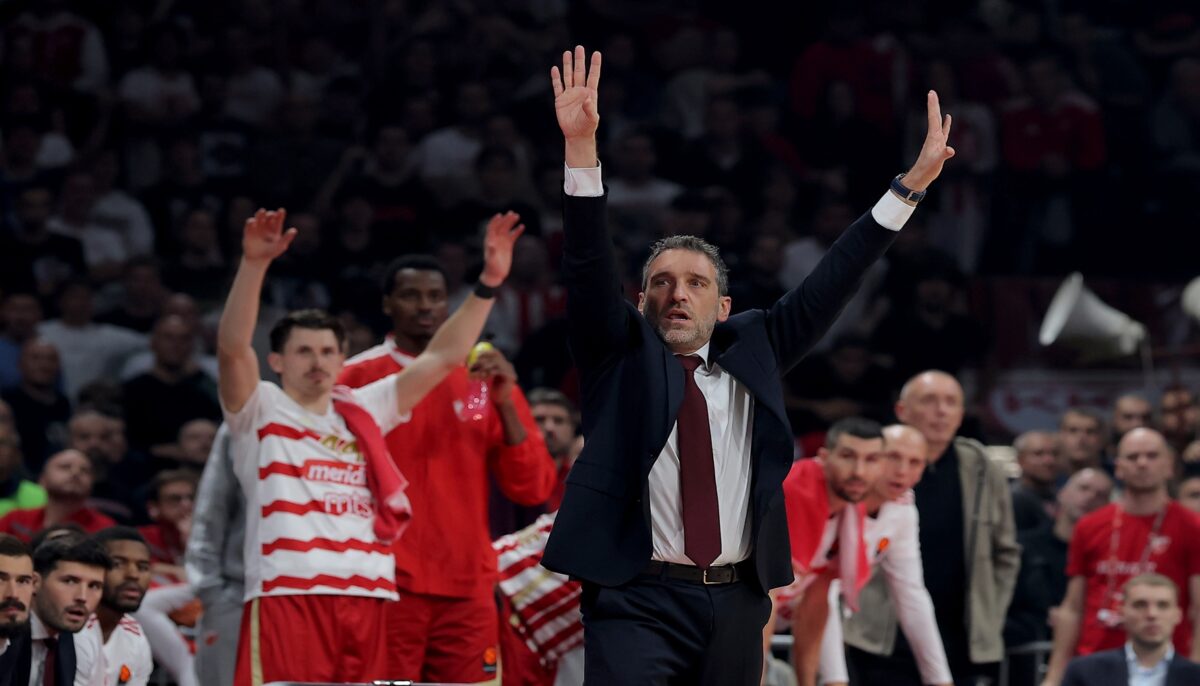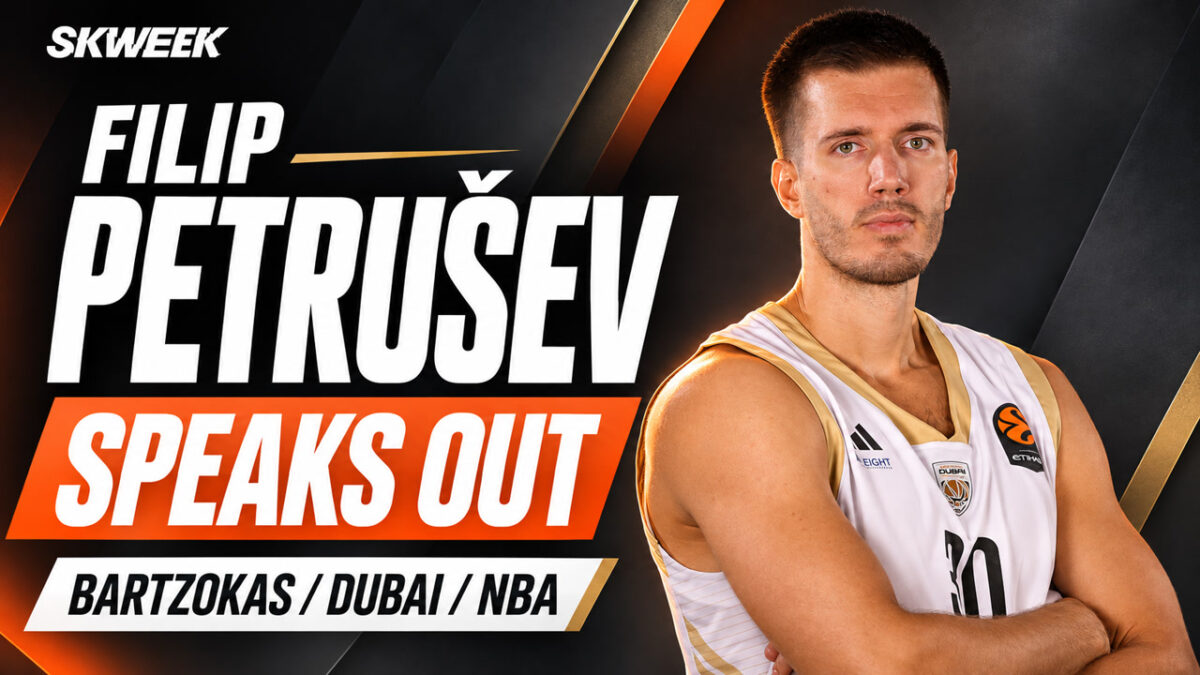

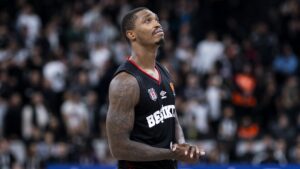
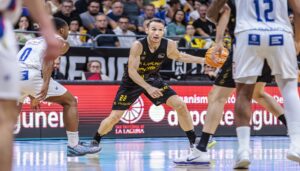
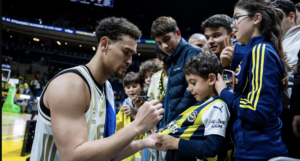
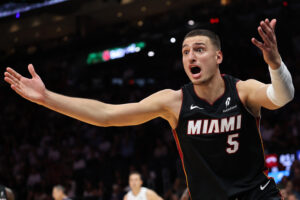

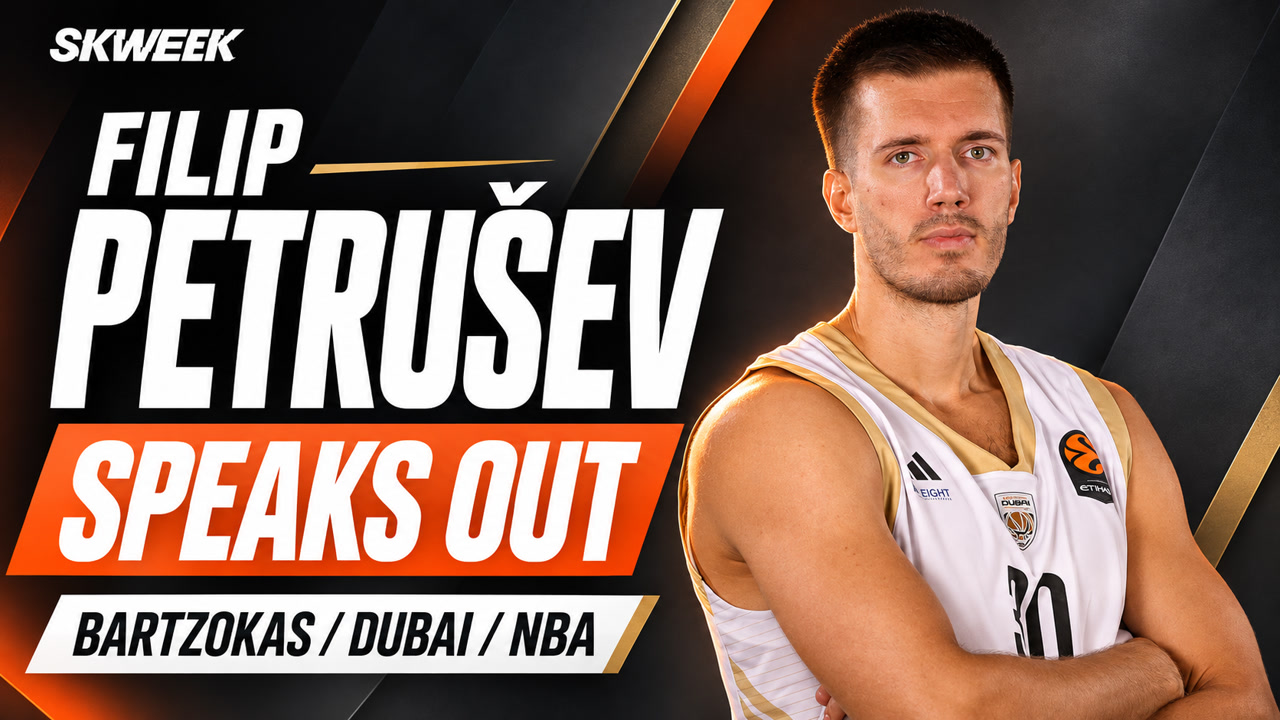

From the coach who pushed him the hardest to the decisions that shaped his career, Filip Petrušev shares his side of the story. He explains his relationship with Giorgos Bartzokas, why Duško Ivanović’s demanding approach brought out the best in him, and why he feels at home in Dubai.


He also talks about Gonzaga, the NCAA, and his journey toward the NBA Draft, addresses rumors linking him with Crvena zvezda, and explains why his body language does not always reflect how much winning means to him.
Exclusively on SKWEEK
His decision to move to the United States and attend Gonzaga
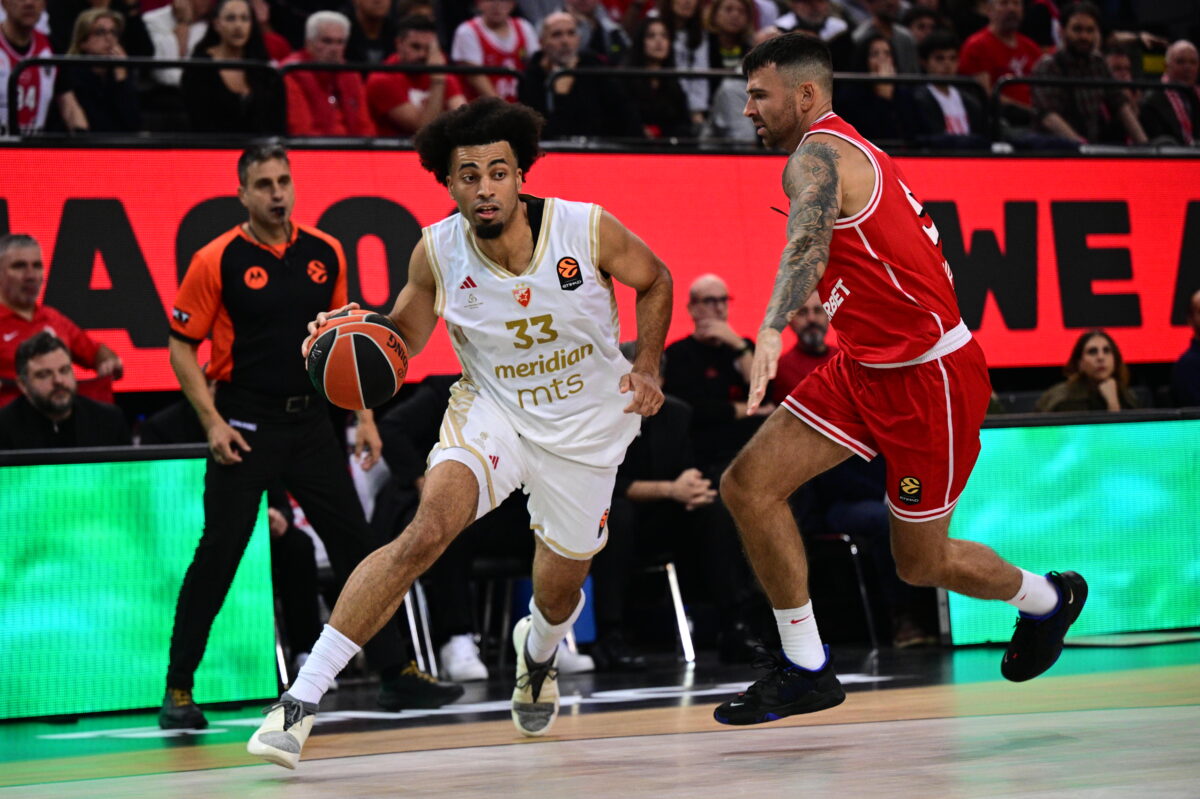
“It was very different compared to today. You know, I had also attended an American high school for a short period of time. In my case, I had a long-term contract with Baskonia that I wanted to get out of.
I believed that moving to the United States would be better for my career because, at that point, I wanted to keep both education and basketball as options.
Things were very different back then because it wasn’t something common. Today, the situation has changed because there’s money involved and players can now get paid in the NCAA. It’s a great opportunity for many European players who aren’t considered top prospects to go there.
But back then, it wasn’t like that. It was simply something different that I decided to try, and in my case, it turned out to work well. But it really wasn’t common at all at the time.”
The biggest misconception people have about him
“I think I was lucky, but at the same time a little unlucky, to have played in countries like Serbia, Greece, and Turkey, where there are a lot of media outlets and a lot of fans. Some of them understand basketball, and others think they understand it.
So there are a lot of opinions and a lot of things being said about players, which may or may not be true.
Usually, I don’t pay attention to those things. I don’t know, maybe the misconception is that I care more about certain things and less about others. But what matters to me is what I believe and what I know about myself.
And what I know is that I always put the team before myself, and winning is always my number one priority.
Obviously, every player is different. Some are better defensively, others offensively.
In my case, I love offense much more than defense, but I try to give as much energy as I can on the defensive end as well.
So, for me, the most important thing is winning. I’ve always been a team player, and I’ve always tried to put the team above everything else. Maybe sometimes it doesn’t look that way, but that’s genuinely how I feel, and that’s the truth.”
Whether he has ever felt misunderstood during his career
“I don’t think there has ever been a situation where I was misunderstood. The thing about me is that I’ve always tried, and I still try, to make the most of my abilities.
So, if I feel that a coach has a different philosophy, prefers certain other players, and I believe that on another team I could have a bigger role, develop more, and show my true potential, then I’ll choose to move to a different environment.
Not because they didn’t want me on the team I was playing for, but because I always want more from myself. If I feel I can contribute more, I’ll look for a situation where I have that opportunity. That’s happened a few times throughout my career.
So it wasn’t that a team didn’t want me. In fact, it was the opposite. It was something I chose for myself.”
The truth behind his departure from Olympiacos
“There was no misunderstanding or anything like that. I was simply looking for something more for myself. At that time, Sasha had returned, and we had a very good roster. But my game is a little different. I like playing two positions. I like playing both the four and the five.
Coach Bartzokas’ system is a little different. The center has a specific role, and the power forward has another.
So, as I said, I simply felt that I could show more somewhere else, which ultimately turned out to be true.
That was all. I wanted to try to maximize my potential because I’m still young, and back then I was two years younger.
There was nothing else. No misunderstanding, absolutely nothing.
I’m still in touch with many Olympiacos players, and we’re very good friends.
It was simply what I believed was best for me. And I think it was very good for Olympiacos as well because that year they reached the Final Four again, and that whole journey led to their success last season.
So I believe it was something positive for both sides.”
His relationship with Giorgos Bartzokas and Miško Ražnatović’s statements
“Certain things were written in the media. I understand that people feel the need to defend themselves and explain certain things that happened. But, as I said, I’ve explained exactly what happened, and our relationship is good.
We always greet each other when we meet. I think he’s a good person, so everything is fine.
He said some things in the media that I believe he shouldn’t have said and that perhaps weren’t true. But I’m not someone who holds grudges against people. I like everybody, and I have good relationships with everyone. I don’t believe in hating anyone. So, yes, everything is fine.”
The coach who pushed him the hardest throughout his career
“The person who pushed me the hardest was Duško Ivanović, who coached me at Crvena zvezda. He was very strict with me and tried to push me as much as possible.
I think Ataman and Bartzokas, just like Duško, are all accomplished coaches, but they have somewhat different approaches.
They expect players to do specific things, and if they don’t, there are consequences. For example, they might take you out of the game.
But Duško was the one who pushed me the hardest, especially in practice. And that’s why I believe I played my best basketball when I had a coach who was really strict and demanding, who pushed me both in practice and during games.
Duško was like that, and Coach Sfairopoulos also had that approach to a certain extent.
I think it also has to do with culture. I come from Serbia, and from a young age, I had old-school coaches who were very strict and demanding in practice. Because I grew up with that mentality, I feel that I still need it today.
And Coach Xavi is a little like that too. Sometimes he might yell and really try to push a player to bring out the best in him.
I believe I perform better with that kind of coaching. But Duško Ivanović was definitely the one who pushed me the hardest out of everyone.”
The possibility of returning to Olympiacos
“Yes, why not? I love Olympiacos. I love the fans. I love everybody there.
Obviously, I get asked this question every time. I’m 26 years old, and I’ve already played for four or five teams, I don’t even know exactly.
But, as I said, I never hold grudges against anyone.
Right now, though, I’m in Dubai, and I really love it here. And the way I see things at the moment, I could stay in Dubai until the end of my career.
So I’m not thinking about any other team right now. Only Dubai.”
Reports linking him with a return to Crvena zvezda
“No, those are just rumors. There will always be rumors. And in a way, it’s a good thing because I guess it means the club still wants me there.
But no. As I said, I’m in Dubai.
There have been a lot of changes, and at the beginning of the season, we had a lot of players. So not everyone can have the same role. These things take time.
But, as I said, I’m completely focused and committed to the team. I believe we have an excellent group and a really big opportunity this year.”
His experience with Dubai BC and the team’s progress
“Right now, we have a record of seven wins and three losses, and I think we’re playing better and better from game to game.
Overall, I think we’re a very talented team with a lot of good players.
You know, when you have a lot of quality players on one team, it takes time for them to learn how to play together and work with each other.
But I think everyone is starting to realize that the most important thing is winning.
And, as I said, little by little, from game to game, we’re improving, getting to know each other better, and playing better basketball.
That’s the most important thing.”
His allegation that someone tried to sabotage his career
“I can’t comment because I can’t know something with absolute certainty.
And when I don’t know something 100%, I don’t want to say anything that might be incorrect.
So whatever I say, I try to base it on facts that I’m completely certain about.
So, no comment.”
The rumor about himself he would like to clear up
“What rumors are out there? I don’t know. Especially lately, I haven’t really been following them.
Maybe sometimes my body language gives the impression that I don’t care.
And that’s because every player has different body language. Some players are very expressive and show their energy and emotions on the court. I’m not like that. During a game, my facial expression usually stays the same. It doesn’t change much.
And people might interpret that as being cold or not having emotions. So maybe some people think I don’t care.
But inside, I’m actually very passionate, and I care a lot about everything, especially winning. So I can understand why someone might get the impression that I don’t care. But in reality, it’s exactly the opposite. So let’s say that’s the biggest misconception.”
The career decision he might have made differently
“That’s a good question. The thing I think about the most is something you already asked me about: my decision to go to the United States and play college basketball. And I say that in relation to the NBA. Because when you go to college, you’re one of thousands of players competing there. On the other hand, when you’re playing in Europe as a European player, there aren’t that many players from European leagues entering the NBA Draft each year. For example, this year there’s that player, Joksimović from Bosnia.
But how many other players competing in the EuroLeague or EuroCup are expected to enter the Draft? So I think about that, and maybe I would have had a better chance of being selected higher in the Draft if I had stayed and played in Europe instead of going to the United States. But at that time, it was the best decision for me. And when you make a decision, you believe it’s the best possible one. So, yes, I think about it sometimes, but we’ll never know whether it would have been better or worse. That’s why I don’t spend much time thinking about what could have happened, because there’s nothing good about dwelling on those thoughts.”
What he would tell his 18-year-old self
“I would warn him that professional basketball can be really, really difficult. And I would warn him not to give up during certain difficult moments. I would tell him to work even harder and always be ready. Because that’s one of the most important things I’ve learned throughout my career. Whether you’re playing or not playing, you always have to be ready. Because if you’re not ready, you have no chance. But if you are ready, then there’s an opportunity. So you have to give yourself the opportunity to be good and to succeed. That’s one of the most important lessons I’ve learned.”
The last time he felt truly happy playing basketball
“I think people are always thinking about their future. And I’m very competitive, so I always want more. But I’ve enjoyed basketball every year. Maybe the only exception was when I was in Memphis because, during the second half of the season, I didn’t play at all. So maybe I didn’t enjoy it as much then. But apart from that period, I’ve always enjoyed it. I’ve always been part of big teams trying to achieve important things. And nothing has changed. I still enjoy basketball, and I keep trying to get better and continue developing.”