











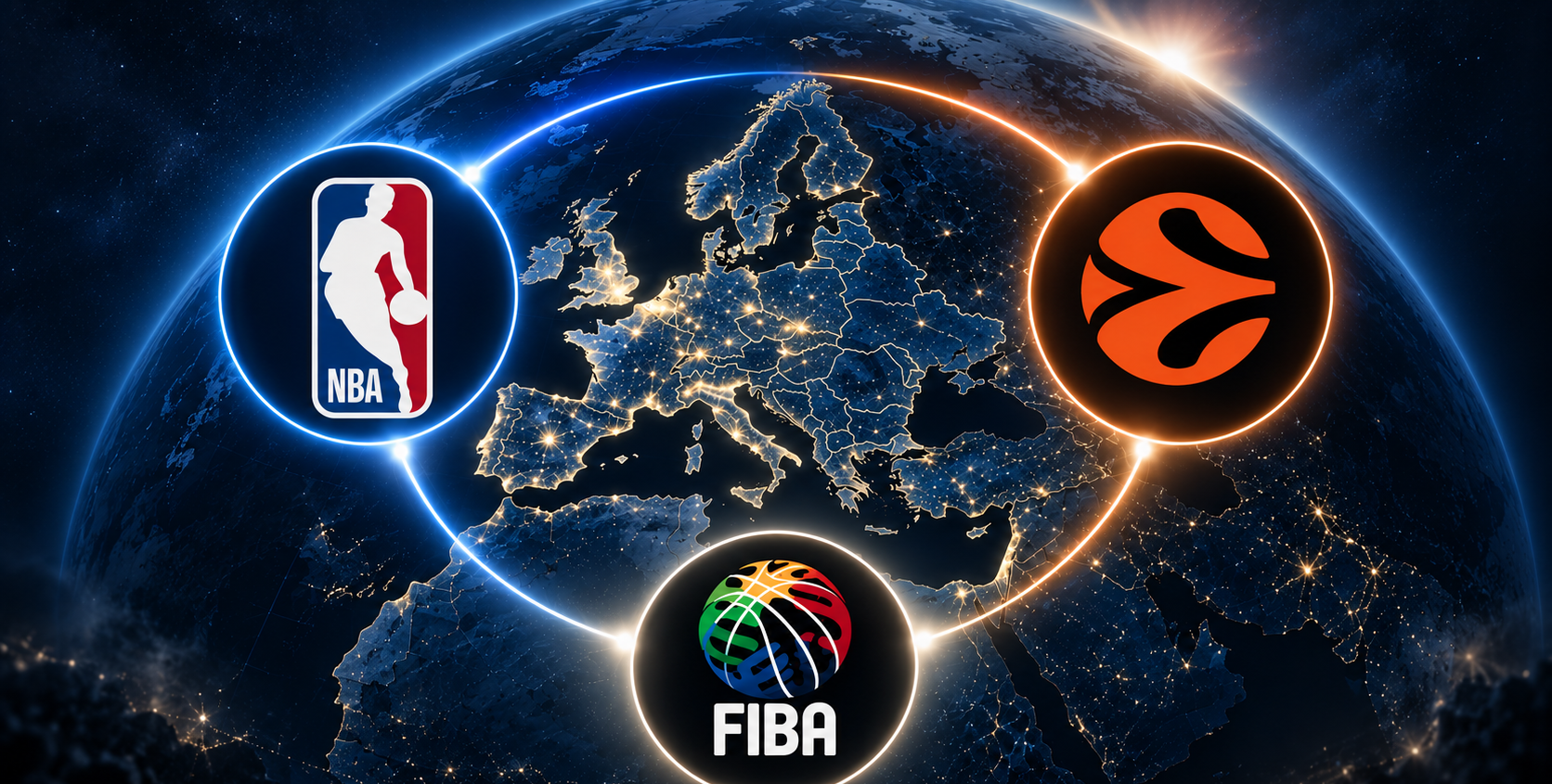

European basketball could reach a decision on October 5 that will determine much more than the future shape of the EuroLeague. The owners of the 13 shareholder clubs will meet at Villa d’Este in Cernobbio, on Lake Como, and one of the main topics is expected to be a possible NBA offer to enter the ownership structure, effectively acquiring a stake in the EuroLeague. The other option is to continue with the already launched expansion project and transition toward a franchise model.


How much of the EuroLeague the NBA would want, at what price, and with what level of control remains unknown, which makes it too early to speak of a conventional takeover. Still, the possibility that such an offer could be presented to the owners changes the conversation around NBA Europe. The question is no longer only whether a new competition will launch on the continent in the fall of 2027 and attempt to take clubs, markets, sponsors, and audiences away from the EuroLeague. There is now also the possibility that the NBA could build its European project on the structure that already exists.
The EuroLeague Is Preparing for Life Without an Agreement
That would be more rational than creating another parallel basketball reality. The NBA and FIBA have already moved well beyond the initial concept. The current plan calls for a 16-team competition, with 12 permanent members and four spots available through a qualification system. Clubs would continue playing in their domestic leagues, while a pathway into the European competition would run through the Basketball Champions League and an additional qualifying tournament. Just as important, the NBA and FIBA have announced plans to coordinate the calendar with domestic competitions and national-team windows.

The EuroLeague, meanwhile, is preparing as if no agreement will be reached. The competition is expected to expand to 24 clubs starting with the 2027/28 season, while its existing long-term licenses would be converted into franchises and additional permanent places would be awarded. Eleven candidates that passed the initial stage have submitted binding offers worth nearly €700 million in franchise fees alone, along with more than €3.2 billion in planned investment over the next five years. The EuroLeague and its licensed clubs have themselves been valued at more than €3.2 billion.
A Direct War Would Split the Market
When everything is considered, a direct conflict would be the worst possible outcome for European basketball. EuroLeague CEO Chus Bueno has already said publicly that the competition is prepared to compete with the NBA if no agreement is reached. At the same time, he acknowledged that two European leagues would split the value of the market, from television rights and sponsorships to fans in the arenas. His message was fairly clear. The EuroLeague believes it needs the NBA in areas where the American organization is stronger, but it also expects the NBA to recognize the value of clubs that have spent a century building their own identities.
The NBA could bring a level of capital to Europe that club basketball on the continent has never seen. Final bids for permanent places in NBA Europe are, in many cases, reportedly between $500 million and $1 billion, with existing basketball and soccer clubs, private investors, and former NBA franchise owners among the interested parties. The project is targeting major markets such as London, Paris, Madrid, Barcelona, Rome, Milan, Berlin, Munich, Athens, and Istanbul.
With that money comes expertise in selling media rights, digital platforms, event organization, arena business, international sponsorships, and building a product that can be sold far beyond the city where the games are played. Adam Silver has spoken openly for years about the gap between basketball’s popularity in Europe and its commercial value. The NBA sees a market in that gap.
Money Cannot Recreate European Basketball Culture
But money cannot create what the EuroLeague already has. Yes, a new franchise can be established in London or Rome and provided with a top arena, a large budget, and a quality roster. What cannot be bought is decades of rivalry between Panathinaikos and Olympiacos, Real Madrid and Barcelona, Partizan and Red Star, or the atmosphere in Belgrade, Kaunas, Istanbul, or Athens. European basketball did not become attractive to the NBA simply because the continent has several major cities. It became attractive because there is already a basketball culture that has built clubs, fan bases, and markets over decades.
From the NBA’s perspective, taking over the EuroLeague would make more sense than building a project from scratch. The NBA would immediately gain infrastructure, basketball quality, and most of the major brands in European basketball. The EuroLeague would gain financial power, expertise, and access to markets it would struggle to develop at the same pace on its own.
Ownership Is Only One Part of the Problem
However, the entire deal cannot be reduced to a change in ownership. European basketball does not need a wealthier owner that does not know what comes next. It has long been clear that its biggest weakness is not only a lack of money, but the absence of a unified system.
The EuroLeague and EuroCup belong to one structure, while FIBA and the Basketball Champions League belong to another. Domestic leagues are trying to protect their own importance while clubs continue to play more games. National-team windows overlap with the club season and regularly force players, clubs, and federations into situations where they have to decide whose interests come first. European basketball has plenty of competitions, but too little hierarchy between them.
NBA Europe Alone Would Not Solve the Fragmentation
That is why a standalone NBA Europe is not a good enough solution either. The competition the NBA and FIBA are building together already tries to address part of the problem. Four places available through sporting results would leave a pathway open for clubs from domestic leagues, while the planned protection of national-team windows would resolve one of the longest-running disputes between the EuroLeague and FIBA. Investment is also planned for domestic leagues, youth systems, and the development of players, coaches, and referees.
Still, if the result is a league that simultaneously goes to war with the EuroLeague, European basketball would solve one problem by creating several new ones. Two elite competitions would compete for the same players, coaches, sponsors, and media partners. In the short term, players would probably be among the beneficiaries because greater competition would increase the price of top-level talent, salaries would rise, and clubs would have to offer better conditions to retain their key players.
There would be far fewer winners in the long term. The continent does not have an unlimited number of clubs capable of financing teams at the highest level, nor an unlimited supply of elite players. One league could have Real Madrid and Barcelona, the other Panathinaikos and Olympiacos. One could try to capture London, the other Paris. Media rights and sponsorship money would be divided, while fans would be left wondering which competition actually represents the highest level of European basketball.
European Basketball Has Already Lived Through a League War
European basketball has already been through that kind of war once. There is little reason to repeat it with even higher stakes. There is also the issue of NBA players. David Kelly, the new executive director of their union, has already warned that the NBPA is not comfortable with the possibility of the NBA using its brand to create a major new source of revenue in Europe while the players who helped give that brand its global value do not share in the proceeds. His position is that at least part of NBA Europe revenue should enter the broader discussion of basketball-related income in future collective bargaining talks.
That shows how far the consequences of this project extend beyond Europe. NBA Europe is not simply an attempt to build a better European competition. For the NBA, it would be a new business product, an additional revenue stream, and a much more direct connection to a continent that produces a significant share of the league’s biggest stars.
The potential impact for European players is different. More money could raise salaries and improve training facilities, medical care, and club organization, while also increasing the ability of European teams to keep their best players for longer. Europe should not become a better-organized development system from which the NBA takes talented players as soon as they are good enough. If a new system is supposed to create better conditions for growth, it also has to increase the value of European basketball as a product in its own right.
A Three-Way Partnership Is the Only Solution That Addresses the Whole System
That is why the third scenario, a partnership between the NBA, EuroLeague, and FIBA, is the only one that addresses the fundamental problem. And, in such a complicated situation, it is also the only logical outcome.
Real Madrid, despite renewing its ten-year commitment to the EuroLeague this summer, is among the clubs publicly supporting exactly that kind of solution. The Spanish giant believes a joint project makes more economic and sporting sense than a direct conflict between the existing competition and the NBA.
Even that agreement would not be simple. Ownership, revenue distribution, the number of permanent members, qualification criteria, the relationship with domestic leagues, the structure of the second and third European tiers, and control over the most important decisions would all have to be resolved. The EuroLeague has meanwhile established the first pan-European collective framework with the players’ association, and its clubs will not give up control easily. FIBA will not abandon the sporting pathway or the national-team calendar, while the NBA is not going to invest billions merely to become a marketing partner.
Each Side Controls Something the Others Need
That may be exactly why a clear division of responsibilities could become the greatest value of such a system. The NBA has money, a global brand, and business expertise. The EuroLeague has the clubs, tradition, rivalries, audiences, and a competition that already operates at the highest level of European basketball. FIBA has the national federations, national teams, and the institutional framework needed to connect the top of the game with the rest of the basketball pyramid.
From that, European basketball could finally build a clear competitive structure. One elite competition would sit at the top. Below it would be clearly ranked European levels with defined pathways based on sporting results instead of parallel systems that largely ignore one another. Domestic leagues would remain the foundation, national teams would receive protected periods without club games, and clubs would know before the season exactly how many games they are expected to play and when.
Europe Does Not Need to Copy the NBA
European basketball does not have to copy the NBA, and in many areas it should not. European sports are built around historic clubs, domestic leagues, and the principle that results on the court should at least partially determine access to the next level. The NBA model offers stability and economic predictability, but copying it completely would mean losing part of what makes European basketball attractive in the first place.
That is why it is interesting that the NBA and FIBA project already combines permanent franchises with four places earned through sporting results. It is a good starting point, but without the EuroLeague it would remain incomplete. The same applies in the opposite direction. The EuroLeague can expand to 24 clubs, sell new franchises, and increase revenue. It can continue independently and would probably survive the competition. But that would not resolve its conflict with FIBA, the national-team calendar, or the fragmentation of European club competitions. It would simply create a financially stronger version of the existing system.
October 5 Could Decide Whether Europe Integrates or Splits Again
That is why October 5 could become D-Day for European basketball. The real opportunity is to bring together, for the first time, the interests of organizations that control three different parts of the European game. If no agreement is reached, the NBA has enough capital to build its own league, the EuroLeague has enough clubs and investors to respond, and FIBA has enough institutional power to support a new project…
Ultimately, all of them can continue on their own. The question is why they would choose to do that again when, together, they could build the system European basketball has been missing for decades.