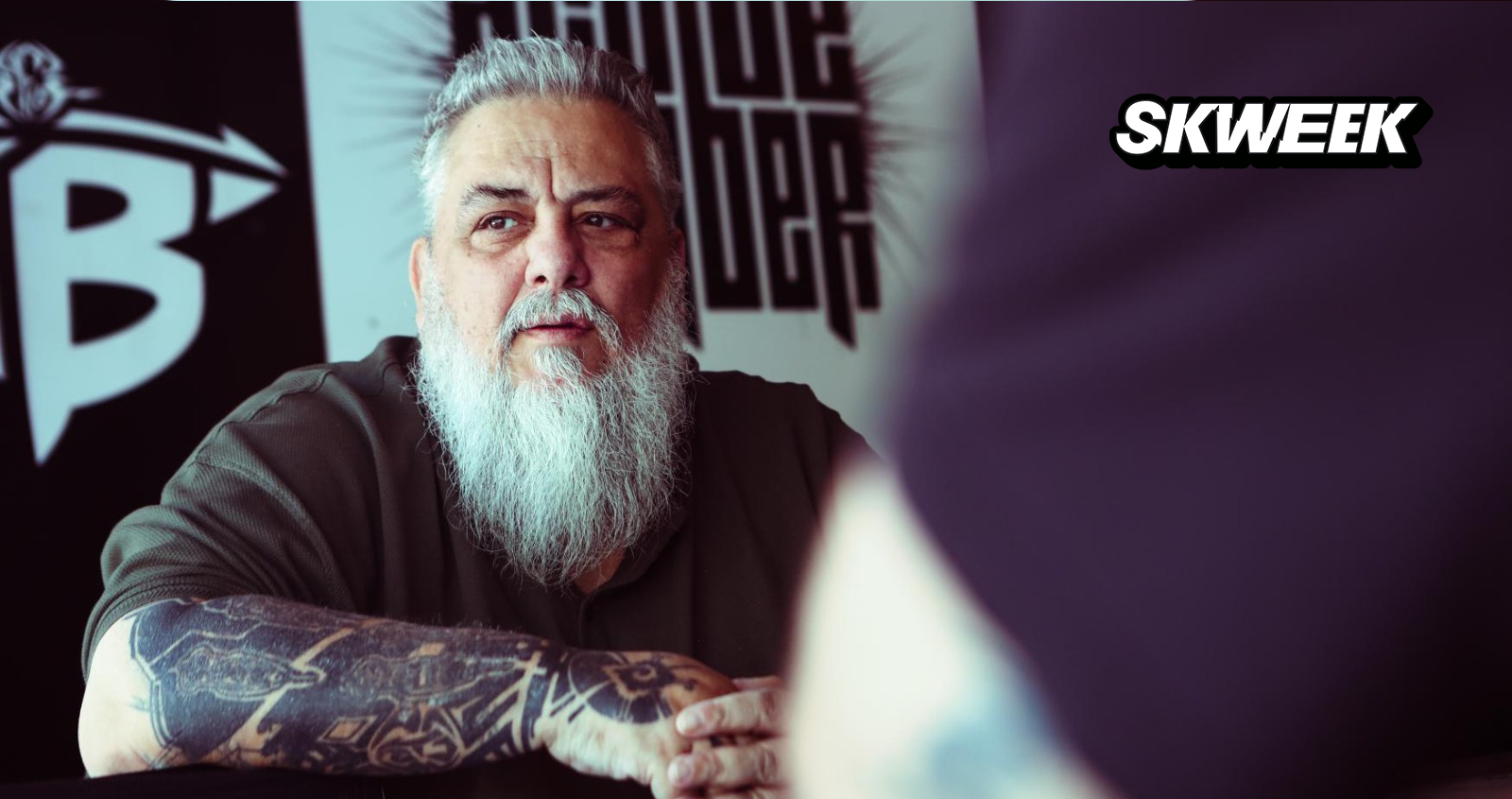

More than two decades after a young Ron Artest unexpectedly landed in Perama, one of the toughest areas in Attica, to record rap music and play basketball at the local playgrounds, B.D. Foxmoor, the pioneer of Greek hip hop, revisits those unforgettable days in a conversation with SKWEEK.


In the early 2000s, B.D. Foxmoor, founder of the iconic group Active Member and the pioneer of Greek hip hop, having already developed his own Low Bap movement, welcomed Ron Artest into his world. Long before he became one of the league’s most fascinating and controversial figures, the future champion spent nearly ten days in one of Attica’s toughest neighborhoods, recording music, playing basketball, and immersing himself in a reality far removed from the NBA spotlight.
And he genuinely seemed at home there.


“I’m a kid from the ghetto and that’s what I’ll always be,” Artest said at the time. “I grew up in Queens, not in some wealthy suburb. This neighborhood reminds me a lot of where I’m from”.
In just ten days, he built bonds that felt deeper than friendship. He connected with Perama, one of the most neglected areas of Attica. He spent countless hours alongside Mihalis Mitakidis, known as B.D. Foxmoor, recording what would become “Guardian Angel”, his own rendition of Active Member’s “Φύλακας Άγγελος”.
And when he wasn’t behind a microphone, he was playing basketball out on the playgrounds.
More than a music collaboration, it became a meeting of worlds: Queens and Perama, hip hop and basketball, America and Greece. In this SKWEEK feature, B.D. Foxmoor revisits the energy, the simplicity, and the unlikely connection that emerged between music, basketball, and a young player who had yet to become the Metta World Peace the world would come to know.
To get a feel for the story, play this.
Did Artest fall in love with Perama because it felt like Queens, or because it brought him back to who he was before everything changed and unlocked something deeper within him?
Look, I never actually asked him directly, but my feeling is that it had to do with the familiarity of his own neighborhood, in a different and much more human way.
When he arrived, he told me, “Mihalis, can I stay wherever I want? I’ve got a gold card.” And I said, “That doesn’t work here. If we’re going to do this properly, Perama is where you start. After that, you can do whatever you want, I don’t know, go on vacation or something.” So, he stayed in Perama. I had him in my son’s room; he didn’t even fit in the bed, obviously.
We would go out in the afternoons, take walks when we weren’t in the studio, and wherever he saw a basketball hoop, he would stop and play with the kids. Even in slippers! The kids would pass him the ball, shouting “dunk,” not knowing who he was, and he would just play like one of them. Like a kid. I have many memories like that.
There was also a moment he later mentioned in a press conference at the All-Star Game, when they asked him what he remembered most. He said: “My childhood in Queens, my friends, and Perama, where we made music.” It was one of those rare answers that says more than it explains.
An NBA player raps in Perama
How does an NBA player end up in one of the toughest areas of Attica?
We met in the spring of 2001. The connection came through a close friend of mine, almost like a brother, Nikos Papaioannou. At that time, Nikos was constantly traveling in the United States.
I don’t even know exactly how he met him, but given the basketball world he was connected to, it wasn’t difficult. He knows a lot of people. He is close with Peja Stojakovic and many other figures from the game. And at some point, Ron told him, “Look, I rap too. I want to do something with music.”
He was raw at that time, completely unpolished. But he came from Queens, a place shaped by Nas, Prodigy, and Mobb Deep. It’s a real hip hop neighborhood.
Anyway, Nikos gave him our CDs, and about twenty days later I got a call. Ron told him, “This is what I want to do, what those guys are doing. I don’t want to work with any Americans! How can we make this happen?” That’s how the connection started.
He offered to cover all the expenses and told us, “Come over, where do you want us to meet?” I told him I couldn’t come to America. I still can’t even now, so I replied, “It’s impossible for me to travel.” He came back saying, “I’ll send you an official invitation.” I answered, “Try, but I don’t think it will work.” And it didn’t. I didn’t get the visa. So, in the end, he came to us.
He arrived during a very important moment in his career, right around his move from the Chicago Bulls to the Indiana Pacers.
In Greece, he spent many days with coach Lefteris Subotic, who introduced him to a shooting technique he simply didn’t have before. When he saw Subotic shoot, he reacted immediately, “This is unbelievable.” He owes a lot to him, honestly. Because after that, wherever he went, people saw a different version of him. He even developed a shot in Perama.
He also expressed that he wanted to focus on music. I believe he stayed about a month in total, with the music sessions lasting around ten days.
What stayed with him from that experience in Perama?
The first time we all sat down to eat together at home, he said, “Are you celebrating something here?” I said, “What are you talking about? This is just how we eat every day; we sit together.” And he looked at me and said, “Seriously?”
He told me that where he grew up, things were completely different, a simple setup at home where everyone had to find their own way to eat. He learned basketball playing with hustlers and guys from the streets, with bets on outdoor courts where people would gamble on games, and the kids’ reward would sometimes be just a piece of pizza from a fast-food place.
He was shocked by all of it, of course. After that, he didn’t really want to leave. He was a special kid, a wounded kid, a tough kid, and you could see that later in the way he played.
Ron should have left after our first conversation!
Why do you think he connected so strongly with you in particular, and what do you think drew him so deeply into this whole journey?
Look, honestly, he probably should have left after our very first conversation (laughs). I told him, “Look, my friend, this is not Queens. Things here work differently, there are rules. I don’t know if you’re used to that kind of structure.”
That clearly stayed with him and made him reflect. He had gone through a personal loss in his family and wanted to do something for Make-A-Wish. So, we got in touch with Make-A-Wish Greece, and through Warner at the time, our label, the idea came to release a single with the material we were working on.
He really loved Guardian Angel and decided to create an English version of it as well. The proceeds from the single were donated to charity.
From the beginning he was listening closely, not only to low bap but to other sounds as well. He had studied everything properly. What stood out was that he was more drawn to the melodic and almost mystical side of it.
In the end he was just like a kid, really.
So, you went into the studio. How did that process unfold?
Everything was upside down and difficult at the beginning. Fortunately, Nikos Papaioannou was there, speaking better English than me, and Nikitas Klint (a member of the group Active Member at that time) as well, helping translate everything. Without them translating constantly, he probably would have left.
What I cared about most was that whatever came out of it, he wouldn’t feel uncomfortable with it. Because, as I said, he wasn’t fully comfortable expressing himself at that point. He wanted to, but it didn’t come easily to him. And I wasn’t used to working with someone who wasn’t fully confident in that space.
Normally, I work with artists who already have a certain level of direction in their production. So, I adapt what they bring into the track. In this case, we all respected the process and agreed to build it together.
There have been all sorts of stories out there, that we got paid, and so on. The truth is we didn’t even let him pay for his own food. Not a single dollar was taken. In fact, we spent money ourselves, and we enjoyed it — we liked taking him around and showing him everything.
We never even let him use his gold card.
Is there a memory from those 10 days in Perama that still stays with you today?
I remember very clearly those nights by the sea. We would sit by the waterfront cafés, just hanging out in the evenings. He would look at the sea and say, “I didn’t expect it to be so close… so close to the water. Is it easy to just go into the sea like that?” It felt strange to him, something completely unfamiliar.
We spent a lot of time trying to explain this place to him, to give him a sense of where he was. But I don’t think you can really explain it — he had to experience it.
I also remember the first drives we took together. We were coming from Aigaleo, a western suburb of Athens, at a time when the area wasn’t even properly developed yet, and he would ride on the back of a motorbike. When we passed the refineries near Petrogaz (a liquefied petroleum gas facility in the area), he was shocked. He kept saying, “I thought I was coming for summer, to Greece, to islands… where are you taking me?”
Later on, the other guys took him around different parts of the city, even to places like Vouliagmeni, showing him a completely different side of Athens so he wouldn’t think everything was the same.
But the truth is, he adapted everywhere.
And I remember another basketball-related moment, when he was training on an open court.
He was fully into it, giving everything, no hesitation at all. Someone even said about him, “He doesn’t hold anything back.” For him, it was never about protecting himself or avoiding contact, even though at that time he was on the verge of becoming an All Star.
At the same time, he was also filming music videos, so there was this constant balance between creativity and responsibility. We were trying to make sure everything ran smoothly around him.
Because the reality was simple. If anything had happened to him, it would have been a serious issue! He had major contractual value, and everyone understood that.
So, we made sure he could experience everything freely, play the game the way he wanted, even dunk in open courts like any kid, but always with people around him making sure nothing went wrong.
Inside him there was a lot of pain
Was there a moment when you felt your relationship went beyond music and became something more like brotherhood?
It kind of ended up there naturally, before he left — before everything wrapped up around the music and the songs we were working on.
We had met a kid — and I say “kid” because that’s really how he felt in that environment — and I had never experienced a relationship like that with someone at such a high level in sports. Not even close, except for people from my own circle.
But inside him there was a lot of pain. A lot of accumulated pain. At some point, I started to understand what it means for kids to grow up in certain neighborhoods, carrying that constant anxiety. And I just thought, “this is unbelievable.”
He experienced many things here, but always in the most human way possible.
There was no distance with him. He would walk into the bakery on his own, grab things off the shelf, and people would say, “no, no, leave it, Michalis will pay.” He had never experienced that kind of thing before. He would go into small grocery shops, pick up fruit, and instinctively try to hand over his card.
And people would just laugh and say, “come on, leave it, Michalis will take care of it.” Simple everyday moments, but completely new for him.
I’m sure those things stayed with him, because he even mentioned Perama later in major interviews. When you only have a few minutes on a global stage, and he still brings it up, that says a lot.
Looking back now, how do you remember those years? Do you feel nostalgia, melancholy, or something more complex?
The truth is, I’ve fallen into that nostalgic way of thinking at times, but I try to avoid it. First of all, I’ve remained active for 35 years straight, I’ve never stopped, so maybe that’s part of it — you don’t sit back and dwell on the past.
The difference between then and now is that back then, people could be happy with very little. And everything felt real. The good and the bad, everyone was real. Today, it feels like we’re living among holograms, screens and projections everywhere.
It’s a strange feeling, honestly. And it seems like no one is ever really satisfied with anything anymore. There’s too much of everything, especially in sports where things have completely spiraled.
Of course, it’s fine for people to secure their future through what they do, but at some point, it all becomes excessive.
Everything feels too complicated now. Back then, things were simpler.
I remember when I was a kid, we played basketball with a water polo ball, on whatever playgrounds we could find. And even that was enough.
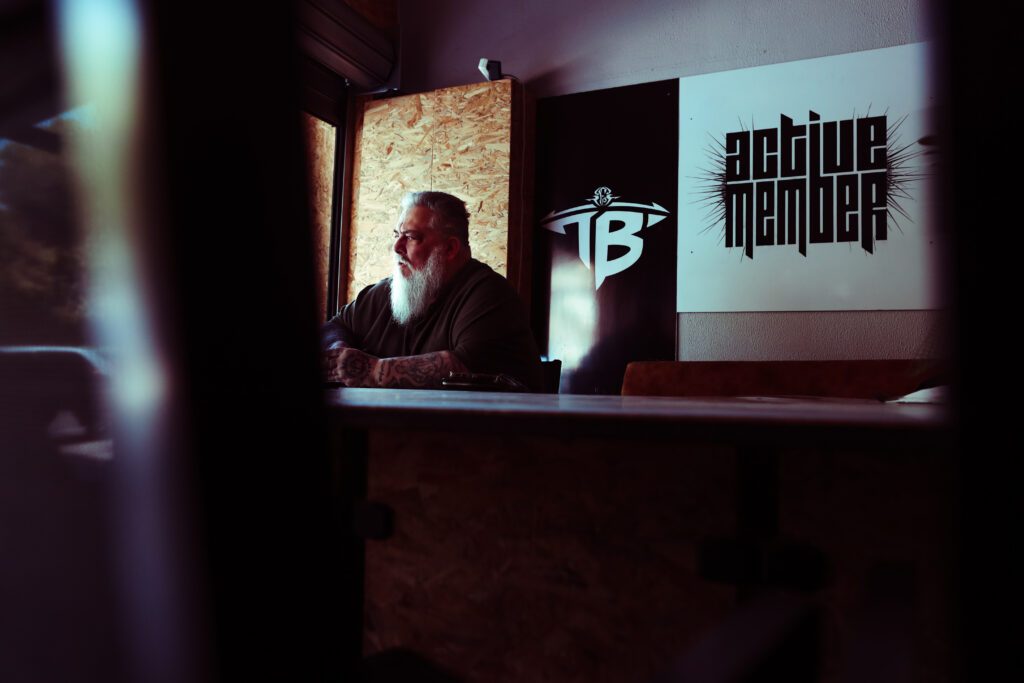
How do you make sense of a young NBA player finding his way to Perama and staying close to you?
I think he needed it in order to ground himself before making the big leap in his career — or maybe he already knew that the big leap was coming, and he needed a place like this to settle, to reconcile with himself before moving forward. That’s how I see it, at least.
Whatever the reason, it worked. His game, raw and almost heroic in its form, wasn’t always understood, but his presence was undeniable. We had seen that kind of energy before, with Rodman and others.
So, those nights when you were going back and forth… did the video take one night to shoot, or several days? Were you going to the studio every night?
No, no, it wasn’t done in one night. It took place over a period of time. It was an old-school production. I think it was directed by a kid who later ended up living on the island of Syros, if I remember correctly. A very talented director of that era, part of the Low Bap circle, part of the crew.
Honestly, it was intense. I’d say it was almost a kind of “marathon” shoot, with cranes and all that equipment. We’ve got plenty of stories from that period.
Was it a controlled shoot, or more of a community-driven moment with friends and fans around?
It was all our people at the court, completely. Everyone was there, watching, playing, part of it. And we were playing all the time as well, so the camera just kept rolling. We had continuous material coming out of that energy.
In the end, does Perama give you something you’re looking for, or something you’ve lost?
Perama has always been, for me, a place of departure. Everyone here grows up wanting to leave. But those who leave… always come back. No matter how many times they go, they return.
I was born in Perama. My papers say Perama. Even that was a battle back then — to have the birthplace registered properly. Usually, they wrote the hospital instead. But my doctor insisted: “No, the cord was cut in Perama.”
I believe Artest absorbed the energy of the place. He was a restless kid — no filters, no prejudices, no fixed ideas. So, he took it all in. And after that, he began to take his career more seriously.
Of course, there was also structure around him here. People were constantly telling him, “Ron, do this, don’t do that.” At times, the money and entourage situation around him was chaotic — too many people, too much noise. That kind of environment can destroy you if you’re not careful.
What matters is that he eventually found balance. He became closer to his children, and from what I’ve seen over the years, he’s doing different things now, living more calmly. And I’m glad he managed to take care of himself a bit more.
He was deeply curious about everything. He found it strange that we were engaged in things connected to a wider world. For him, the world was Queens, and until his teenage years he probably hadn’t gone far beyond it. Basketball was what eventually took him out.
Everything we told him back then about music, politics, and life he absorbed without barriers. That freedom, that lack of conditioning, is what made him so open.
That was him, very expressive, deeply emotional, but at the same time extremely tough. A kid shaped entirely by where he came from.
What did a normal day in Perama look like for him?
It was right near the center of Perama. I had a rented apartment at the time, and Ron Artest was staying in my son’s room. He didn’t really fit in there. He kept changing things around, always waiting for that afternoon meal he had fallen in love with. And then he started asking for it in the morning too. He would go to the bakery on his own, walking around the neighborhood freely.
We had even warned people around the area, “If you see a guy walking around…” because he would go out barefoot, just walking the streets. He moved through Perama like he belonged there. So, we told everyone, “He’s with us, no need for any issues, just let him be.” And people were welcoming anyway. He would go into the bakery, pick up three or four loaves of bread in the morning, and just bring them back like it was nothing.
Then he discovered cheese pies… and that became a whole new world for him. He had never really had coffee before either, so we were trying to ease him into it. But once he got a taste, he was hooked. He even tried to show us he was living a “clean, athletic life,” but that didn’t last long. He would eat anything.
I kept telling him, “Forget what you eat in America. Eat freely here.” And honestly, he just embraced everything.
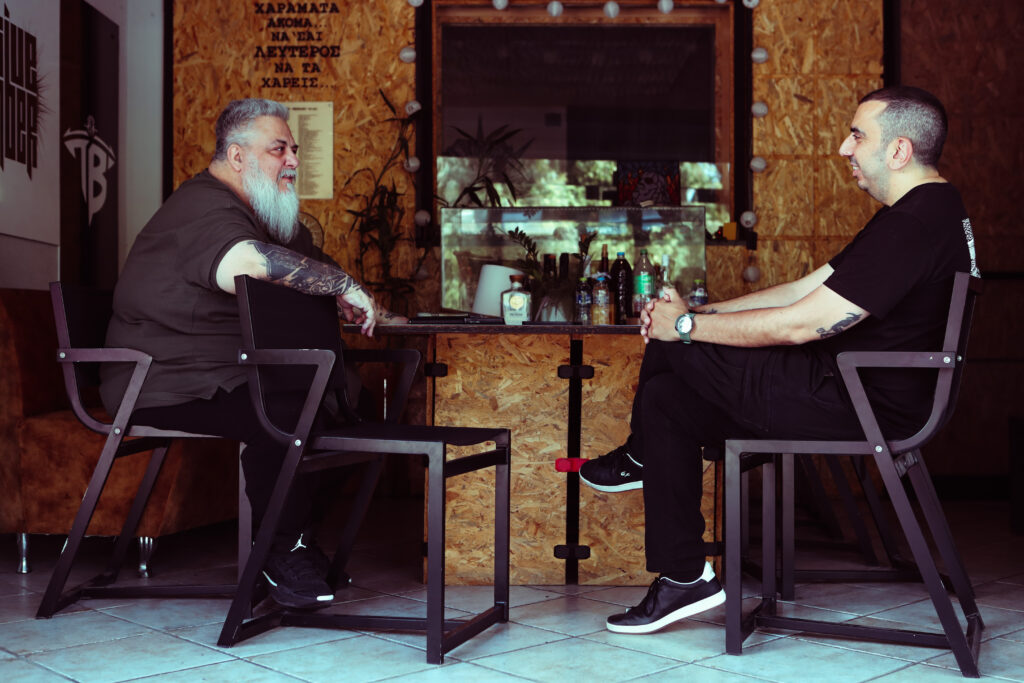
Looking back now, what do you think Perama ultimately gave him — beyond basketball, beyond music?
I think it gave him something much deeper than both. It grounded him in a different kind of reality, one that stripped everything down to something pure and human. Away from the noise, the image, the pressure.
In Perama, he wasn’t “Ron Artest the NBA player.” He was just a kid again. And sometimes that’s exactly what someone like him needs — a place where nothing is expected from you, where you’re not defined by what you’ve become.
And maybe that’s what stayed with him the most.
Photo credits: Argyro Anastasiou – Eurokinissi