




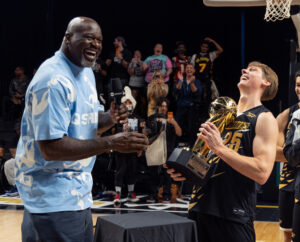

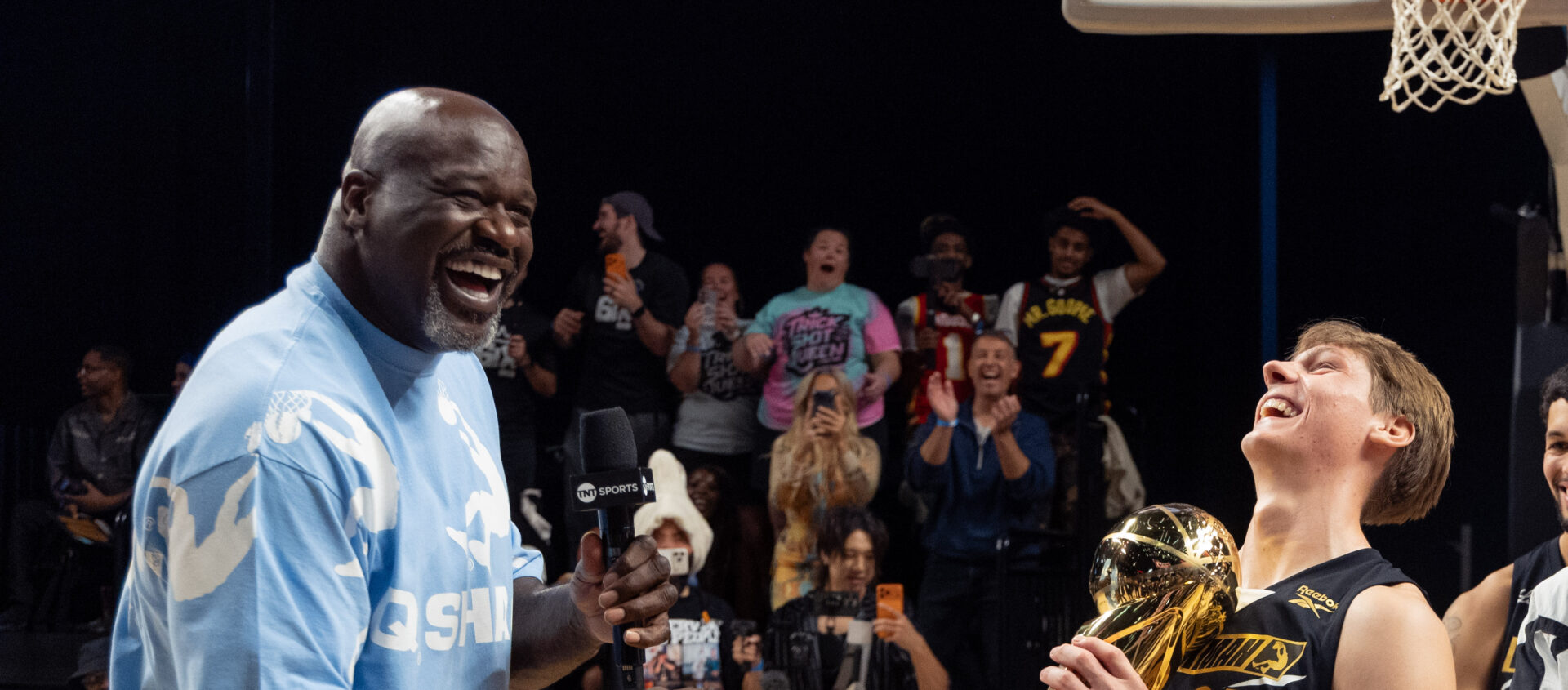

The inaugural DUNKMAN World Dunk Championship delivered exactly what Shaquille O’Neal had envisioned when he launched the project. It brought professional dunkers, elite athletes and familiar NBA names together in one place, creating a competition designed to take dunking beyond All-Star Weekend and establish it as a discipline of its own. In the end, however, the title did not go to the biggest favorite, Mac McClung, but to a young man with a very different background.


Six Months From Surgery to a World Title
Cam Hazzard was playing recreational basketball at Abilene Christian University in January when, on one jump, his hand collided with an opposing player. His hand was essentially broken in several places, one joint was separated, his middle finger was badly injured, and surgery left him with plates and screws. Doctors immobilized his arm against his body, and at the time, he had no idea whether he would ever be able to dunk normally again.
A week after surgery, the invitation to DUNKMAN arrived. Shaquille O’Neal had seen one of his videos and wanted him among the 24 competitors in the inaugural season of the professional dunk league. Hazzard accepted even though he still could not move his hand, and he did everything he could to speed up the recovery. He returned to training after two and a half months, and two and a half weeks later his vertical leap was measured at 50 inches, or an incredible 127 centimeters. Hazzard later recalled that a man named Chuck told him Shaq had seen his video and said he wanted that guy in the league.
A little more than six months after surgery, Hazzard became the first DUNKMAN world champion in Atlanta on Tuesday night, winning $500,000. Along the way, he beat some of the best professional dunkers on the planet, while three-time defending NBA Slam Dunk Contest champion Mac McClung was eliminated in the quarterfinals. Hazzard did more than win the title. He also produced the highest-rated dunk of the entire inaugural season, earning a 9.91, the best score in the competition’s history.
The Champion Is an Accounting Student and Trumpet Player
The most interesting part of the story is that the new world champion is not a professional basketball player. He is 20 years old, studies information systems, accounting and finance, carries a 4.0 GPA, essentially straight A’s in the American grading system, plays trumpet in the university band on scholarship and is spending this summer interning at a financial company in Austin. Until recently, he considered dunking a hobby. Now it has earned him half a million dollars.
Shaq Wanted Dunking to Become Its Own Sport
Those were precisely the kind of people Shaq wanted to find when he launched DUNKMAN with TNT Sports and Authentic Brands Group, a project billed as the first professional league devoted exclusively to competitive dunking. Instead of the best athletes attracting a wider audience once a year during NBA All-Star Weekend, Shaq’s idea was to turn dunking into a season-long competition with its own competitors, rules, contracts and a serious prize pool.
DUNKMAN began with 24 competitors divided into four groups, with the group stage taking place over four consecutive weeks: Group A on July 21, Group B on July 28, Group C on August 4 and Group D on August 11. The championship round followed on August 26, after the four group winners and four additional competitors who received wild cards advanced. The eight remaining contestants at Overtime Elite Arena in Atlanta were Mac McClung, Cam Hazzard, Isaiah Rivera, Dylan McCarty, Jordan Sutherland, Dylan Haugen, Joel Henry and Dengxing Chen. McClung entered as the No. 1 seed after scoring a 9.63 in the group stage, followed by Hazzard, Rivera and McCarty.
McClung Gave the New League Immediate Credibility
McClung’s presence was important for the credibility of the new competition. NBA fans know him well after he won the Slam Dunk Contest in 2023, 2024 and 2025, becoming the first player in history to claim the trophy three consecutive times. He also arrived at DUNKMAN with a reputation for pushing the technical limits of dunking, or, put more simply, making dunks increasingly difficult and spectacular. During the group stage, he completed a dunk with nearly 720 degrees of rotation and received a 9.63, at the time the highest score in the league. On another earlier attempt, he cleared a car with two people positioned on top of it.
A 39-Year-Old, 5-Foot-9 Dunker Took Out the Favorite
That made the opening quarterfinal matchup an upset the new competition probably needed. Facing the No. 1 seed was Dengxing Chen, a 39-year-old Chinese dunker who stands only 5-foot-9.
Chen has been competing professionally for nearly two decades and has a measured vertical leap of 52.76 inches, roughly 134 centimeters. His résumé includes titles at the Quai 54 World Dunk Contest and the CBA dunk contest, along with a second-place finish in a competition held as part of the FIBA World Cup. One of the people who inspired him to pursue this path was Vince Carter, whose dunking style Chen tried to copy before shaping it in his own way.
McClung tried to raise the stakes again. He cleared a car with three people stacked inside it and threw down the dunk. Even that was not enough. Chen, the eighth seed, eliminated the biggest name in the field and advanced all the way to the final, where Hazzard was waiting.
Hazzard Had Already Shown What Was Coming
Hazzard had already shown during his first day of group competition why he received an invitation. He opened with a reverse 360 windmill off the dribble for an 8.48, followed with a 360 inverter that earned a 9.13, then finished with a combination of a 360-degree rotation, a pump motion and a behind-the-head finish for a 9.55. That was enough to win his group ahead of Joel Henry and Chen. He earned $35,000 that day and returned a month later for the championship round in excellent form.
His signature move is even more complicated. Hazzard performs what is known as the “360 under both,” rotating 360 degrees in the air while taking the ball under both legs before finishing at the rim. He says fewer than 10 people in the world have completed the dunk. His repertoire also includes the 360 behind-the-back and variations of the Eastbay, a dunk in which the ball is passed between the legs in midair before being thrown through the rim. Much of it, remarkably, Hazzard taught himself.
His Development Was Interrupted Long Before the Broken Hand
For someone who did not dunk for the first time until age 15, his progress was unusually quick, though it came with another serious interruption. A few weeks after completing his first windmill in 2022, he slipped on a wet court during an AAU game and tore both hamstrings. The injuries were severe enough that the tendons pulled pieces of bone away from their attachment points, leaving him unable to jump for the next year. When he returned, he began following the professional dunk scene more closely and attending specialized camps. Among the dunkers whose styles he studied were Isaiah Rivera, Jordan Kilganon, Jordan Sutherland and Donovan Hawkins.
Professional Dunking Existed Long Before DUNKMAN
Two years later, some of them became his competitors, which also says a lot about DUNKMAN itself. Professional dunking existed long before Shaq’s league. There were specialized contests, tours and camps, and over time dunkers began developing moves far more complicated than anything the average viewer gets to see once a year in the NBA. At the same time, the All-Star Weekend dunk contest had long since lost much of its appeal and sense of genuine excitement. For years, there had been talk about the need for a major television platform capable of bringing that entire scene together in one competition. DUNKMAN became that platform, with Shaq as its public face.
Unlike the All-Star Weekend dunk contest, where competitors generally come from the NBA and dunking represents only one part of their overall basketball skill set, DUNKMAN brings together people who have spent years training almost exclusively for this discipline. For that reason, scores are not based only on crowd reaction and spectacle. Judges evaluate the difficulty of the attempt, originality, execution, power and other technical elements. Scores take approximately a minute to process after each dunk, allowing organizers to make the format resemble judged sports more closely than a traditional exhibition.
O’Neal intentionally stayed off the judging panel. His role is that of an owner and commissioner, while the television production brought together several familiar basketball names. Adam Lefkoe hosted the show alongside Vince Carter, Draymond Green and basketball content creator CashNasty. Longtime professional dunker Jonathan Clark, known as JClarkTheJumper, provided additional technical analysis.
Vince Carter’s Dunks Became the Starting Point
Carter’s presence carries particular significance. When discussing the modern history of dunking, it is difficult to find a more important NBA night than the 2000 Slam Dunk Contest in Oakland. Air Canada produced a series of dunks that became a reference point for the generations that followed, from his 360 windmill to the between-the-legs dunk off a pass from his cousin and then-teammate Tracy McGrady, followed by the famous attempt in which he hung from the rim by his forearm.
More than a quarter-century later, professional dunkers are combining and building on elements of those moves while Carter watches proudly from courtside. The limits have moved much further in the meantime. An Eastbay between-the-legs dunk, for example, is no longer enough to guarantee a title. Chen used the same basic move while clearing six people during the group stage and received a 9.31. Hazzard has combined a between-the-legs move with a full-body rotation, while McClung has reached two rotations in the air.
That also makes DUNKMAN an interesting look at how the discipline has evolved. What was once enough for an NBA star to change the history of the Slam Dunk Contest is now a starting point for specialists who break these moves down to their smallest details, spending years working on takeoff, rotation and ball control as the discipline itself becomes increasingly complex.
Hazzard Arrived From a Completely Different World
Hazzard is a good example of how different that world is from professional basketball, because he did not arrive through an NCAA program, the developmental leagues or a European club. He is a straight-A student who also plays in the university band and spends the time between academic years interning at Treaty Oak Financial in Austin, working in an area that combines finance, data and business systems.
His story becomes even more unusual because a serious move into the dunking world was never part of a long-term plan. He first dunked in 2021 at age 15. The severe hamstring injuries cost him nearly a full year of development, and by 2024 he was spending four or five hours a day in the gym without a specific training program or a coach. He has said that he studied jumping mechanics and strength programs on his own, while the more advanced dunks did not begin to come until 2025.
One social media video then launched him into the world surrounding DUNKMAN. According to Hazzard, he edited the clip without expecting much, only to see it reach roughly 1.5 million views. That led to an invitation last May to the Jordan Brand Jumpman 23 event in London, where he was already scheduled to be because of a student program at Oxford.
$500,000 Changes What Professional Dunking Can Be
The money Hazzard won at the DUNKMAN World Championship matters for several reasons. Professional dunkers have spent years trying to carve out a place for themselves online, attracting attention through exhibitions and specialized contests, but in the past it was difficult to describe this field as a stable professional sport capable of providing a substantial income. That changed when Shaq and the league’s sponsors put up a $500,000 championship prize. It is a significant financial reward, the largest in the history of dunk competitions, and with that money and contracts for its competitors, DUNKMAN has tried to change the way the public views the discipline.
The First Champion Was the Least Obvious One
The inaugural season could hardly have produced a more unusual champion. Mac McClung already had a name and three NBA dunk-contest trophies. Isaiah Rivera belongs to the generation of professionals Hazzard watched while he was learning. Dengxing Chen has been part of the discipline for nearly two decades and, at 39, eliminated the biggest favorite. In the end, they were all beaten by a student who began the year with metal plates in his hand and no idea when he would be able to dunk again.
Only a few months ago, Hazzard thought dunking might become a serious hobby and perhaps an additional source of income. After the first DUNKMAN season, he can add a much more concrete line to his résumé: the first world champion in professional dunking.