




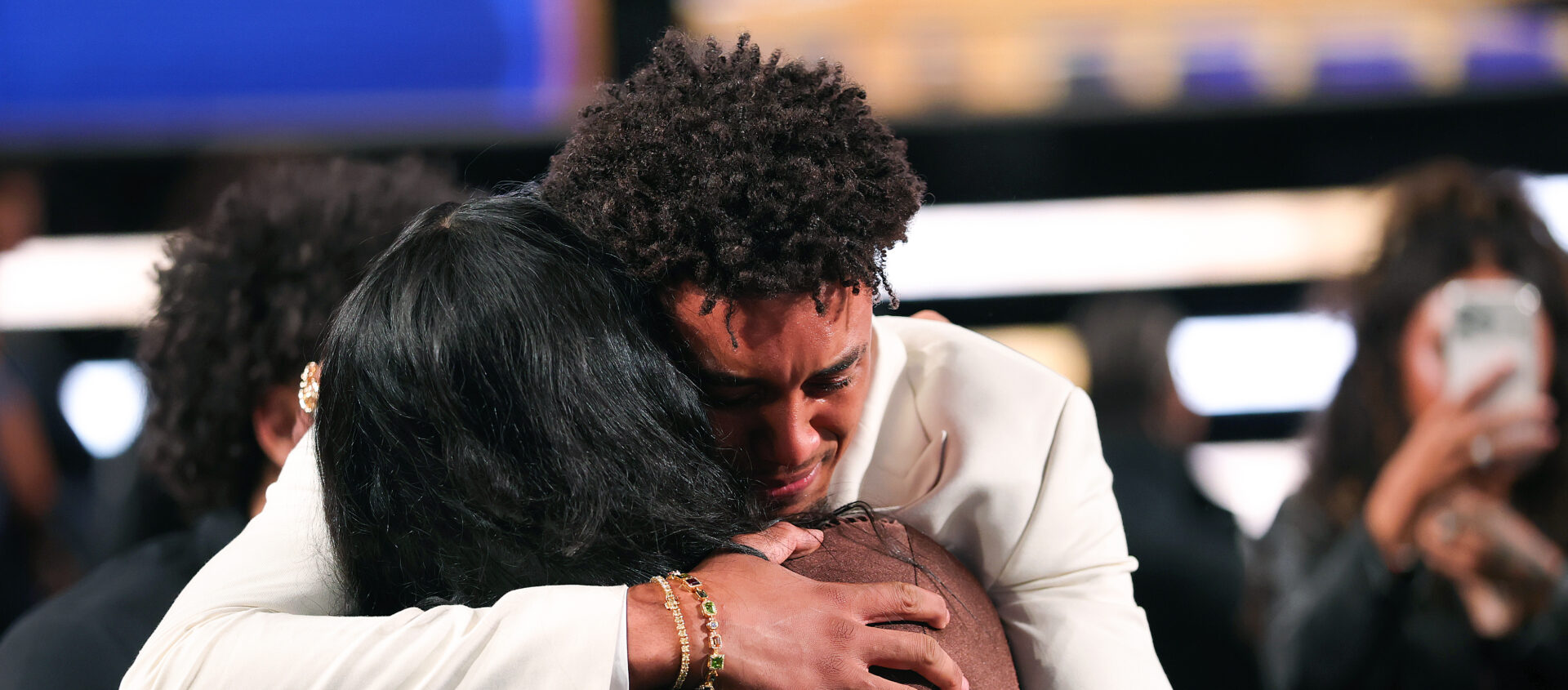

When Adam Silver called his name, Yaxel Lendeborg did not head straight for the stage. He turned to his mother, Yissel Raposo, pulled on a Golden State Warriors cap and held her. Then the tears came.


She had spent his final college season undergoing cancer treatment. He was playing the best basketball of his life while trying not to let her see how afraid he was. Without her, he might not have finished high school. On draft night, he went 11th overall.
Basketball had not always looked like a way forward. Lendeborg slept through classes, was suspended from school and scraped by with barely passing grades. Most nights disappeared into video games. His academic record kept him off the team, and his mother tried whatever she could think of to shake him out of it. She removed the television, game console, clothes and furniture from his room. She even took the door off its hinges. It made little difference.
The trouble went deeper than a teenager refusing to take school seriously. Lendeborg was seven when his grandfather died, a man he had regarded as a second father. His relationship with his own father was already difficult. Looking back, he said much of his motivation disappeared after his grandfather’s death. He became a different child.
The Night His Mother Finally Reached Him
One night during his senior year, his mother picked him up from a friend’s house after he had spent hours playing Madden. She did not start the minivan. They stayed in the parking lot and talked about his grades, the problems at home and the options that were disappearing in front of him.
Graduation depended on him completing 10 additional courses at a local community college. He resisted at first, until he saw his mother crying. She was working two jobs, trying to hold the family together, and had run out of ways to reach him. Lendeborg later said that was the first time he understood how much his behaviour was affecting everyone around him.
Eleven Games and One Unexpected Opportunity
He completed the courses and returned to basketball near the end of the season. His high school career amounted to 11 games for Pennsauken High School. The team won 10 of them. A professional career still did not cross his mind. After the final loss, while his teammates sat disappointed in the locker room, Lendeborg was mostly concerned with where they were going for dinner.
His mother saw more in his basketball than he did. She sent out film, contacted coaches and looked for a school willing to take a chance. When Arizona Western, a junior college in Yuma, offered him one, there was not much of a family debate. She told him he was going.
Arizona Gave Him a Basketball Routine
It was his first time living far from home. He cried at the farewell, on the drive to the airport, during the flight and after arriving in Arizona. Also, he missed his family and Dominican food. The problem was that he was shy and knew no one, also he had never been responsible for the details of his own life.
Basketball gave him a routine he understood. Arizona Western kept his role simple. Run the floor, rebound, finish around the rim and use his strength to take up space. In his final season, he averaged 17.2 points and 13 rebounds while shooting 72.7 percent from the field. One night against Scottsdale, he grabbed 31 rebounds.
He was not yet anything close to a modern NBA forward. Most of his work came inside, where energy and strength could solve the problem. The coaches also noticed that he could pass, bring the ball up after a rebound and stay involved in possessions that had not been designed for him.
From Junior College Project to Division I Star
The move to UAB was the first real indication that basketball might become a career. A player with 11 high school games behind him was suddenly an important part of a Division I program.
Andy Kennedy did not leave him around the rim. Lendeborg began attacking from the perimeter, passing from the high post and switching onto guards. In his second UAB season, he averaged 17.7 points, 11.4 rebounds and 4.2 assists. Against East Carolina in the conference tournament, he finished with 30 points, 20 rebounds, eight assists, five steals and four blocks.
He won the American Conference Defensive Player of the Year award in both of his seasons at UAB. His second year ended with 654 points, 420 rebounds and 157 assists, making him only the second Division I player to reach 600, 400 and 150 in the same season. Larry Bird was the first.
Why He Walked Away From the 2025 Draft
Lendeborg entered the 2025 NBA Draft after that season. He performed well at the combine, appeared in projections near the end of the first round and had a realistic chance to begin his professional career. Instead, he returned to college.
Michigan’s NIL package made that choice easier, but his explanation was not mainly financial. Lendeborg did not think he was mentally ready for the NBA. He felt he might reach the league before learning how to live with everything that came with it.
Money still mattered, just not on its own. He later said he removed schools from consideration when their coaches turned the recruitment into little more than a discussion about the offer. He committed to Michigan without taking an official visit, believing Dusty May would put him in a setting where his old habits, on and off the court, would no longer be enough.
There was no need to prove that he could fill a box score. UAB had settled that. Michigan would show what happened when he joined a deeper team, faced stronger competition and no longer had every possession shaped around his strengths.
The ball did not remain in his hands for long stretches under May. With Aday Mara, Morez Johnson, Elliot Cadeau and other talented teammates around him, Lendeborg had to read the floor faster, move with more purpose away from the ball and make open shots when they came.
His averages dropped to 15.1 points, 6.8 rebounds and 3.2 assists, but he shot 37.2 percent from three-point range. Michigan went 37-3 and won the national championship. Lendeborg was named Big Ten Player of the Year and became a consensus first-team All-American.
A Championship Season Through His Mother’s Treatment
While his career was moving quickly, his mother was going through treatment. She hid the diagnosis from him for a time because she did not want it hanging over a season that could change his life. Once he found out, he kept playing, helped with expenses and tried to be present from the other side of the country.
While Lendeborg’s career was gathering speed, his mother was being treated for stage four appendix cancer. She kept the diagnosis from him at first, afraid that the news might weigh on him during a season that could change his future. By the time he wrote publicly about her illness, she had completed nine of 12 chemotherapy treatments. From Michigan, he helped with expenses and tried to remain part of her daily life, even as basketball kept him hundreds of miles from home.
He injured his ankle and knee late in the NCAA Tournament, then returned before he was fully healthy. The draft was close enough to think about, but he did not want his college career to end from a seat on the bench. Michigan won the title.
Why Golden State Chose an Older Rookie
The story brought attention to Lendeborg. Golden State’s decision was about the player.
He turns 24 in September. That age would worry a team at the start of a rebuild, one prepared to spend several seasons waiting on a prospect. The Warriors are operating on a different timeline. As long as Stephen Curry can still carry an offence, they need young players who have a chance to earn minutes without spending years learning how to survive an NBA game.
At the combine, Lendeborg measured 6 feet 8.75 without shoes and weighed 241.4 pounds, with a 7-foot-3.25 wingspan. He has the size to defend several positions, finish possessions on the glass, switch onto smaller players and play center in smaller lineups.
His game does not depend on holding the ball, an important quality in Golden State’s offence. He can pass out of the short roll, attack the space left when a defense turns toward Curry, crash the offensive glass or push the ball himself. If the shooting improvement from Michigan holds up at the NBA line, Steve Kerr should be able to move him between lineups without changing the rest of the team around him.
There is a little basketball irony in the fit. Lendeborg admitted that he could not stand Curry when he was younger. He rooted for Kyrie Irving and Cleveland, which made Golden State the enemy during their run of Finals meetings. Ten years later, he has joined the Warriors, where part of his job will be using the space Curry creates and helping him late in his career.
There are still obvious questions. Lendeborg does not have the first step of a high-level NBA wing, and he is unlikely to become the player who is handed the ball when an offence breaks down. One good shooting season does not settle every concern.
With the 11th selection, the Warriors are not simply betting on the biggest potential. They chose someone who already understands winning basketball. It is interesting to note that the Warriors listened to trade offers, and Mike Dunleavy later said Joe Lacob was becoming impatient. He wanted the conversations to stop and the team to select the player it had already chosen.
This Time, the Decision Was His
For years, somebody else had pushed Lendeborg toward his next step. His mother made sure he finished school. She sent him to Arizona when he did not want to leave home. His coaches moved him away from the basket and asked him to build a different game.
Leaving the 2025 draft was his own call. A year later, when Silver read his name, Lendeborg turned toward his mother before he went anywhere else.