







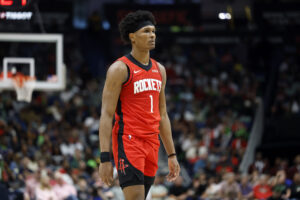



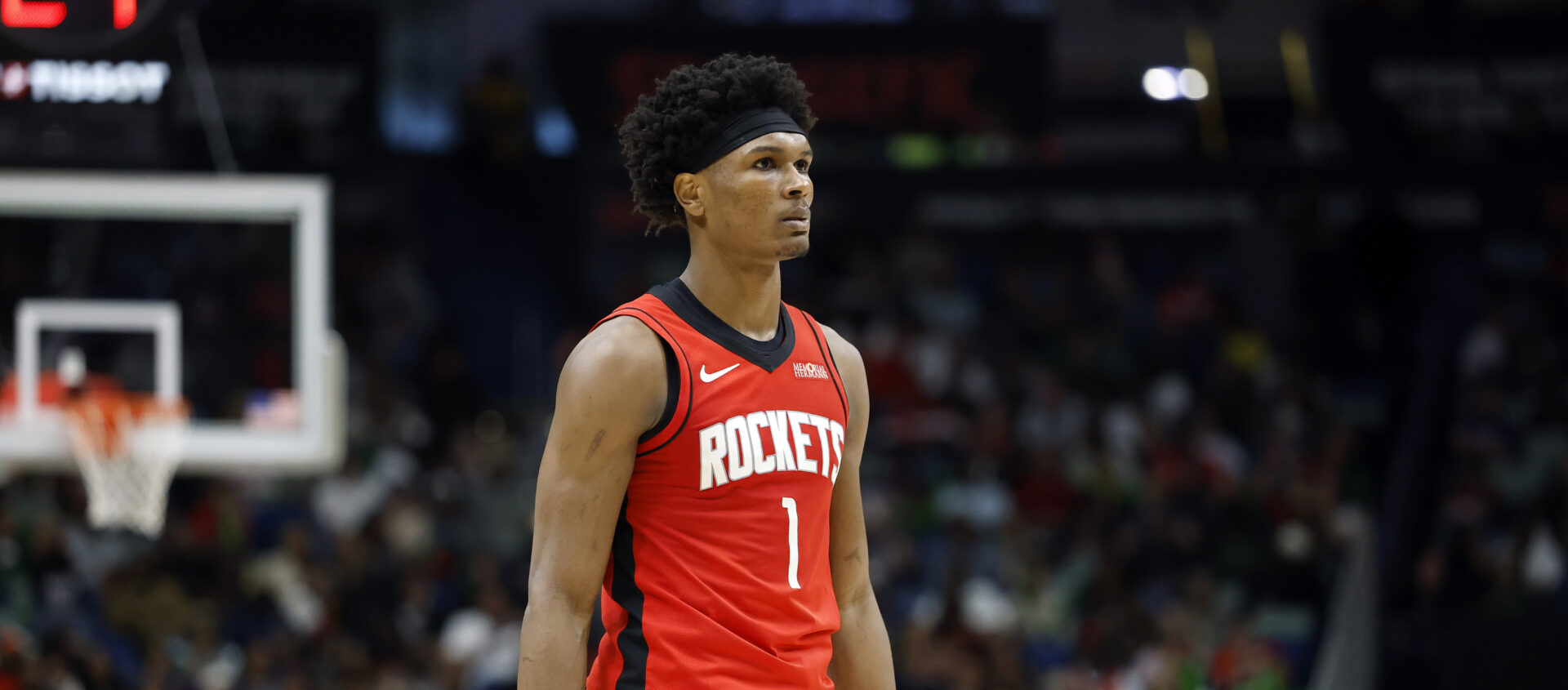

The Houston Rockets have resolved one of the biggest questions about their future by extending Amen Thompson. The five-year, $208 million deal is a major investment, but it also comes in below the maximum he could have received, following a model the Rockets had already used with Alperen Şengün.


Thompson’s new contract will begin in the summer of 2027, after he plays out the final season of his rookie deal. The extension has no player or team option, includes a 10 percent trade kicker and runs through the summer of 2032. At first glance, the size of the deal is enough to raise the question of whether a player who still lacks a reliable jump shot is worth more than $40 million per year. The more important number, however, is that Thompson could have received around $252 million.
Houston has therefore secured him for roughly $44 million less than the maximum rookie-scale extension and through what should be the first part of his prime. Thompson gets some protection through the 10 percent trade kicker, while the Rockets get five guaranteed years at a price below the max.
The Şengün Contract Established the Model
That type of deal is not an exception to the way general manager Rafael Stone has built the roster in recent years. In October 2024, Alperen Şengün was eligible for a five-year maximum extension worth roughly $224 million. He signed for $185 million, with a player option in the final season. His deal started at approximately 22 percent of the salary cap rather than the maximum 25 percent. Houston saved nearly $40 million compared with the largest contract Şengün could have signed, and it has now used a similar model with Thompson.
Thompson’s $208 million is more than Şengün’s $185 million, but the league’s salary cap has increased in the meantime. As a percentage of the cap, their contracts fall within a very similar range. The Rockets have paid the two most important players from their young core like foundational pieces without giving either of them a full maximum contract.
That is not a small distinction under the NBA’s current financial system. The second apron places serious restrictions on the league’s most expensive teams, so a few percentage points of the salary cap on one contract can eventually determine how much room a club has for the rest of the roster, what kinds of trades it can make and how easily it can retain quality mid-tier players.
That is where Houston has tried to create some room. Şengün and Thompson are locked in long term, as are Jabari Smith Jr. and Tari Eason. Smith received a five-year, $122 million deal, while Eason extended for five years and about $81 million. The Rockets have secured a large part of their young core before those individual contracts could begin to seriously complicate further roster building.
Thompson Is No Longer Being Paid Only for Potential
Thompson, however, is a different investment from Smith or Eason. Houston is no longer paying him primarily for the projection of what he might become. Last season, he averaged 18.3 points, 7.8 rebounds, 5.3 assists and 1.5 steals in 79 games while shooting 53.4 percent from the field. His 2,953 minutes led the entire NBA, making him only the third Rockets player to do so after Moses Malone and James Harden.
The statistical profile explains only part of why Houston was willing to invest $208 million. Thompson made the All-Defensive First Team in just his second NBA season and finished among the leading vote-getters for Defensive Player of the Year. He can take the opponent’s best guard or wing, defend multiple positions and give coach Ime Udoka the freedom to change coverages without making major changes to his lineup.
Part of his value is that a strong defensive possession does not have to end with him giving the ball to someone else before Houston can run. At 6-foot-7, with his strength and exceptional athleticism, Thompson can create the turnover or secure the possession himself, push the ball and finish at the rim. Few players his size provide the same combination of rebounding, on-ball defense and the ability to take the ball the length of the floor.
His offensive responsibility also expanded last season. Fred VanVleet’s injury put the ball in Thompson’s hands more often, giving Houston a chance to use him for longer stretches as an organizer. His assist numbers increased, and he was asked to make more decisions out of the pick-and-roll, on drives and after switches.
That represents an important change from when he was selected with the fourth pick in the 2023 draft. His athleticism, defense and transition play already looked like clear NBA strengths, while the main questions were how much he would improve with the ball and whether he could function effectively in the half court. Three years later, Houston clearly believes it has received enough answers.
The Contract Reflects Both His Value and What Is Still Missing
The biggest question remains the same, because Thompson made only a little more than one-fifth of his 3-point attempts last season. Opponents can therefore give him significant space on the perimeter, close off driving lanes and use a bigger defender without much fear that the strategy will consistently be punished from outside. A large share of his attempts still comes from close to the basket.
During the regular season, his other strengths can compensate for that limitation. The issue becomes more serious in the playoffs, when teams prepare for the same opponent throughout a series and attack the same weakness possession after possession. If the defender assigned to Thompson can consistently sag several feet off him, the floor becomes tighter for Şengün, Kevin Durant and Houston’s other creators.
Houston is paying him like one of the team’s foundational players, but the contract still reflects a gap between what Thompson is today and what he could become if his shooting develops. There are reasons for the Rockets to expect further progress. Thompson has improved significantly at the free-throw line, while his ballhandling and playmaking have developed enough for him to take on more organizational responsibility. None of that guarantees that he will become a good 3-point shooter, but his development has not stopped with the strengths he brought into the league.
Thompson does not have to become an excellent shooter to be an extremely valuable player. He can already be one of the best defenders on a team with major ambitions, rebound like a wing or a big, create advantages in transition and handle part of the playmaking burden. If shooting remains a weakness, his offensive ceiling will be limited. If he can develop it even to the point where defenses can no longer completely ignore him, the value of the overall package rises considerably.
Durant Represents the Present, Thompson the Years After It
The extension also says plenty about the direction of the franchise. Kevin Durant was brought in to help Houston win now. The Rockets are no longer a team that can measure a season only by the progress of its young players. After returning to the playoffs and adding one of the best scorers of his generation, results now carry greater weight.
At the same time, the organization has not allowed its pursuit of immediate success to undo what it built during the rebuild. Durant represents the current attempt to compete at the top, while Şengün and Thompson are expected to remain important long after the veteran part of the roster has changed.
Their contracts will overlap for most of the coming years, along with the deals signed by Smith and Eason. That gives Houston continuity while gradually defining the hierarchy. Şengün is already an All-Star center through whom a significant part of the offense can run. Thompson has become the second young player to receive a contract worth well over $30 million per season.
Houston Is Trying to Build an Expensive Core Without Becoming Trapped by It
The Rockets have not paid either of them the maximum. That could ultimately matter more than the difference between $185 million and $208 million. In a system where one poorly structured major contract can restrict a roster for years, Houston is trying to build a core good enough to be expensive without becoming so expensive that the team can no longer add around it.
There is risk involved. If Thompson’s shooting remains at its current level, every major playoff series will raise the same question, and Houston will have to find ways to hide that weakness offensively. If his development with the ball stalls, $208 million will be a serious price for a player whose greatest impact comes at the defensive end.
Everything Thompson has shown so far explains why the Rockets were willing to accept that risk. He is already an elite defender, one of the best rebounders among perimeter players, extremely dangerous in transition and increasingly functional as a creator.
Two years ago, Houston found a way to keep one of its best young players in Şengün below the maximum price. It has now applied the same principle to Thompson. The Rockets have done more than resolve another contract, because they are gradually defining the players they want to build around once the current veteran phase of the roster reaches its end.