






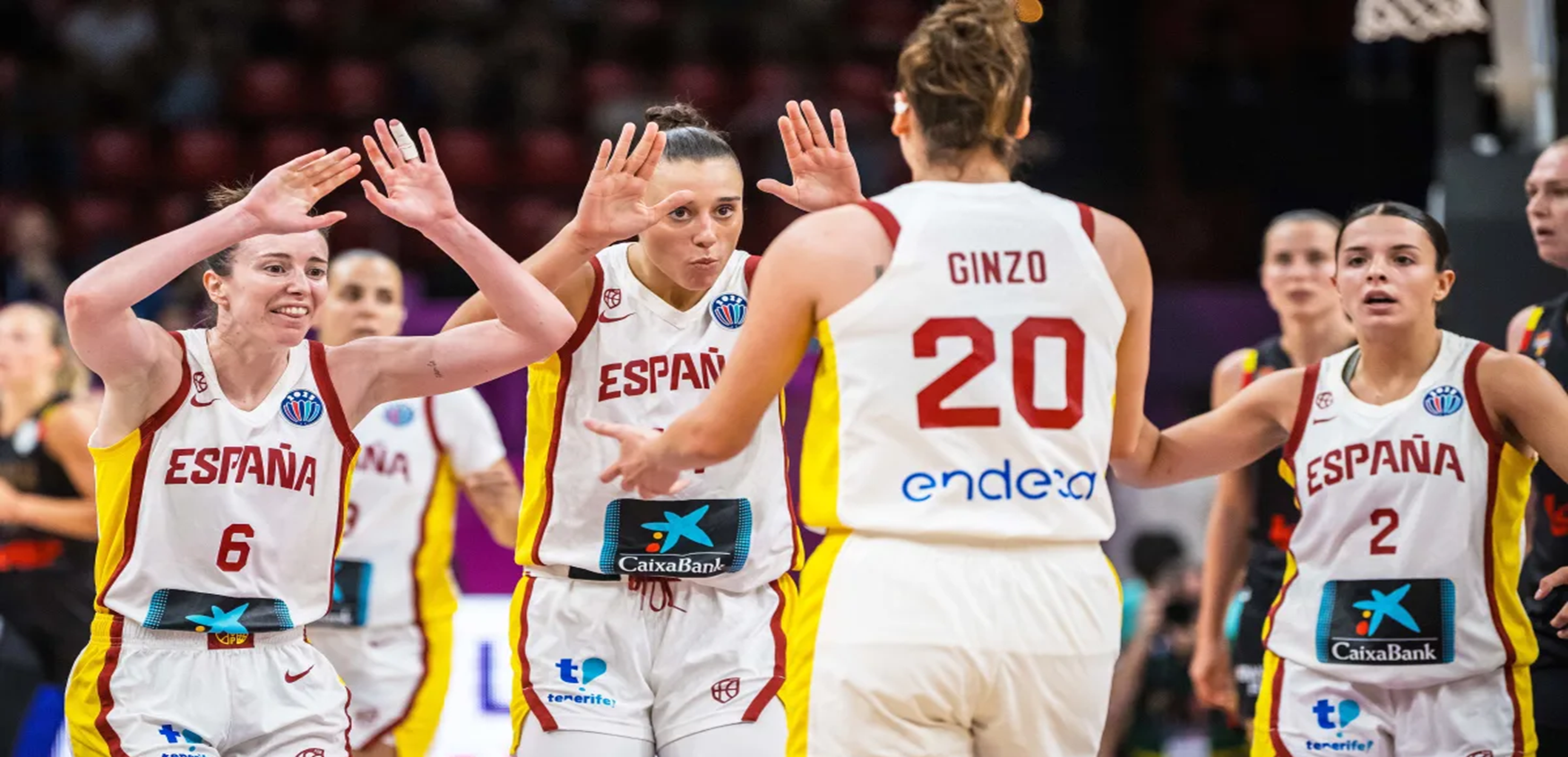

Just under a year ago, with three minutes left in the Women’s EuroBasket final, the changing of the guard in European women’s basketball seemed to be on the verge of becoming a reality. A young Spanish team, already missing key players María Conde, Maite Cazorla and Megan Gustafson, was on the brink of bringing down Belgium, the continent’s dominant force in recent years. Miguel Méndez’s side led 65-53.


But then basketball once again showed the kind of magic that only it possesses. A magic that can make it the most unpredictable sport of all… and also the cruelest one. Barely five minutes of game time later, and with no one quite able to explain how it had happened, Belgium had retained its European title after an astonishing finish: 65-67. In between came an improbable comeback, capped by Antonia Delaere’s basket after a turnover on a pass from Mariona Ortiz to Alba Torrens, a moment that still hurts deeply in Spain. The 2013, 2017 and 2019 European champions had once again settled for silver, just as they had in 2023, losing to the same opponent, although this time in far more painful fashion.
There is a school of thought that says you have to lose a final before you learn how to win one. Few lessons could have been more valuable for Spain than that unpredictable finish at the Peace and Friendship Stadium in Piraeus, when Méndez’s team let a victory that seemed all but secured slip through its fingers.
A year has now passed since that bittersweet experience, when Spain, despite its absences, exceeded perhaps even the expectations surrounding it on the back of a new generation led by Awa Fam and Iyana Martín, but failed to close out a game it had all but won. Now, Spain faces an even greater challenge with the FIBA Women’s Basketball World Cup taking place in Germany in September. And the Spanish national team arrives with an abundance of technical and physical talent that puts Méndez’s side firmly among the contenders for just about any goal.
On a player-for-player basis, Spain —with no injury absences this time around— boasts its strongest roster in years, blending veteran experience with emerging talent. Obviously, the United States, which recently announced its own roster, is the overwhelming favorite to win the tournament. But beyond the Americans, there is no team Spain cannot look squarely in the eye. Indeed, even the team’s public statements reflect that mindset. “Expectations are at their highest. We want to win every game we play, regardless of the opponent,” Méndez said recently, making no attempt to put a ceiling on his team as he returns to a World Cup tournament after missing the previous edition, held in Australia in 2022.
Spain, which the past weekend defeated Germany twice on the road in its opening warm-up games, began preparations with a 21-player roster, including five players currently competing in the WNBA: Raquel Carrera, María Conde, Awa Fam, Alicia Flórez and naturalized Megan Gustafson. The roster retains the core of the team that won the silver medal at EuroBasket 2025. All 12 members of that silver-medal squad return: Alba Torrens, Mariona Ortiz, Iyana Martín, Aina Ayuso, Elena Buenavida, Helena Pueyo, Andrea Vilaró, Irati Etxarri, Paula Ginzo, María Araújo, and the aforementioned Carrera and Fam. That continuity is particularly valuable for a team that has gradually added new pieces without sacrificing a recognizable identity. And three major names have now been added to the EuroBasket core: Maite Cazorla, Conde and Gustafson. Their inclusion raises the level even further for a roster that already had a highly competitive foundation.
Conde arguably represents the biggest qualitative upgrade. The Madrid-born wing returns to the national team after missing the last EuroBasket following a serious Achilles tendon injury. She brings size, athleticism, offensive talent and experience at the highest levels of both European and American basketball. Cazorla, meanwhile, adds playmaking, speed and the ability to create from the perimeter. Gustafson provides a high-level interior presence, particularly valuable in a tournament in which Spain will have to match up physically with some of the world’s biggest powers.
But the depth does not end there. Alicia Flórez, Lola Pendande, Marta García and Nerea Hermosa round out a group in which the first two cuts, following the two games against Germany, were Txell Alarcón and Carolina Guerrero, both of whom have already left camp and will not be part of the World Cup squad.
Amid that blend of youth and experience stands an undisputed leader in Alba Torrens. The captain, with 222 international appearances, is by far the most experienced player on the roster and the only one to have played in three World Cups… earning a medal in all three: bronze in 2010 and 2018 and silver in 2014.

And around her, Spain has a changing of the guard that is no longer a promise, but a reality. The young talent is particularly striking on the perimeter: Iyana Martín, Aina Ayuso, Helena Pueyo and Elena Buenavida offer different profiles and different ways of understanding the game, but they share something essential: they are no longer joining the national team simply to learn. They are there to compete for minutes and responsibility.
Inside, too, Spain appears to have regained its depth. Raquel Carrera remains one of the team’s main interior reference points, while Awa Fam, Paula Ginzo, María Araújo, Lola Pendande, Nerea Hermosa and Megan Gustafson give Méndez plenty of options depending on the opponent and the circumstances of the game.
All of this points to a much more versatile Spain than we have seen at previous tournaments, with a level of physicality beyond what the team has historically been accustomed to. Spain can play at pace with multiple ball-handlers, lean on the individual talent of its perimeter players, establish an interior presence or go with bigger lineups.
Ultimately, as always, the court will have the final say. Opponents such as Belgium, Australia, France and China —not to mention overwhelming favorites the United States— could all derail Spain’s path. But with the final 12-player roster yet to be determined, there is little doubt that Miguel Méndez’s team has every right to dream big in Germany.