


Winners are remembered. Stories are written about them, their photographs live forever, and their names end up as answers in sports trivia.


This isn’t a story about them.
This is a story about great players and outstanding teams that came within touching distance of a EuroLeague title – and walked away without one.

Most of these great teams won the EuroLeague either before or after the defeats you’re about to read about. Some, however, never got another chance.
And some losses hurt forever.
Here are five of the best teams that failed to win the EuroLeague.
Ginóbili, Jarić, Rigaudeau… But No Title (2001-02)
Kinder Bologna became European champion in 1998, led by Predrag Danilović, Zoran Savić and Antoine Rigaudeau.
Three years later came one of European basketball’s more absurd seasons: Kinder won the EuroLeague, while Maccabi won something called the SuproLeague.
The less said about that, the better.
Europe’s best clubs were reunited for the 2001-02 season, with the Final Four taking place in Bologna.
The stage seemed perfectly set for another celebration in Bologna.
Rigaudeau was the only player left from that famous 1998 team, but Ettore Messina now had Manu Ginóbili, Marko Jarić, Matjaž Smodiš, Antoine Granger and plenty more talent at his disposal.
Still, a team with Dejan Bodiroga on the floor and Željko Obradović on the bench can never truly be considered an underdog.
Panathinaikos erased a 14-point deficit and won 89-83 behind 21 points from Bodiroga and 22 from İbrahim Kutluay, with Sani Bečirović’s crucial missed free throws also playing their part.
Ginóbili and Jarić left for the NBA after the season.
The Bologna giant, meanwhile, soon found itself fighting for survival rather than trophies. It narrowly escaped bankruptcy and has never returned to those heights.
Duda’s Juggernaut Walked Away Empty-Handed (2004-05)
Fourteen games. Fourteen wins.
CSKA swept all seven opponents in the opening stage of the EuroLeague, including Panathinaikos, Benetton and – as it would later turn out – the team that would ultimately bring them down, Tau Cerámica.
They lost just once in the Top 16, a meaningless defeat to Barcelona, before cruising past Ülker 2-0 in the playoffs.
And then came the Final Four.
In Moscow.
Everything seemed to be falling into place for Dušan Ivković’s CSKA.
You remember that team: leading scorer Marcus Brown, the high-flying David Andersen, future legends J.R. Holden and Theodoros Papaloukas, old-school big man Dimos Dikoudis, Antonio Granger…
It seemed as though nothing could stop them.
But coaches don’t say “anything can happen in one game” for no reason.
And on the biggest night, the pressure finally seemed to get to them.
On May 6, 2005, Duško Ivanović’s swaggering Tau Cerámica showed up at the Olympiisky and ruined the party.
Arvydas Macijauskas, one of the greatest shooters European basketball has ever produced, poured in 23 points. José Calderón and Luis Scola provided the support, and the team from Vitoria pulled off a stunning upset.
Maccabi, led by Anthony Parker and Šarūnas Jasikevičius, beat Tau in the final.
As for CSKA…
Ivković had laid the foundations for the modern CSKA, but left after that defeat.
Alexander Gomelsky died in August 2005 and never got to see the spring of 2006, when a brilliant Papaloukas finally led CSKA to its first European title since 1971.
Olympiacos’ Superteam Couldn’t Finish the Job (2009-10)
Back then, it wasn’t exactly common for players with legitimate roles and solid minutes in the NBA to cross the Atlantic and join EuroLeague teams.
Well, Olympiacos brought in two of them.
Josh Childress had arrived the previous summer, followed by Linas Kleiza ahead of the 2009-10 season.
It was another attempt by the Piraeus club to recreate the glory of 1997, when David Rivers starred on the court and Dušan Ivković coached from the sideline.
Kleiza and Childress piled up points. Miloš Teodosić was putting together a season that would end with him being named EuroLeague MVP. Then there was the championship pedigree of Papaloukas, along with Ioannis Bourousis, Nikola Vujčić, Sofoklis Schortsanitis…
And yet, despite all the wins, Panagiotis Giannakis’ team never truly looked like a championship team.
That became clear at the Final Four in Paris. Olympiacos needed plenty of luck to get past Partizan in the semifinal, only to run into Xavi Pascual’s Barcelona machine in the final.
The Catalans had lost just two EuroLeague game all season – against Partizan in Pionir and against Real in the Play-Offs.
In the final, they blew Olympiacos away 86-68 behind Juan Carlos Navarro.
No drama. No suspense. No doubt.
Olympiacos didn’t win the Greek championship that season either.
That summer, one transfer would change the course of the club’s history. A certain man with the initials V.S. would lead Olympiacos to two EuroLeague titles over the next three seasons.
Printezis! (2011-12)
CSKA already had a formidable core.
Then, before the 2011-12 season, they added Andrei Kirilenko – still in his prime and with a decade of NBA experience behind him.
He had been one of the NBA’s best defensive players, and back in Moscow he became a superstar who did everything for the team.
Add Miloš Teodosić, a dominant Nenad Krstić in the paint, an emerging Alexey Shved and veterans such as Viktor Khryapa and Ramūnas Šiškauskas, and Jonas Kazlauskas had an extraordinary roster.
CSKA lost just two games on their way to the Final Four.
They survived a tense semifinal against Željko Obradović’s Panathinaikos.
Then they went up 19 against Olympiacos late in the third quarter of the final.
And then, little by little, a miracle began to take shape.
As the lead disappeared, panic began to set in. It was difficult to tell who had lost the plot more – CSKA’s collection of stars on the court or Kazlauskas on the sideline.
And yet, despite everything, CSKA still had the trophy in their hands.
Up one.
Two free throws.
Šiškauskas at the line.
He missed both.
What followed remains part of every EuroLeague highlight reel.
Spanoulis to Printezis. The floater.
And the miracle was complete.
CSKA’s Final Four curse had reached another level. It would not finally be broken until 2016 – and even then, they nearly blew a 20-point lead against Fenerbahçe in the final.
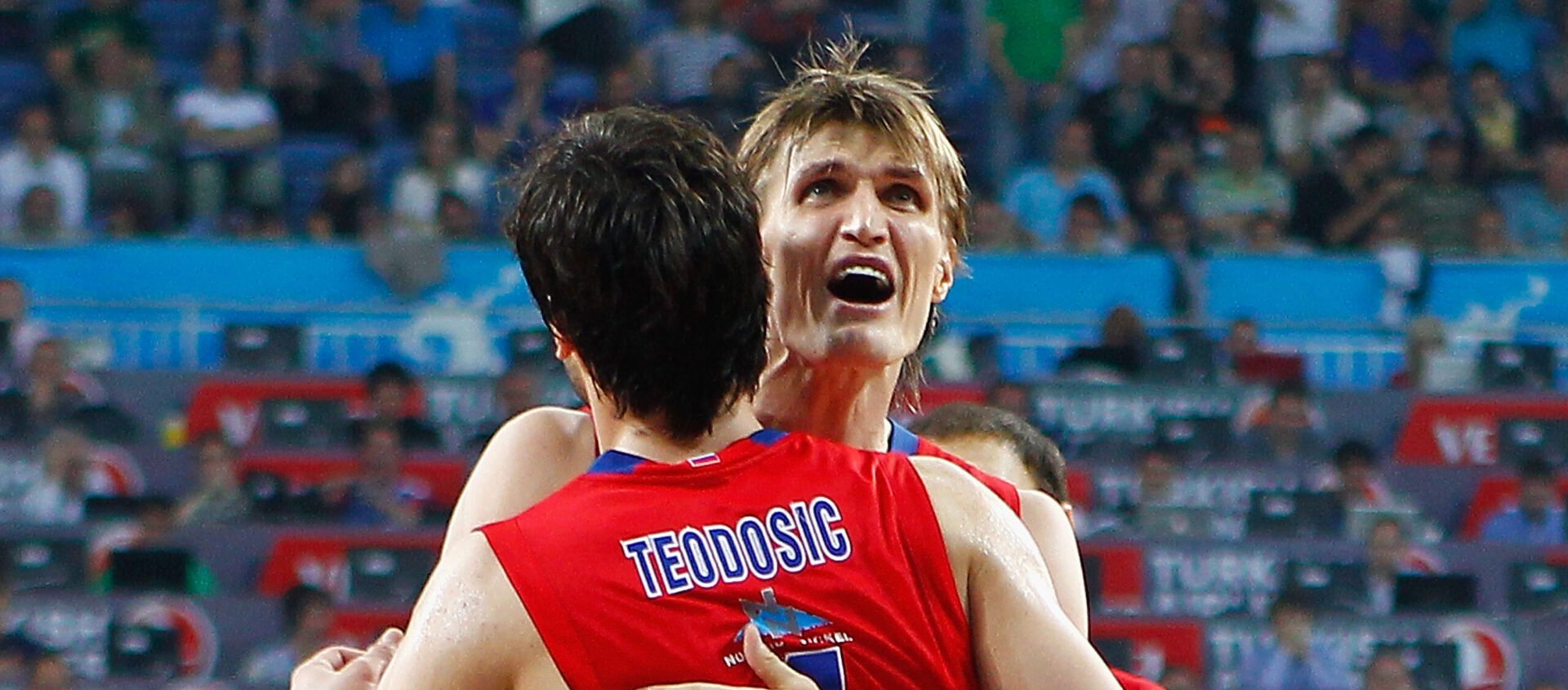
“The 2012 final wasn’t won by Olympiacos – it was lost by CSKA. By ourselves,” Teodosić said a few months before finally winning the first and, as it turned out, only EuroLeague title of his career.
“We had an excellent team and, if we had won the title then, many things could have been different. Maybe we could even have won it two years in a row.
“That defeat in Istanbul was the worst moment of my career.”
The Biggest EuroLeague Upset of the 21st Century (2013-14)
Real Madrid destroyed Barcelona 100-62 in one semifinal.
In the other, Maccabi stunned CSKA, somehow turning an almost lost game into a 68-67 victory.
By every bit of conventional sporting logic, Real Madrid was supposed to win that title.
A dominant, immensely talented team against an underdog that had already pulled off one miracle and, you would think, had little left in the tank.
Pablo Laso’s team had gone 10-0 in the opening stage that season, followed by an 11-3 record in the Top 16 before eliminating Olympiacos in the playoffs.
Then, instead of the expected coronation, Tyrese Rice happened.
Real looked nervous.
Too nervous.
Sergio Llull missed all six of his three-point attempts.
At the other end, Rice scored 26 points – 21 of them in the fourth quarter and overtime.
Maccabi won 98-86 and lifted the European Cup for the sixth time.
Both Laso and Llull made no attempt to hide the devastation inside the Real Madrid locker room.
“When you go all the way and come away with nothing, the pain stays with you,” Laso said.
Nikola Mirotić would never again come that close to lifting the EuroLeague trophy.
Sergio Rodríguez, Llull, Rudy Fernández, Jaycee Carroll, Ioannis Bourousis and Laso, however, would get their redemption.
One year later, Real Madrid were champions of Europe.