


Inside Burgos, they knew better. Nothing about his rise had been quick.


He had spent three full seasons in LEB Oro, experienced promotion disappointments, changed coaches, adapted to different roles and watched more established teammates receive opportunities before him. Rather than becoming frustrated, he treated every season as another stage of preparation.
“I’ve matured a lot,” he told Diario de Burgos in March 2024. “Not only as a player but also as a person. My game hasn’t changed dramatically because I’ve always played in a similar way, but you learn so much from experience, both on and off the court. You become mentally stronger because you go through good moments and bad moments. I think you learn more from the bad moments than from the good ones.”
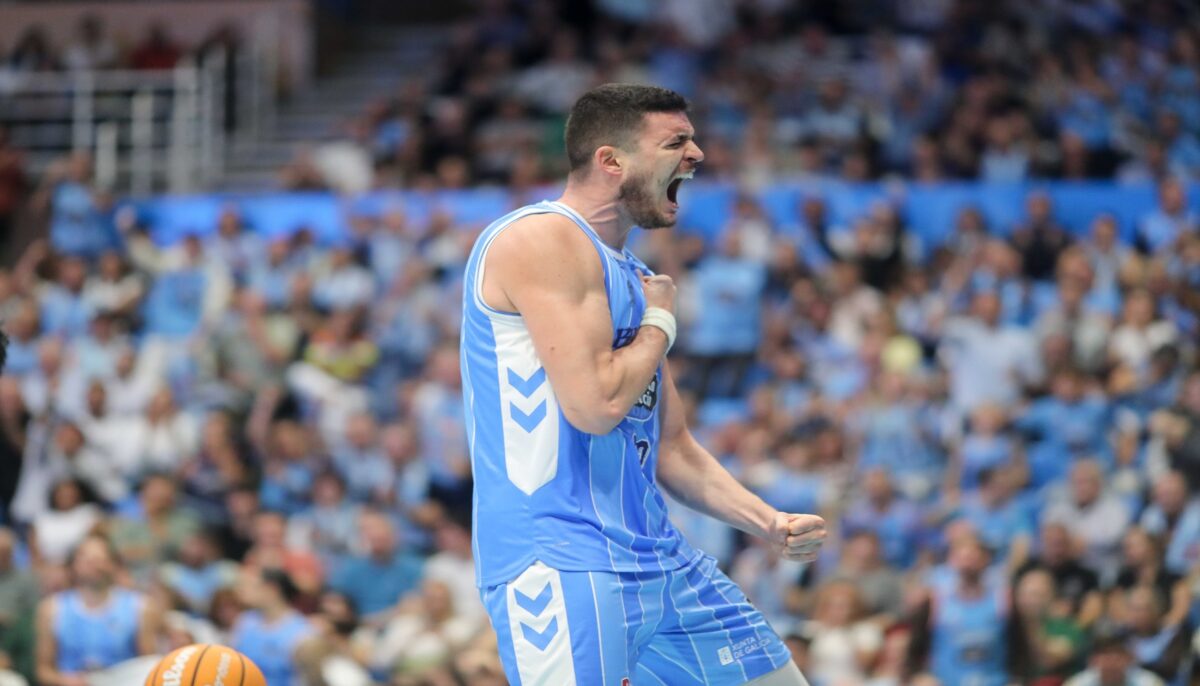
Those difficult years coincided with one of the most turbulent periods in San Pablo Burgos’ history.
The club had recently experienced the highest point in its existence by winning consecutive Basketball Champions League titles before suffering the shock of relegation from the ACB. Expectations never changed.
Promotion was the only acceptable outcome.
Failure carried consequences, but Corbalan embraced that environment.
“I love that pressure of having to win every single day,” he explained. “Some people say that if you lose one game, it’s not the end of the world. But losing should never feel the same as winning. I like clubs with high ambitions. I want to play for teams that fight to get promoted, to play in Europe. That mentality is the right one.”
That sentence perhaps explains why Valencia eventually identified him as an ideal fit.
His personality had already been shaped by elite expectations long before he reached elite basketball.
Learning different roles
One of the less visible aspects of Corbalan’s development was his willingness to adapt.
During his first professional seasons he alternated between point guard and shooting guard depending on the coach, the roster and the team’s needs. Sometimes he was initiating offense. Sometimes he was finishing possessions.
The constant positional changes even became a source of debate among Burgos supporters.
Corbalan, however, refused to become trapped by labels.
“I feel comfortable playing because I like playing basketball,” he told Diario de Burgos. “Whether it’s at the one or the two doesn’t really matter. I adapt my game to whichever position I’m asked to play.”
That flexibility would later become one of his greatest selling points.
Speaking to Basquet Plus, he admitted that he genuinely enjoyed both positions.
“I liked playing point guard and I like playing shooting guard. The difference now is that I’ve grown individually. This season I have more freedom offensively and defensively. As long as I have confidence, I think I’ll play well in either position.”
Modern basketball increasingly values players capable of making decisions across multiple positions.
Corbalan may not be a traditional floor general, but he is comfortable initiating offense, attacking closeouts or functioning away from the ball.
That versatility has become one of the defining characteristics of his game.
The season everything changed
Promotion to the ACB represented only the beginning.
Survival proved considerably harder.
San Pablo Burgos opened the 2025-26 Liga Endesa campaign by losing eleven of its first twelve games. Confidence evaporated, results deteriorated, and relegation appeared increasingly inevitable.
Corbalan experienced the frustration firsthand.
“It was difficult because we weren’t just losing on the last possession,” he told Diario de Burgos. “At first we simply weren’t competitive. It became very hard to walk into the locker room and find words to motivate your teammates. After the third loss you can still say something. After the fourth maybe too. But after the fifth, sixth, seventh, eighth… it became really difficult.”
Everything changed when veteran coach Porfirio “Porfi” Fisac replaced Bruno Savignani.
Corbalan has repeatedly described Fisac’s arrival as the turning point of both his own season and Burgos’ survival campaign.
“He brought us confidence,” Corbalan explained. “Confidence changes everything. But confidence comes when you win. Before every game you have to believe you can win. If you don’t believe it, it’s very difficult. That’s what Porfi did so well. The players started believing, shots started falling and everything became easier.”
The impact went beyond tactics.
Fisac expanded Corbalan’s offensive responsibilities while simultaneously trusting him to defend the opposition’s best perimeter players.
The Argentine responded with the finest basketball of his career.
He averaged over 15 points, more than three rebounds and nearly three assists per game while becoming one of the league’s premier perimeter defenders. Burgos completed an unlikely escape from relegation, securing survival before the final weekend.
Individual recognition naturally followed.
Corbalan earned a place among the Liga Endesa MVP candidates and was selected to the All-Second Team in what was officially his first full ACB season.
Characteristically, his reaction focused elsewhere.
“If I hadn’t been selected, it wouldn’t have changed me mentally,” he told Clarin. “It’s nice that people recognised I did my job well in my first ACB season. It means I’m on the right path. But my biggest satisfaction was that I started playing well when the team started winning.”
A relentless competitor
Statistics explain only part of Corbalan’s emergence.
His identity is built on competitiveness. Several interviews reveal an athlete who genuinely enjoys moments many players try to avoid.
Asked whether he would sign up for another game decided on the final possession, his answer came immediately.
“Ever since I was a kid, you dream about having the last shot. Or defending the last possession while you’re ahead. Those are the most beautiful moments in sports. You can make it and win or miss and lose. I’d always sign up for those situations.”
That mentality repeatedly appears throughout his interviews.
Pressure does not intimidate him. Responsibility energises him. It is an unusually consistent theme regardless of the interviewer or context.
Breaking down the game
Spanish analysts have become increasingly fascinated by Corbalan because he does not fit neatly into one category. He possesses the size of a modern combo guard at 1.93 metres, yet plays with the explosiveness of a smaller athlete.
Several Spanish scouts describe his first step as elite by ACB standards. Others point to his vertical athleticism, particularly his ability to finish through traffic rather than simply above it.
Basketball analyst Sergio Vegas perhaps summarised him best when describing him as “the type of player who makes you stay glued to the television.”
His dunks attract attention and his competitiveness keeps coaches happy.
Unlike many athletic guards, Corbalan rarely attacks the rim recklessly. His first instinct is to collapse the defence, force rotations and then read the next action.
His transition game is already EuroLeague calibre. His open-court speed allows him to generate easy baskets, while his willingness to attack contact makes him particularly dangerous against retreating defences.
Perhaps even more impressive is his defensive commitment. He finished among the ACB leaders in steals, averaging around 1.5 per game, but that statistic only hints at his overall impact. His defensive identity is based on relentless ball pressure.
He enjoys physical matchups while embracing difficult assignments.
“Pablo Prigioni asks me for intensity,” Corbalan explained while discussing his role with Argentina in an interview with Basquet Plus. “Defence cannot be negotiated. Offensively, some days one player scores more than another. But defensively, intensity has to be there every day.”
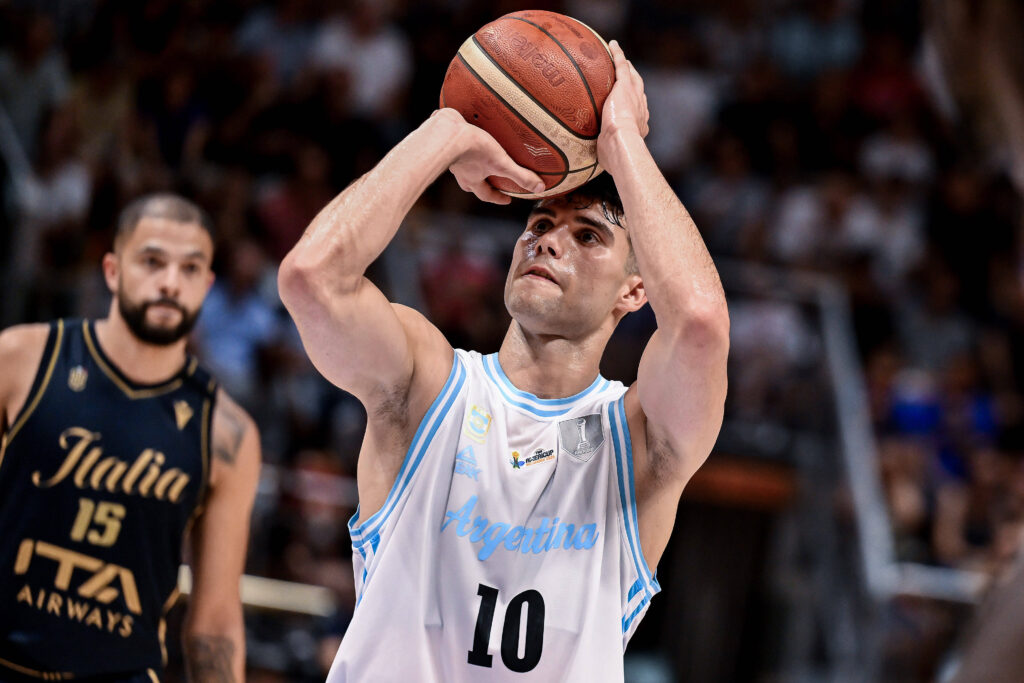
That philosophy perfectly mirrors the way he plays at club level.
He rarely conserves energy for offense. Instead, he attacks both ends of the floor with similar aggression.
There remain areas requiring improvement. Corbalan himself openly acknowledges them.
“If I look at the numbers,” he told Clarin, “I want much more than 30% from three and 60% on two-point shots. I can also improve a lot defensively. I feel like I still have huge room for improvement.”
The three-point shot remains the most obvious developmental area.
Interestingly, neither Corbalan nor his coaches see mechanics as the principal issue.
“The difference isn’t that I’m shooting differently,” he explained to Basquet Plus. “The difference is that the shots are going in. I was already taking them before. I simply started working even harder, especially mentally. Confidence from the coach also helped a lot.”
Spanish analysts largely agree. His shooting percentages remain inconsistent, but his willingness to take open shots has never disappeared.
That confidence, combined with his work ethic, explains why most talent evaluators expect further improvement rather than regression.
Why EuroLeague clubs started calling
By the second half of the season, Burgos understood they were unlikely to keep him.
Valencia eventually won the race. However, Baskonia had monitored him extensively, and Real Madrid also appeared among the clubs following his progress, while other EuroLeague organisations requested information.
The attraction was easy to understand.
Corbalan combined ACB production, defensive intensity, positional versatility, athletic upside and—thanks to his Spanish passport—did not occupy a non-EU roster spot.
Just as importantly, his buyout remained relatively affordable for EuroLeague clubs.
Valencia recognised the opportunity before anyone else could close the deal.
For Corbalan, however, the transfer represented far more than a reward for one outstanding season.
It marked the beginning of an entirely different level of expectation.
Valencia: The next step
Corbalan arrives at Valencia Basket after establishing himself as one of the ACB’s breakout players. According to El Correo, Baskonia explored signing the Argentine guard, while Valencia ultimately secured one of the league’s most sought-after domestic additions following a season in which he averaged 15.5 points, 3.2 rebounds, 2.6 assists and 1.5 steals for San Pablo Burgos.
His move comes as Valencia enters a new cycle. Pedro Martinez, who guided the club to the Liga Endesa title and the EuroLeague Final Four, is leaving to coach Real Madrid, while the backcourt has also undergone significant changes with the departures of Jean Montero, Brancou Badio and Darius Thompson. The club has already added T.J. Shorts, one of Europe’s premier creators, and Corbalan joins a perimeter lineup that needs to be reassembled.
Rather than arriving as a primary ball-handler, Corbalan offers positional flexibility. Playing off the ball gives him greater offensive freedom while still allowing him to create when necessary. His profile is built on versatility more than volume scoring.
Corbalan himself remains focused on improvement rather than recognition. After earning All-ACB Second Team honours and receiving MVP consideration in his first full ACB season, he told EFE that he still feels “very far” from his best version. In interviews with both EFE and Basquet Plus, he identified three-point shooting, defence and decision-making as areas where he believes he can continue to grow.
Long-term, his ambitions remain unchanged. “Dreams are always about playing at the highest level possible,” he told EFE, while pointing out that the NBA remains his ultimate objective.
For now, however, his attention has consistently remained on the next challenge rather than the one beyond it—a pattern that has characterised every stage of his career, from leaving Argentina as a teenager to climbing from Spain’s fourth division to the ACB in just four years.