










The NBA Finals between the New York Knicks and the San Antonio Spurs was not compelling only because of the basketball. Beneath the series sits another story, one that often gets lost behind the size of the contracts. So, how much money players actually take home once taxes, NBA escrow and representation costs are deducted from their gross salaries?


Public conversation usually stops at gross salary. When people hear that Karl-Anthony Towns is earning a little more than $53 million in the 2025/26 season, or that De’Aaron Fox is at around $37 million, those figures can sound like the full story. An NBA contract tells us what a player is worth on the market, but not how much money actually remains in his account.
Why New York and Texas Are Not the Same
That distinction matters even more in this Finals matchup because the Knicks and the Spurs operate in very different tax environments. New York is one of the most expensive places in America for a professional athlete. In addition to federal tax, players can face a serious state and local tax burden. San Antonio, by contrast, benefits from one of Texas’ biggest advantages, because the state has no personal income tax.


This is where the so-called “jock tax” becomes important. It is the tax professional athletes pay when they earn income while playing in other states or cities. An NBA player is not taxed only where his team is based. He is also taxed in places where, for part of the season, he is considered to be working. Part of his annual salary can be assigned to those days and taxed at local rates.
In practice, this is usually calculated through “duty days,” which include days spent on games, practices, travel and other team-related obligations. That is why it would be too simple to say that a player based in Texas pays only federal tax. The home portion of the season is lighter from a tax standpoint for Spurs players, but the road still comes with a bill.
How the Estimate Was Calculated
For this estimate, a simplified model was used. For New York Knicks players, the calculation applies 37 percent for federal tax, using the top marginal rate for income at this level, around 10 percent for state, local and jock tax, 10 percent for NBA escrow, and another roughly 5 percent for the agent, financial and legal advice, and money management. Under that model, Knicks players are left with about 38 percent of their gross salary.
For the San Antonio Spurs, the calculation is more favorable. The model uses 37 percent for federal tax, around 4 percent for jock tax, 10 percent for escrow and 5 percent for the agent and related financial costs. That leaves Spurs players with roughly 44 percent of their gross salary. Abstract, but on salaries of $20 million, $30 million or $50 million, the difference becomes real money very quickly.
This is not a tax return calculated down to the last dollar. The actual net amount depends on a player’s residency, marital status, tax credits, deductions, game schedule, bonus structure and the league’s final revenue calculation. It shows the gap between gross salary and the money a player can realistically expect to keep.
Escrow, Agents and the Hidden Costs
NBA escrow is not a traditional tax, but a mechanism built into the collective bargaining agreement between the league, owners and players. During the season, the NBA withholds 10 percent of player salaries so it can later determine whether the revenue split between players and owners has stayed within the agreed framework. For that reason, a conservative estimate treats escrow as a deduction, even though it is not formally a tax.
Agent commission in NBA contracts is subject to limits, so it would be misleading to present it as if an agent simply takes five percent automatically. In this calculation, that five percent represents a wider set of costs: the agent, financial adviser, tax planning, legal support and wealth management.
What Knicks Stars Actually Keep
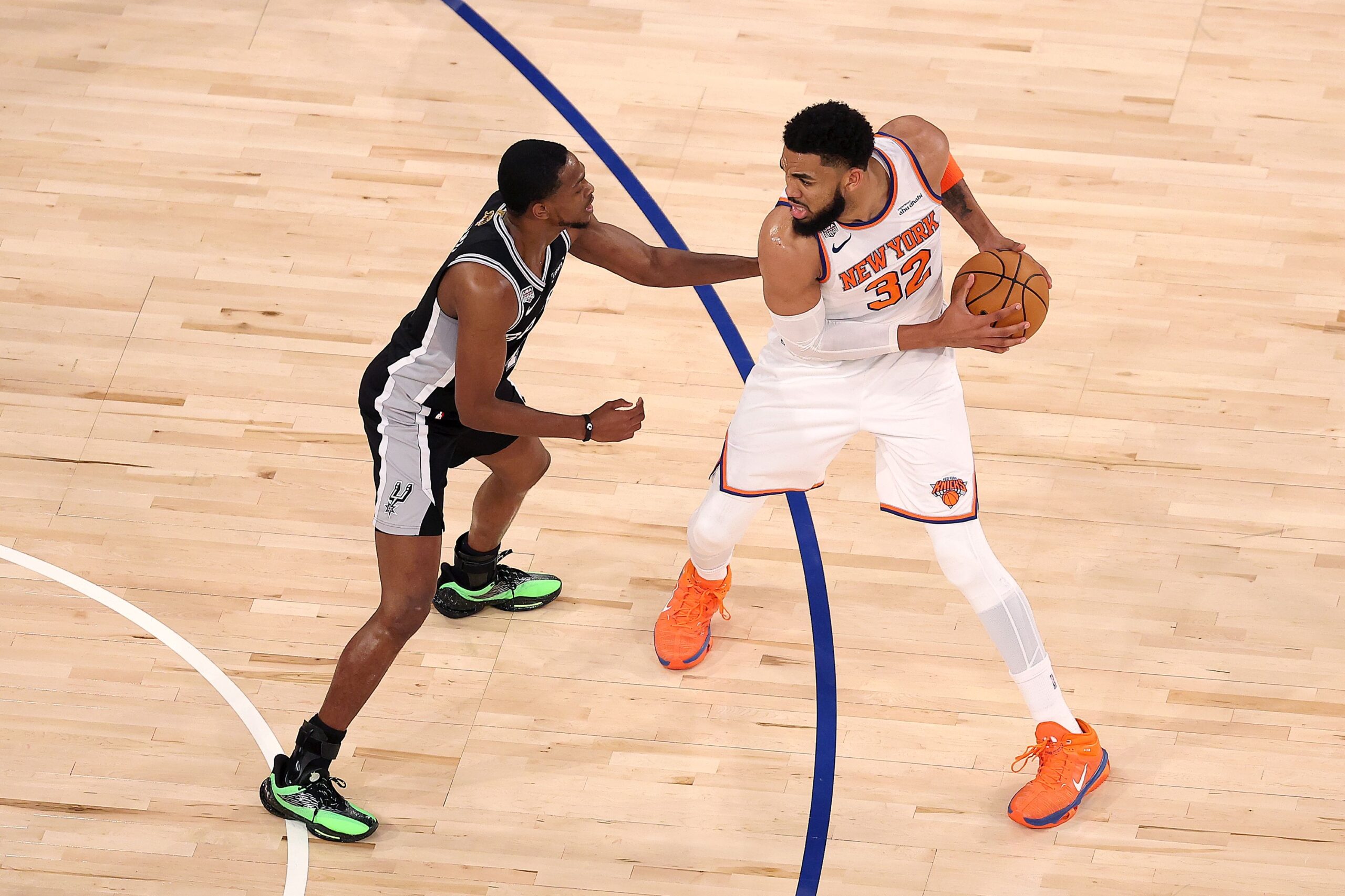
For New York, the highest-paid player in this calculation is Karl-Anthony Towns. His salary for the 2025/26 season is $53.14 million. Once this model is applied, Towns is left with approximately $20.19 million. More than $30 million of the nominal salary is gone before the real net number is reached.
OG Anunoby has a salary of $39.57 million, and by this estimate he keeps around $15.04 million. Jalen Brunson earns $34.94 million gross. Under the same model, he is left with approximately $13.28 million. His case is particularly interesting because his value to New York is greater than the number on his contract.
Mikal Bridges, with a salary of $24.9 million, comes out at approximately $9.46 million net. Josh Hart, whose salary is $19.47 million, is left with around $7.4 million. In total, the five highest-paid Knicks players have about $172.03 million in gross salary, but by this estimate they keep around $65.37 million.
The Spurs’ Texas Advantage
For San Antonio, the picture looks different. De’Aaron Fox is the highest-paid Spurs player in this group, at $37.1 million gross. Because of Texas’ more favorable tax environment, he is left with approximately $16.32 million. Devin Vassell, with a salary of $27 million, comes out at around $11.88 million after deductions. Harrison Barnes, goes from $19 million gross to about $8.36 million net.
Keldon Johnson has a salary of $17.5 million and keeps approximately $7.7 million. Victor Wembanyama is the special case in this group. We put him in place of Kelly Olynyk because the difference in salary is minimal. Although he is already one of the most important players in the league, Wemby’s $13.38 million salary is still governed by the structure of a rookie contract. By this estimate, he is left with around $5.89 million. In the NBA context, it shows how fortunate San Antonio is to have a generational player on a contract that sits far below his real market value.
The Real Gap Between New York and San Antonio
Taken together, the five Spurs players in this calculation, Fox, Vassell, Barnes, Keldon Johnson and Wembanyama, have around $113.97 million in gross salary and about $50.15 million left net. New York’s five-man group is much more expensive on paper, by around $58 million gross. But once the conversation shifts to take-home money, the gap falls to about $15 million.
The Knicks have larger contracts, a brighter market spotlight and a more expensive payroll, but their players also pay the price of New York. Spurs do have the tax advantage of Texas and a setup that allows their players to keep a larger share of what they earn.
Net income is the other side of that same story. And in these Finals between the Knicks and the Spurs, the difference between New York and Texas can also be measured in the millions of dollars.