










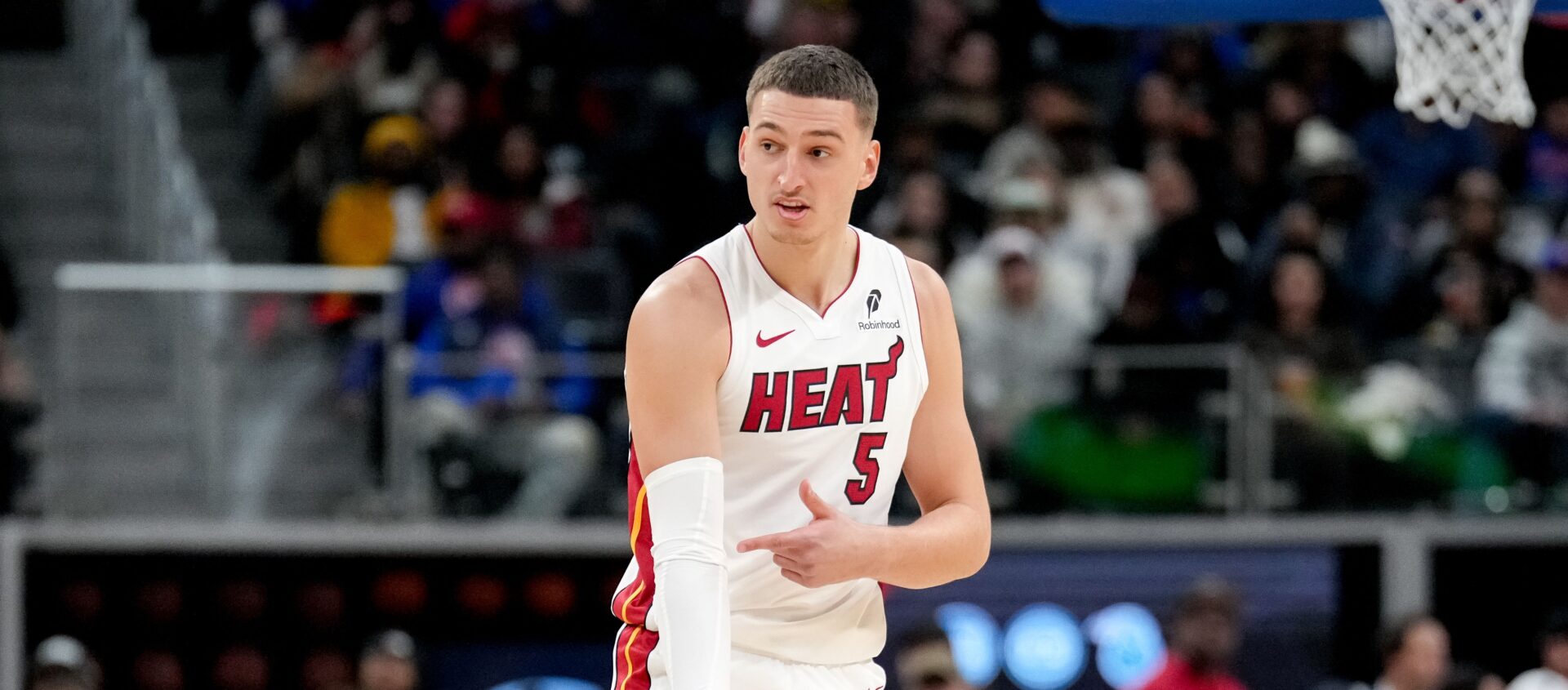

Giannis Antetokounmpo’s arrival has changed the situation in Miami. The Heat are no longer in a position to wait patiently for young players to develop. Once a player of Giannis’ level is on the roster, the next two or three seasons have to be treated as a real championship window.


The question is what kind of team Miami can put around him. For now, only nine players are on the payroll. That makes the decisions involving Andrew Wiggins and Nikola Jović far more important than they would have been before the trade. Wiggins matters because of what he can give the Heat on the floor. Jović matters because he may be the best remaining piece Pat Riley can use to finish the roster.
Giannis Has Sped Up Miami’s Timeline
The numbers explain why Wiggins’ decision matters so much. After sending Tyler Herro, Kel’el Ware, Jaime Jaquez Jr. and Kasparas Jakučionis to Milwaukee, Miami would have around $188.7 million committed to nine players for the 2026/27 season, assuming Wiggins picks up his player option worth roughly $30.17 million. He has until June 29 to make that decision.
The projected salary cap is about $165 million, but Miami was always going to operate above it. New players would mostly have to come through trades, exceptions and minimum deals. The more important number is the first apron, currently projected at roughly $209 million.
That leaves the Heat with a little more than $20 million to work with. It sounds like a reasonable amount until the rest of the roster is taken into account. In this setup, the first apron functions as a hard ceiling. Miami cannot simply cross it and deal with a larger tax bill later.
Without Norman Powell, the Heat would have only nine standard contracts. They still need at least five players just to enter the season with a normal roster. Five veteran minimum deals could take up somewhere between $10 million and $12 million. Most of the available room would be gone before Riley found another ball-handler or a shooter he could trust in the playoffs.
Every million saved on Wiggins’ next deal would matter.
A New Wiggins Contract Could Give Miami More Room
The best outcome for the Heat is not losing Wiggins. It is convincing him to decline the option and sign a longer contract with a lower salary in the first year.
If his starting salary came in somewhere between $22 million and $25 million instead of $30.17 million, Miami would not suddenly have conventional cap space. What it would gain is several million dollars of breathing room below the apron, which is more useful to the Heat in their current position.
That difference could decide whether Powell stays, whether another playoff-level player can be added, or whether Miami has to build most of its bench out of minimum contracts.
There is also the basketball side of the decision, and that may be even more important.
Why Wiggins Fits Next to Giannis and Bam
A starting lineup of Davion Mitchell, Norman Powell, Andrew Wiggins, Giannis Antetokounmpo and Bam Adebayo would have size, athleticism and the potential to be one of the league’s better defensive units. It would also have a spacing problem.
Mitchell, Giannis and Bam are not players defenses will consistently follow far beyond the three-point line. That puts more pressure on the other two starters to shoot, move without the ball and avoid slowing the offense down.
Wiggins fits that job better than most of the players Miami could realistically find. He can guard the opponent’s best wing, take on difficult assignments across several positions and play without needing the ball on every possession. He can attack a closeout, run the floor and hit enough open threes to keep the offense from becoming too crowded.
If he leaves, Miami does not lose only one starter. It loses its best option against bigger wings, one of its more dependable perimeter shooters and a player who does not need touches to remain useful.
Replacing that profile would not be easy. Good 3-and-D wings are expensive, and most teams are reluctant to trade them. Moving Wiggins would make sense only if Miami received a player who solved a larger problem, such as a reliable primary creator, a high-level shooter or a guard capable of organizing the offense late in games.
Using him simply to cut salary would create as many problems as it solved.
Jović Is Valuable for a Different Reason
Jović is in a less secure position. His salary of about $16.2 million next season is large enough to be useful in salary matching, but not so large that it becomes difficult for another team to absorb in a trade.
After Miami gave up several young players in the Giannis deal, Jović is one of the few remaining players who combines youth, upside and a contract that can be used in another meaningful move.
Trading him would not automatically clear $16.2 million from the payroll. If Miami takes back a player earning a similar amount, the financial picture barely changes. The point of the deal would be to exchange future potential for someone more ready to help now.
Jović’s path to minutes has also become less obvious. Giannis will take most of the minutes at power forward. Bam remains the central piece of the frontcourt, while Bobby Portis brings experience and shooting. Jović would need to establish himself as a floor-spacing big and secondary playmaker, but his shot was the part of his game that failed him most last season.
Miami may not have the patience to wait for that role to develop.
The Heat Should Still Avoid Selling Low
That does not mean Jović should be moved simply because another team shows interest. Trading him after a poor season could mean selling at the lowest point of his value. He is still young, has unusual ball-handling ability for his size and can create something in transition. He also sees passes that many players at his position do not. There is still a useful NBA player there, especially if his outside shot returns.
Riley will almost certainly listen to offers. But Jović should only be moved for a player who can enter the rotation immediately, whether that is a dependable shooter, a combo guard or a wing ready for serious playoff minutes. The Heat cannot afford another developmental project in return. Not now.
Miami Still Has Work to Do
Giannis gives Miami a core that can compete for a championship, but he does not make the roster complete on his own. The Heat still need more playmaking, more shooting, another capable wing and several dependable players off the bench. Miami has already decided to keep Pelle Larsson for $2.3 million next season.
Wiggins’ decision will shape how much financial room Miami has to address those weaknesses. Jović’s contract may shape what level of player the Heat can acquire in their next trade.
Wiggins is needed to make the current roster work. Jović may be the piece Miami uses to make it good enough.