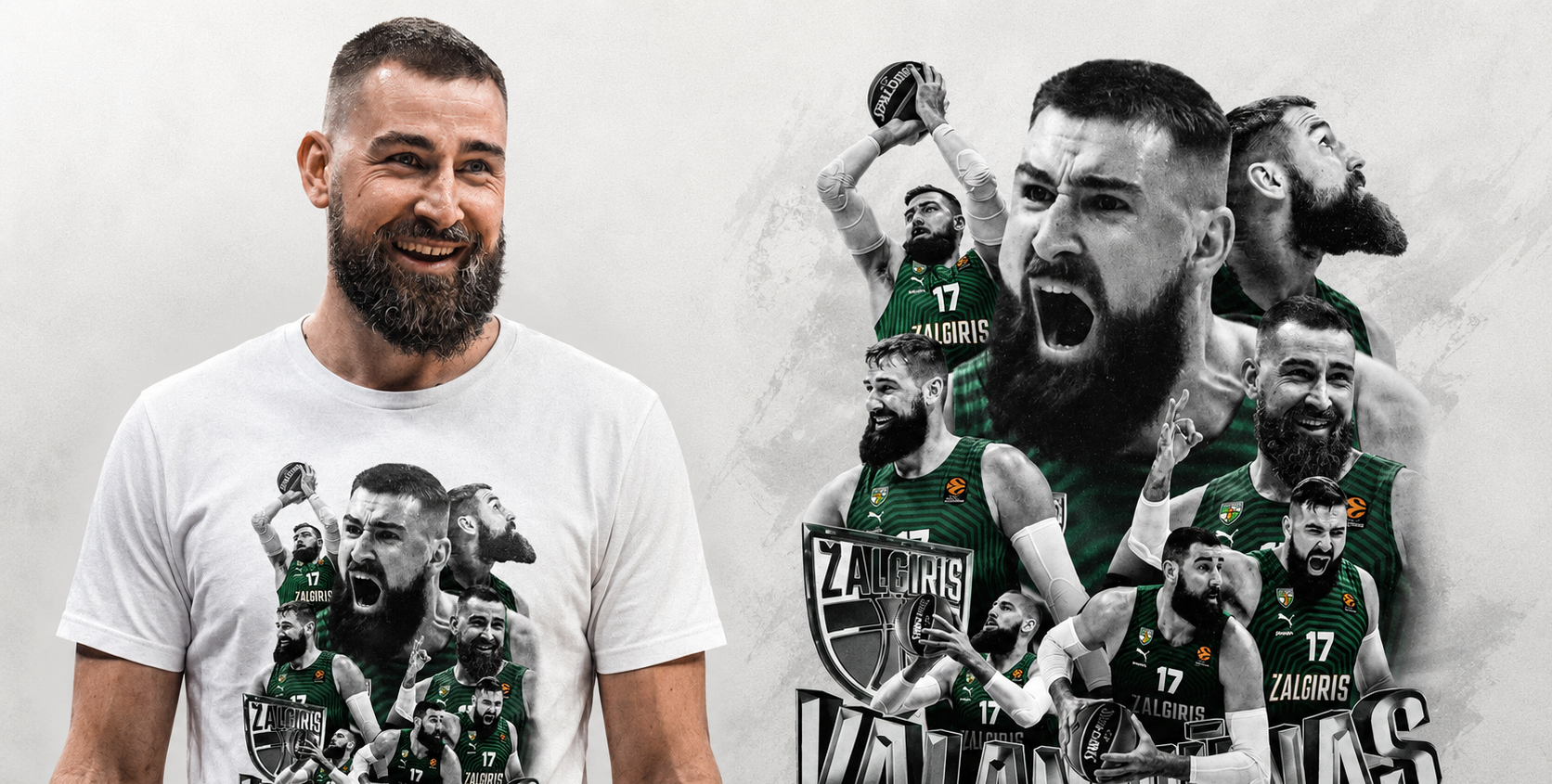

Jonas Valančiūnas is coming back to European basketball after more than 1,000 NBA games and 14 seasons, most of them spent as a starting center.


He is not returning to Lithuania as a familiar name that no longer lives up to its reputation. Valančiūnas played 65 games for Denver last season and remained a useful NBA big man, capable of scoring inside, controlling the glass and giving a team real size around the rim. Žalgiris is not bringing him home for a farewell tour.
His NBA résumé immediately makes this one of the most notable Euroleague signings of the century. Whether it becomes one of the greatest returns is another question. That distinction cannot be earned right away. Valančiūnas still has to show how much of his NBA game can translate back to Europe and how far Žalgiris can go with him at the center of the project.


The pool of players being considered here is deliberately narrow. They must have played professionally in Europe, built a meaningful NBA career and then returned to make a major impact in the Euroleague. A short stint at the end of an NBA bench is not enough. Neither is returning to Europe with a famous name and little left on the floor. Some of these players dominated for one season. Others became pillars of championship teams for years. Together, they provide the standard Valančiūnas will now be measured against.
Andrei Kirilenko: The Most Complete Season After a Return
Kirilenko left CSKA as one of the best young players in Europe. By the time he returned during the 2011 NBA lockout, he was an NBA All-Star, a three-time All-Defensive selection and a veteran of nearly 800 games.
He did not treat Moscow as a temporary stop while waiting for the NBA to reopen. Kirilenko was named Euroleague MVP and Best Defender, made the All-Euroleague First Team and led the competition in both rebounding and blocks.
CSKA’s collapse against Olympiacos in the championship game kept the season from ending as it should have. That loss did not make Kirilenko any less dominant. He protected the rim, defended across multiple positions, ran the floor and affected possessions without needing the offense to revolve around him. Few returning NBA players have ever controlled so many parts of the game at once.
Arvydas Sabonis: A Farewell Season That Became an MVP Campaign
Sabonis reached the NBA only after injuries had taken away some of the movement and athleticism that defined his earlier years. He still played 470 games for Portland and averaged 12 points and more than seven rebounds.
When he returned to Žalgiris in 2003, just before turning 40, the move appeared to be the final chapter of a historic career. Lithuania would get a few more nights with its greatest player, while Sabonis would leave the game in the place where his story began. Instead, he became the best player in the Euroleague.
Sabonis averaged 16.7 points and 10.7 rebounds and carried Žalgiris to the edge of the Final Four. The unforgettable finish against Maccabi kept his team from reaching it, but the season had already become much more than a sentimental homecoming. At an age when most centers are trying to survive limited minutes, Sabonis was still dictating games.
Evan Fournier: A Proven NBA Scorer Who Delivered Right Away
Fournier came back after 12 NBA seasons and more than 700 games. For much of that time, he was a starter and a dependable scorer in Orlando, not a player searching for a role.
His transition to Olympiacos was quick. Fournier made the All-Euroleague Second Team in his first season and became one of the players trusted to create a shot when the offense stalled or a close game reached its final possessions.
He also adjusted to a structure that did not hand him unlimited touches. Olympiacos asked him to operate within an established system, pick his spots and share offensive responsibility. Fournier did that without losing the shot-making that brought him to Piraeus in the first place. In May, he helped Olympiacos win its first Euroleague championship in more than a decade.
Andrés Nocioni: Built for the Games That Tighten Up
Before leaving for the NBA, Nocioni had already established himself at Baskonia. More than 500 NBA games later, he returned with the same reputation he had built in Chicago, with physical presence inside, confrontational and capable of affecting a game without a high-usage offensive role.
He spent two seasons back at Baskonia before joining Real Madrid in 2014. The following spring, Madrid won its first Euroleague title in 20 years and Nocioni was named Final Four MVP.
He was not Real’s leading player over the full season, but his value became clearest when the games grew more physical and every possession carried more weight. He rebounded outside his position, defended with force and never looked uncomfortable taking an important shot. Nocioni’s return was defined by what happened when Real finally got back to the championship stage.
Rudy Fernández: The Constant Across Three Championship Teams
Rudy never became the NBA star some expected him to be, but four seasons and 249 games with Portland and Denver still amounted to a legitimate NBA career.
His second act with Real Madrid lasted far longer and meant much more. Rudy won the Euroleague in 2015, 2018 and 2023, earned First and Second Team All-Euroleague honors and remained valuable after his scoring role began to shrink.
Real changed around him. Luka Dončić came and left. New guards took over the offense, the frontcourt was rebuilt and younger wings claimed larger roles. Rudy kept finding ways to matter. He defended primary ball handlers, chased shooters, moved the ball and took difficult shots without needing many attempts. Kirilenko had the more dominant peak after returning. Rudy had a level of staying power almost nobody else on this list can match.
Nikola Mirotić: Individual Dominance Without the Euroleague Trophy
Mirotić returned at 28, after six NBA seasons and meaningful roles with Chicago, New Orleans and Milwaukee. He still had NBA offers, which made his decision to sign with Barcelona one of the biggest European moves of its era.
He quickly became one of the toughest frontcourt matchups in the Euroleague. Mirotić could seal smaller defenders, pull slower bigs away from the paint and score from almost any spot inside the arc or beyond it. He won the Euroleague MVP award in 2022.
Barcelona reached three straight Final Fours during his time there and failed to win the title. That failure cannot be placed on Mirotić alone, but it remains part of the evaluation. He played like the star Barcelona paid for. The team around him never finished the job.
Nenad Krstić: An NBA Starter Whose Return Is Easy to Underrate
Krstić’s NBA career is often reduced to the knee injury that interrupted him just as he was averaging 16.4 points for New Jersey. That version of the story overlooks 419 NBA games and 373 starts.
When he joined CSKA, he immediately became one of the best offensive centers in Europe. Krstić made the All-Euroleague First Team in consecutive seasons and gave a championship contender a reliable scoring option when the game slowed down.
He did not have Sabonis’ passing or Kirilenko’s defensive range. His game was more direct. Krstić established position, scored over either shoulder, stepped into midrange jumpers and drew fouls against defenders who could not handle his size and touch. The title never came, with the 2012 loss to Olympiacos standing as the most painful missed opportunity, but his individual level after returning was never in doubt.
Juan Carlos Navarro: One NBA Season, Then Straight Back to the Top
Navarro spent only one year in the NBA, making him the clearest exception on this list. It was still a real NBA season. He played all 82 games for Memphis, averaged 10.9 points and made the All-Rookie Second Team.
He returned to Barcelona at 28 and was immediately named Euroleague MVP. One year later, he won the championship and earned Final Four MVP honors. Navarro’s stay in the United States was short because he chose to make it short. He had shown that his scoring and shooting could hold up in the NBA, then went back to a team where he could control more possessions and carry greater responsibility. The move did not restart his European career. It opened its best stretch.
Alexey Shved: Massive Numbers, Limited Team Success
Shved played 182 games across three NBA seasons. He never locked down a permanent starting job, but he had a genuine rotation role in Minnesota and averaged nearly 15 points during his short run with the Knicks.
Khimki gave him the ball, the freedom and almost complete control of the offense. Shved became the Euroleague’s leading scorer, later led the competition in assists and produced stat lines rarely seen in the modern European game.
His teams never reached the Final Four or developed into true championship contenders. That is the unavoidable limit of his case. Shved had an enormous impact on games and on the way Khimki played, but the entire structure was built around his individual production. The numbers were historic, although the team results were not.
Mario Hezonja: A Stable Role That Never Materialized in the NBA
Hezonja did not meet the expectations attached to the fifth pick in the NBA Draft. Five seasons, 330 games and 69 starts still make his American career more substantial than it is sometimes remembered.
His return to Europe took time to settle. He played for Panathinaikos and UNICS before finding the right environment in Madrid. With Real, Hezonja won the Euroleague in 2023 and later made the All-Euroleague Second Team.
His place in this discussion remains fluid because his career is still moving. He already has a championship, a major role for one of Europe’s biggest clubs and the individual status that eluded him in the NBA. There is still time for him to climb much higher.
What about the others?
Several other names help complete the picture, even though they do not fit every part of the criteria quite as neatly. Daniel Theis joined Monaco after more than 400 NBA games and a Finals appearance with Boston. He immediately helped Monaco reach the Euroleague championship game, but his post-NBA European career is still too short to compare with the players above.
Marco Belinelli has one of the strongest NBA résumés in the group, with 860 games, 13 seasons and a championship with San Antonio. He first returned to Virtus while the club was still in the Eurocup. By the time Bologna reached the Euroleague, Belinelli remained a dangerous scorer, although no longer a player capable of matching the scale of his NBA career with similar Euroleague influence.
Luis Scola joined Milan at 39 after 743 NBA games. His footwork, touch and reading of the floor still produced points, but the season was cut short by the pandemic before his return could develop into a complete Euroleague chapter.
Rašo Nesterović came back with 811 NBA games and a championship ring from San Antonio. He averaged nearly 11 points and more than five rebounds in his only Euroleague season with Olympiacos, but the team missed the Final Four and he never returned for a second year.
And, Valančiūnas?
Valančiūnas now arrives with a stronger NBA résumé than nearly everyone in this conversation. In terms of seasons, games and years spent as a dependable starting center, he belongs in a small group with Kirilenko, Sabonis and Fournier.
What he does not yet have is their Euroleague return. His previous European résumé belongs to a much younger player at Lietuvos Rytas. The version coming to Žalgiris is older, more accomplished and used to playing a very different role.
That is what makes his place on this list impossible to settle today. His NBA career has already earned him entry into the discussion. What happens in Kaunas will determine whether he stays near its edge or moves toward the top.