
Ever since Valencia Basket brilliantly captured the second Liga Endesa title in the club’s history, good news has been in short supply around Roig Arena. Although the taronja outfit took an undeniable step forward on the court this past season —also lifting the Endesa Supercopa and reaching the EuroLeague Final Four for the first time in club history— it still operates below the financial powerhouses of European basketball.


That financial gap has allowed some of the continent’s biggest clubs to raid Valencia’s roster. Jean Montero has joined Olympiacos, Brancou Badio signed with Panathinaikos, Braxton Key moved to Fenerbahçe, Sergio De Larrea headed to the Dallas Mavericks, while Jaime Pradilla remained in Spain after completing a move to Real Madrid.
To make matters worse, in a stunning move that caught virtually everyone off guard, Real Madrid also pried away head coach Pedro Martínez after triggering his buyout clause. For many Valencia supporters, that was the most painful departure of them all. Martínez is a club legend, having also coached the team to its first-ever Liga Endesa championship back in 2017. The combination of the timing of his exit and, above all, his destination left a deep scar on the club, which has turned to former assistant coach Xavi Albert to lead the team into the new season.


Beyond Spain’s two traditional giants, Real Madrid and Barcelona, whose football-backed resources place them in a different financial universe, Valencia Basket remains the country’s most ambitious independent basketball project. The construction of L’Alqueria del Basket —widely regarded as Spain’s premier youth basketball development facility— and the opening of the Roig Arena last season underline the club’s remarkable growth in recent years.
At the heart of that project stands Juan Roig, owner of supermarket giant Mercadona. According to club sources, Roig injects around €20 million of his own money every season to balance the books of what he has often described as the sporting project closest to his heart: Valencia Basket.
For that reason, the idea that Valencia would simply stand by after seeing so much talent leave was never particularly believable. The club also received substantial transfer income from the departures of Montero, Pradilla, De Larrea and Martínez. Now, after recovering from the shock of losing its head coach, Valencia has begun to respond in what has become one of the most competitive summer markets in recent memory.
Panathinaikos, Olympiacos, Dubai Basketball, ASVEL, Real Madrid and several other clubs are spending aggressively. Valencia, working with different financial tools, is trying to compete through smart, creative recruitment.
TJ Shorts, Dylan Osetkowsky and emerging Argentine guard Gonzalo Corbalán —who enjoyed an outstanding rookie campaign in the Liga Endesa with San Pablo Burgos— were the first additions to Xavi Albert’s squad. But Valencia’s latest signing, every bit as unexpected as Martínez’s departure —only this time in the club’s favour— has once again sent shockwaves through Spanish basketball.
While Mario Saint-Supéry may not yet be a household name across Europe, he is widely regarded as one of Spain’s brightest young prospects. Given the financial muscle NCAA programs have acquired through NIL deals in recent years, few imagined Valencia Basket would be able to lure back from Gonzaga University the player who was named MVP of the 2022 FIBA U16 European Championship after averaging 21.9 points, 6.0 rebounds and 4.1 assists while leading Spain to the silver medal.
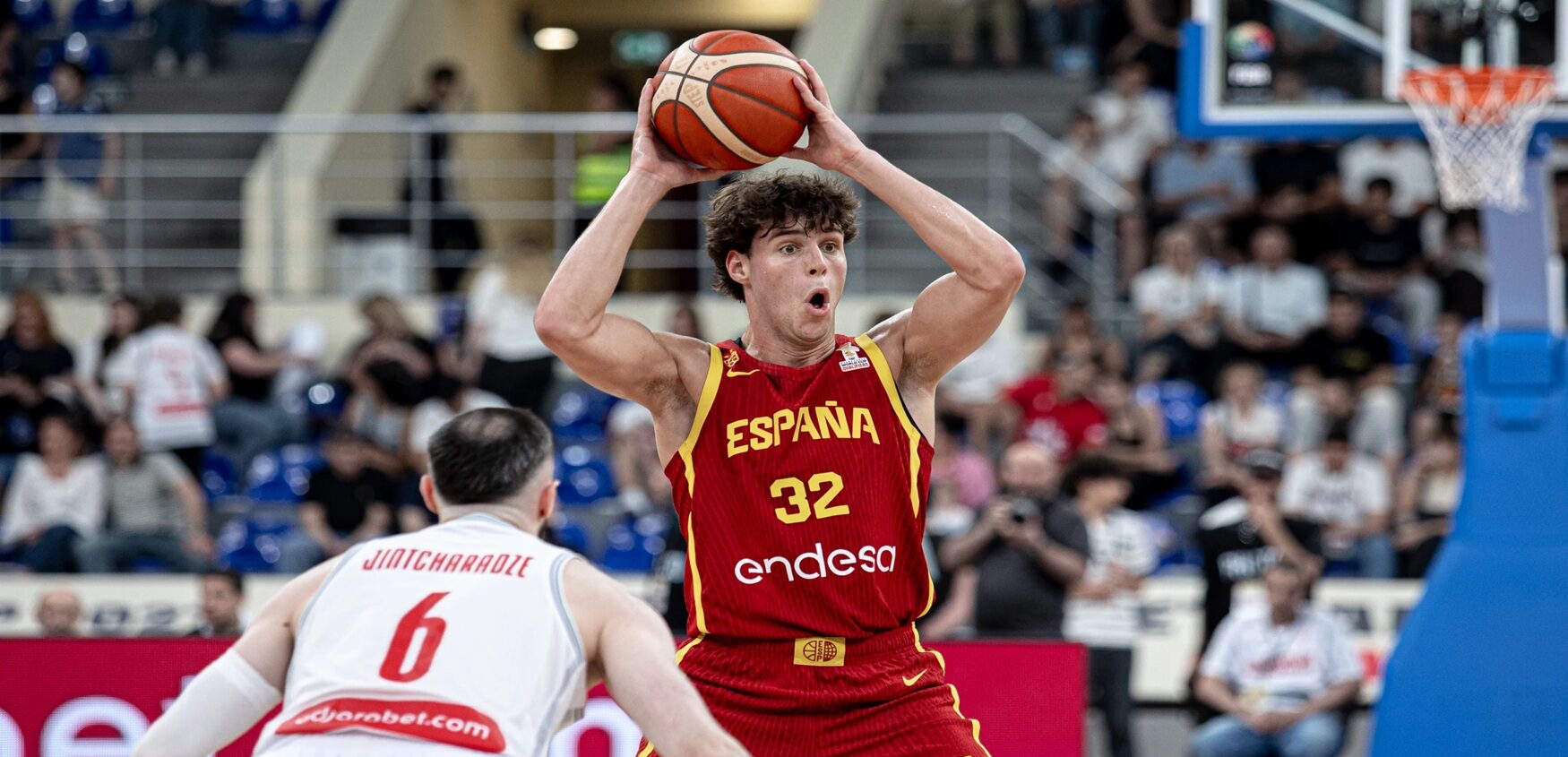
Nicknamed “The Little Prince” because of his maternal surname —his paternal surname is Fernández— and a supposed, though never confirmed, family connection to the author of the famous novel, the Málaga-born combo guard has long been viewed as one of the players capable of leading Spain’s national team back to the highest level. He already made his senior debut at 2025 EuroBasket under Sergio Scariolo and recently featured in Spain’s latest FIBA World Cup qualifying window under new head coach Chus Mateo.
Saint-Supéry is a different kind of player: fearless with the ball in his hands and blessed with an offensive creativity rarely seen in Spanish basketball in recent years, where hard-working role players have become increasingly common but genuine game-changers remain in short supply.
A product of Unicaja’s academy, he never quite found the opportunity to establish himself with his hometown club, which was entering the most successful period in its history under Ibon Navarro. Instead, he spent two seasons on loan —first with Tizona Burgos in Spain’s Primera FEB during the 2023-24 campaign, then with BAXI Manresa in the Liga Endesa in 2024-25— where he continued his steady development under coach Diego Ocampo, whose willingness to trust young players proved instrumental in his growth.
He then followed the path of many elite European prospects by moving to Gonzaga, attracted by the opportunities created through NIL and the NCAA system. Unlike the overwhelming majority of those players, however, he returns to Europe after just one season. And not because he failed to find his place in the United States, but because Valencia Basket has identified him as one of the cornerstones of its new sporting project.
Regardless of the immediate impact he may have on the court —his transition to EuroLeague basketball could well require patience— Saint-Supéry’s arrival should be viewed as a strategic statement. Valencia Basket has consistently been one of Spain’s smartest operators when it comes to recruiting domestic talent, and by securing one of the country’s most exciting young players on a four-year contract, the club is making its ambitions unmistakably clear.
After losing Montero, Badio, Pradilla and De Larrea, this signing feels almost like an act of defiance. It is an unexpected but highly calculated move, bringing back a player from a market that few European clubs have dared challenge. Valencia Basket has delivered a clear message to the rest of Europe: its project remains very much alive, and it intends to compete with the continent’s elite.
For Spanish basketball fans, who are increasingly eager to see homegrown stars emerge in a league dominated by international talent, the arrival of “The Little Prince” in orange will become one of the season’s biggest storylines. After all, the evolution of Mario Saint-Supéry could play a significant role in shaping the future of Spain’s national team.