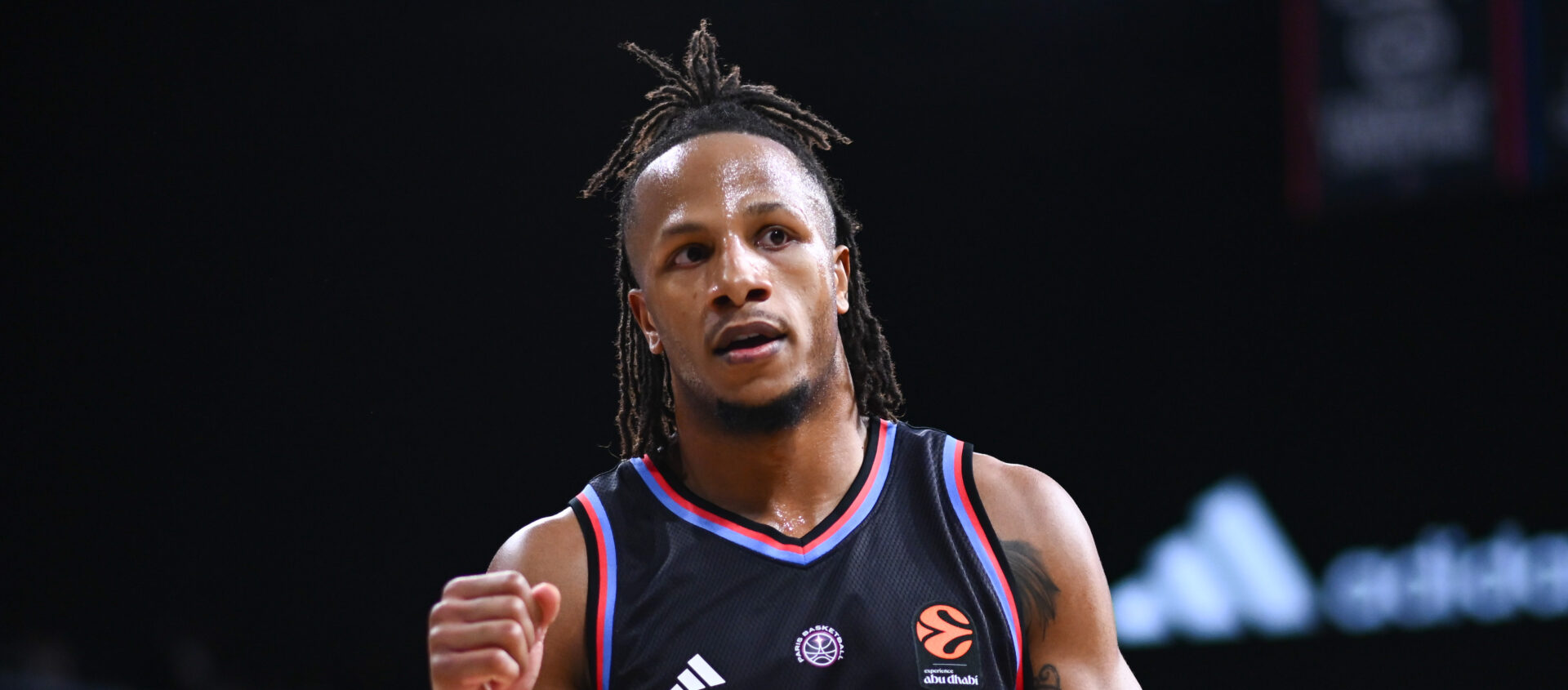

Kevarrius Hayes broke the ice, and now Partizan are beginning to line up their signings and put together the roster for next season. After signing captain Vanja Marinković to a new contract, the Belgrade club officially announced two more players: Paris forward Lamar Stevens and Italian point guard Alessandro Pajola.


Pajola’s arrival deserves a separate look. This one is about the former Cleveland Cavaliers, Boston Celtics and Memphis Grizzlies forward who spent last season with Paris…
First in Line for the Toughest Assignment
When Joan Peñarroya begins handing out defensive assignments, Stevens will likely be first in line for the best perimeter scorer on the opposing team. He is not coming to Belgrade as a direct replacement for Isaac Bonga. They differ too much in size, style and offensive responsibility for that comparison to work in full. Still, Stevens is expected to take over the most demanding part of Bonga’s old job.


Bonga could guard anyone from point guards to power forwards. He helped initiate the offense and used his length to close passing and driving lanes that already appeared open. Stevens operates differently. His defense is built less around wingspan and more around strength, footwork and the ability to absorb contact without losing position. Peñarroya should have someone he can send after a dangerous guard or wing without having to reshape the entire defense around that matchup.
Former Cleveland coach J.B. Bickerstaff once called Stevens “a hell of a one-on-one defender” after assigning him to slow down Shai Gilgeous-Alexander. Bickerstaff pointed to his strength and persistence, particularly the way he made one of the NBA’s best scorers work for every point.
Stevens is not a gambler who constantly jumps into passing lanes in search of steals. Most of his work begins with positioning. He tries to stay square, take away the first driving angle and force the scorer into a more difficult shot than the one he originally wanted. There is little mystery to it. He competes, accepts contact and rarely gives up on a possession after being beaten by the first move.
That matters in the Euroleague, where many of the best scorers are no longer small guards who depend entirely on a screen to create an advantage. A growing number have the size to punish a switch, take a weaker defender into the post or simply rise over him. Stevens can handle those matchups without Partizan having to send help on every possession.
He will not be a full-time answer against the quickest point guards, and traditional centers will still be too much for him over longer stretches. Between the shooting guard and power forward positions, however, there are not many assignments he cannot at least handle for a few possessions.
A Natural Defensive Partner for Hayes
Smaller lineups should give Peñarroya another option. Stevens can play power forward and switch across several positions, especially next to a mobile center who is comfortable defending higher up the floor. His strength should make it harder for opponents to turn every switch into an automatic post-up.
Alongside Hayes, he could be part of a defensive pairing with a fairly clear division of responsibility. Stevens can start on the primary perimeter scorer and funnel him toward the help, while Hayes uses his mobility and leaping ability to cover space closer to the rim.
What Partizan Must Replace Around Him
There are limits to how far that idea can go. Stevens will not fix Partizan’s defense by himself. He is not a rim protector, nor does he have Bonga’s length when rotating from the weak side to clean up a teammate’s mistake. Once the first line is broken, his influence becomes smaller. His value will therefore depend in part on the discipline of the other four players, particularly in pick-and-roll coverage and when finishing possessions with a rebound.
Rim protection is not one of his strengths. Neither is rebounding at a level that would automatically solve Partizan’s problems when he plays power forward. This is where another important distinction from Bonga appears. Bonga did more than take the most difficult defensive matchup. He rebounded, pushed the ball after misses, occasionally brought it up himself and helped connect different parts of the offense. Stevens averaged 3.3 rebounds and fewer than one assist in roughly 20 minutes per game with Paris. If Peñarroya uses him regularly at the four, Partizan will have to recover some of that rebounding through the center, guards or the other wing.
He will not reduce the workload of the primary ball handlers the way Bonga occasionally could, either. Stevens can make the next pass, but the offense should not rely on him to organize possessions.
The Shooting Percentage Does Not Tell the Whole Story
That end of the floor is the less polished part of his game, although he is far from harmless. His shooting numbers in Paris were particularly interesting. Stevens made 41.7 percent of his 3-point attempts in his first European season, a figure that suggests a high-level shooter until the volume is considered. He made 20 threes on 48 attempts.
That is not enough evidence to say he has fully corrected one of the weaknesses that followed him through the earlier stages of his career. Stevens shot 28.7 percent from deep in the NBA and 27.6 percent at Penn State.
The question is not whether Partizan can turn him into a high-volume shooter. It does not need that. Partizan needs him to make enough open shots that defenses cannot leave him unattended and clog the lane. Away from the 3-point line, his offensive responsibilities should remain fairly simple. He can crash the offensive glass, cut behind a defense that loses sight of him, finish in transition and use his strength against a smaller defender. He handled the ball more often in college and finished a large share of Penn State’s possessions, but he never became a creator at the professional level.
Paris did not ask him to run secondary pick-and-rolls or consistently manufacture offense late in the shot clock. He is better when he receives the ball with an advantage already in place and makes a quick decision: shoot, attack the rim or move it to the next teammate.
A Difficult Introduction to European Basketball
His first season in Europe should not be judged only by averages of 9.3 points and 3.3 rebounds. A foot injury cost him training camp and the first 12 rounds of the Euroleague season. He did not debut until late November, by which point his teammates had already spent two months practicing and playing within the system.
He still found a place in the Paris rotation and became a dependable contributor by the end of the season. Partizan is getting a player with a year of European experience behind him rather than someone learning the competition from the beginning. That should matter for a player expected to handle major defensive responsibility immediately.
Before Defense Became His Profession
His path toward that role did not begin in professional basketball. Stevens grew up near Philadelphia in a family with its own history in the sport. His father, Lou Hudson, scored more than 2,000 points at Widener University and often worked out with Lamar before school. Stevens later admitted that he was not particularly good when he was younger. He was mostly taller than the other children.
He also played football and baseball. His basketball development accelerated only when he committed fully to the sport. At Penn State, he became one of the most important players in program history. Stevens started all 135 games over four seasons and finished with 2,207 points, only seven short of the school record. His final opportunity to break it disappeared in 2020, when the conference and NCAA tournaments were canceled because of the pandemic.
He was neither a supporting player nor a defensive specialist in college. Stevens averaged 16.3 points and 6.5 rebounds and regularly had the ball late in games. He was selected to the All-Big Ten first team twice, then led Penn State to the 2018 NIT championship and was named the tournament’s most valuable player. Even then, Stevens spoke about wanting to guard all five positions. Publicly, however, he was still known first as Penn State’s leading scorer.
There is another side to his Penn State story. During his senior year, Stevens wrote a children’s book titled “Lamar’s Climb: A Journey to Happy Valley.” Six people with special needs connected to the basketball program helped create the illustrations. After the game in which the book was presented, he stayed for more than two hours to sign copies.
The NBA Forced Him to Redefine His Value
The NBA forced him to reconsider how he measured his value. Stevens went undrafted in 2020. Cleveland gave him a two-way contract before eventually converting it into a standard deal. He spent five seasons in the league and played 220 games for the Cavaliers, Celtics and Grizzlies, usually without secure minutes or a permanent place in the rotation.
He left Penn State accustomed to getting the ball when games were being decided. To stay in the NBA, he had to accept that his most valuable work would often happen while someone else had it. In Cleveland, Stevens became the original face of the team’s internal “Junkyard Dog” award. The coaching staff used it to recognize the player who competed with physicality, accepted difficult assignments and handled work that was not always visible in the box score.
That part of his career says more about Stevens than his NBA scoring average of 5.6 points. He changed roles without behaving as though defensive and supporting work was beneath him. Later, when his career moved between the G League, 10-day contracts and another attempt to earn a place in Memphis, the same approach kept him in the league.
Partizan Has Already Defined His Role
He will not have his old college freedom in Belgrade. Partizan will not ask him to be the first or second offensive option, and he will not be expected to rescue broken possessions through isolation play. His work will be much closer to what kept him in Cleveland and what Paris later asked him to do.
Partizan has found the player who should stand first in front of the opponent’s leading perimeter scorer. What happens around that assignment will depend on the teammates chosen to cover the areas his game does not naturally provide.