










Alongside the surprising relegation of Dreamland Gran Canaria, the other team to drop out of the ACB this season was Covirán Granada. Yet, somewhat remarkably, one of the members of the ACB First Team of the season plays for the Andalusian club, alongside Mario Hezonja (MVP), Jean Montero, David DeJulius and Timothé Luwawu-Cabarrot.


That player is Luka Božić, a 30-year-old Croatian power forward who averaged 16.2 points and 6.6 rebounds per game while posting a league-best 24.3 efficiency rating —the highest average in the ACB over the last 18 seasons—. Those numbers made him the most efficient player in Spanish basketball and, in fact, the fan favourite in the MVP voting. However, the votes of coaches, media members and other experts tipped the scales in favour of Hezonja.
There is little doubt that Granada’s relegation hurt Božić’s MVP candidacy. The player himself expressed his frustration on Instagram, saying he was “highly disappointed with the ACB MVP award selection… but sometimes you can’t go against politics.” Still, the question remains: how does a player from a team that finished bottom of the standings —effectively doomed months before the end of the season and officially relegated with three weeks still to play— end up among the ACB’s best five?


Statistically, Božić’s season was outstanding, especially down the stretch. In fact, the Croatian matched an ACB record that had belonged exclusively to Arvydas Sabonis since the 1991-92 season. Back then, the Lithuanian legend, playing for Forum Valladolid — his first team in Spain, after recovering from his devastating Achilles tendon injury and before joining Real Madrid—, recorded at least 27 efficiency points in 12 consecutive games. A feat nobody had been able to replicate for 35 years.
Until Luka Božić.
Born in Bjelovar in 1996, during Croatia’s post-war years, Božić’s first sporting passion was taekwondo — perhaps the source of his ability to absorb contact. He did not stay in the sport for long, though—. At age nine, encouraged by a neighbour, he began playing basketball, and completely fell in love with the game after watching Space Jam for the first time.
On the court, Božić is an old-school power forward: extremely effective in the low post, capable of scoring from mid-range and beyond the arc, though not a particularly dangerous three-point shooter. Despite a style that can sometimes appear predictable to opposing defenses, his toughness and competitiveness have made him one of the ACB’s breakout stars this season.
This was his second year in Spain after making his debut with Hiopos Lleida on loan from Valencia Basket. In the summer of 2025, Valencia terminated the final year of his contract after head coach Pedro Martínez showed little interest in keeping a player originally signed when Álex Mumbrú was still in charge.
Božić’s remarkable statistical explosion can be explained by an extraordinary stretch between Rounds 22 and 33, when he accumulated 391 efficiency points —an average of 32.6 per game—. His game-by-game figures were as follows: 33 (vs. Manresa), 30 (at Valencia), 35 (vs. Lleida), 32 (vs. Girona), 33 (at Murcia), 27 (vs. Unicaja), 29 (vs. Andorra), 33 (at Bilbao), 32 (at Zaragoza), 35 (vs. Barça), 37 (at Baskonia) and 35 (vs. Tenerife).

Such numbers belong to a different era. Before the age of load management and increasingly congested schedules, elite players routinely logged heavy minutes, making it easier to approach these kinds of records. Sabonis’ streak, for example, ran from January to March 1992 and featured an average efficiency rating of 35.9.
It is also worth noting that the unforgettable Lithuanian center produced another streak of 11 consecutive games with at least 27 efficiency points in 1995 as a Real Madrid player —shortly before leading Los Blancos to the EuroLeague title—. That run was even more astonishing, as he averaged 42.4 efficiency points per game.
In 2026, however, a stretch like Božić’s is a genuine rarity. Over those final 12 games, he averaged roughly 30 minutes per contest, making his production all the more impressive in today’s game.
Before arriving in Spain, Božić was already a major figure in Croatian basketball. He won back-to-back ABA League MVP awards with KK Zadar, where he played two separate spells. It was during the second stint that he truly blossomed and attracted the attention of Valencia Basket.
His career also includes stops at Bosnia’s Široki and Montenegro’s Budućnost, after developing as a player at KK Zagreb. He arrived there at the age of 18 largely out of necessity.
“I come from a poor family,” he recalled in an interview with IDEAL. “My mother told me: ‘If you’re going to stay at home, you’ll need to earn money to help pay the bills. You can either do that or move to Zagreb.’ So I left to make a living.”
In the same interview, Božić highlighted coach Danijel Jusup as the key figure in his development after a difficult start in the Croatian capital. Years later, perhaps not coincidentally, Božić’s two ABA League MVP awards came with Jusup coaching Zadar.
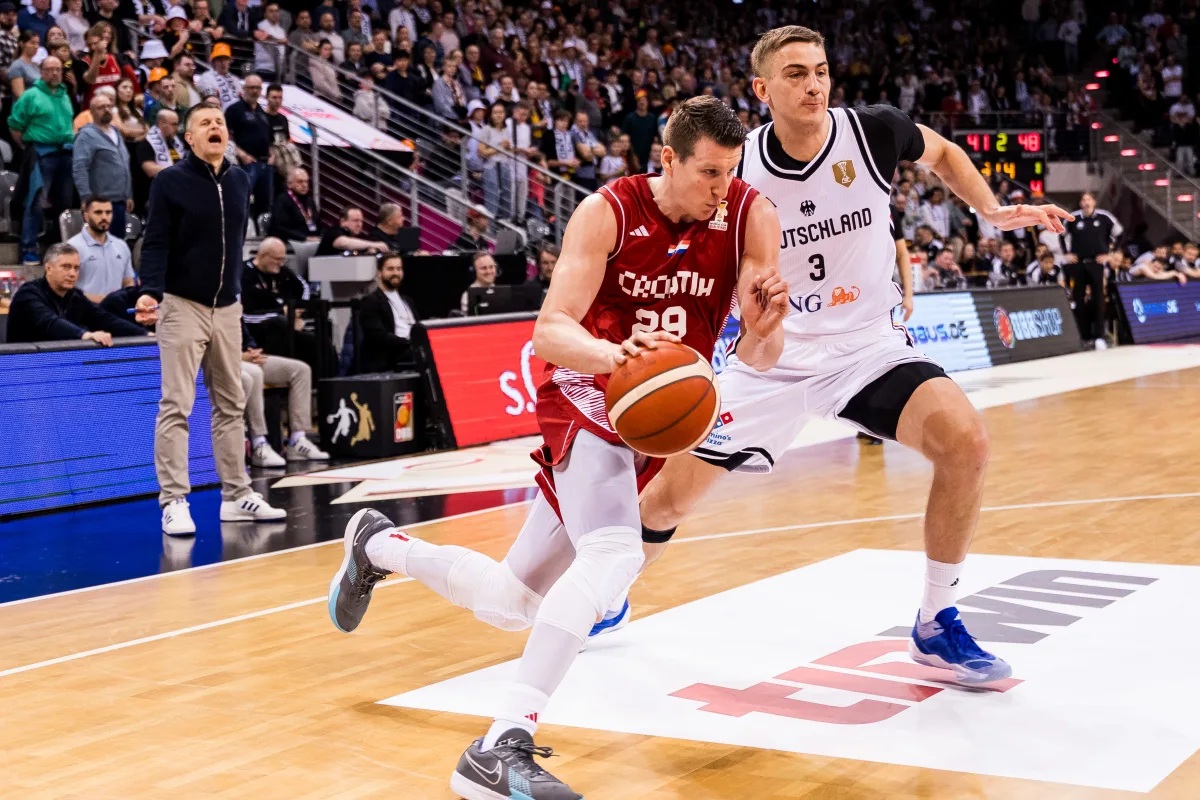
Now, following Covirán Granada’s relegation, Božić is set to become a free agent this summer. He signed a two-years contract with the Andalusian club, but the team’s relegation allows him to leave the deal early. He enters the market at the peak of his career after excelling in what is widely regarded as Europe’s strongest domestic league.
Known for his serious and reserved personality — “I’m not someone who spends time in cafés or lying in the sun. If you want to talk to me, the easiest way is probably while we’re training together!” he told IDEAL — the Bjelovar native came painfully close to surpassing Sabonis’ record.
Ayer fue el cumpleaños de un auténtico MVP 🎂
Un MVP que repite por segundo mes consecutivo…🏆 ¡LUKA BOZIC, MVP de ABRIL de la #LigaEndesa!
1⃣8⃣,5⃣ puntos
3⃣,5⃣ asistencias
7⃣,5⃣ rebotes
3⃣0⃣,3⃣ de valoración| @CoviranGranada pic.twitter.com/6EvcLZEppj
— Liga Endesa (@ACBCOM) April 30, 2026
In Granada’s final game of the season, a 110-105 road loss to San Pablo Burgos, his streak ended when he posted “only” 24 efficiency points, finishing with 15 points, six rebounds and seven assists. Had he reached 27 once again, he would have extended the run to 13 consecutive games and broken the record held by the legendary Lithuanian center.
Regardless, Luka Božić delivered a sensational season, as his numbers clearly show. It may be little consolation in a year that ended in relegation, but matching Arvydas Sabonis is an achievement that not so many players can claim.