







Can an algorithm identify the next superstar before anyone else? Can data uncover a hidden gem that traditional scouting overlooked? In today’s basketball landscape, the answer is increasingly yes.


Who is Who
Clutch Data is a basketball consultancy that helps basketball organizations make better decisions through customized, data-driven insights. The company was founded in 2022 by Sebastian Buzzalino and Thierry Aymerich, who met while completing a Master’s in Basketball Analytics in Spain and saw an opportunity to bridge high-level data science with practical decision-making in European professional basketball.
Sebastian studied Industrial Engineering at the National University of La Plata (Argentina) and briefly played professional basketball in Argentina’s second division. He has been passionate about numbers and data-driven decision-making since an early age, starting with hand-drawn shot charts for his basketball team before moving into modern data analysis methods.


Thierry holds a degree in Statistics from the University of Perpignan (France) and an MBA in Sports Big Data, and drives the strategic vision behind Clutch Data’s advanced analytics. He previously spent over 15 years leading data projects in the healthcare sector at Real Life Data, Atrys Health and Cegedim.
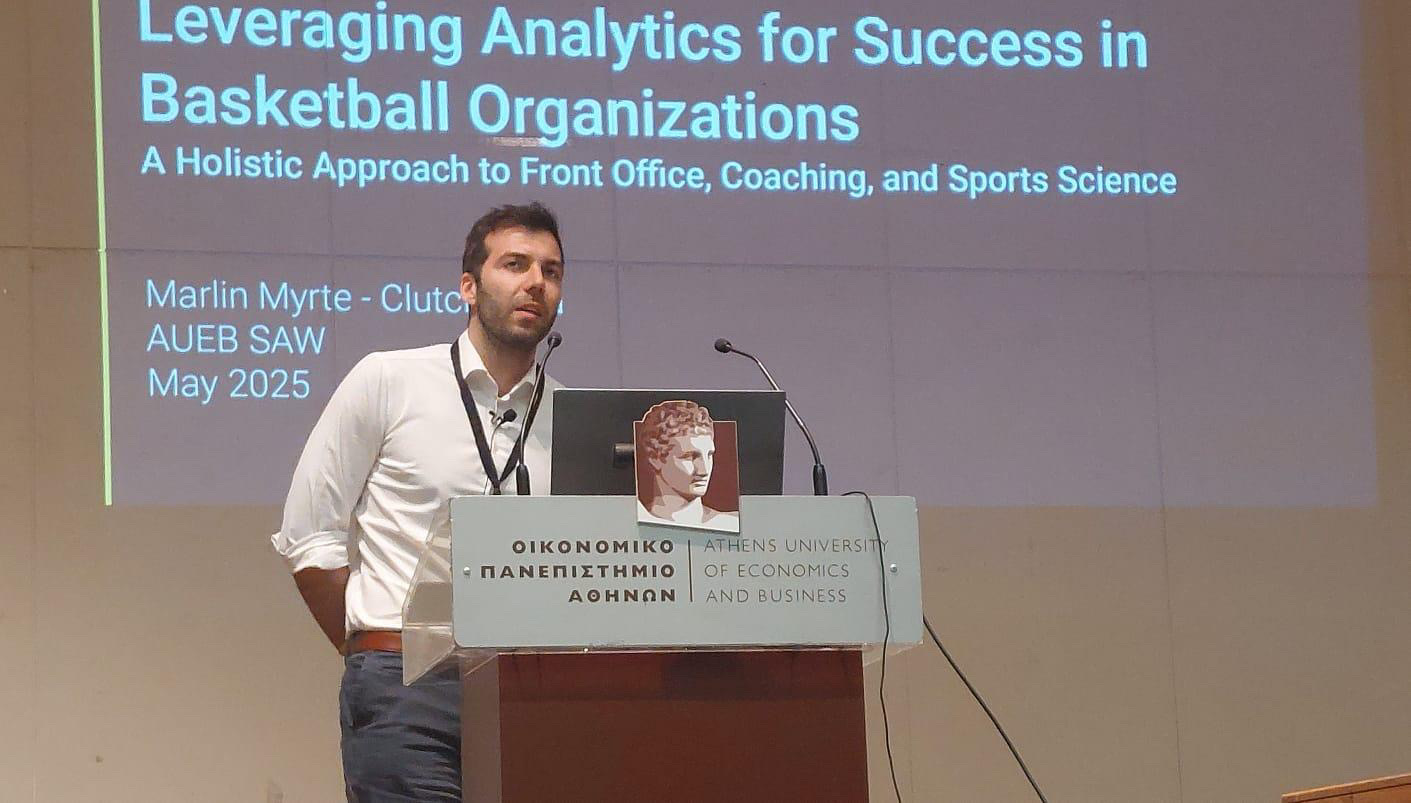
About three years ago, Marlin Myrte joined the team to strengthen its Data Science and Research capabilities. Marlin holds a Bachelor’s degree in Economics from Athens University of Economics and Business and an MSc in Big Data & Business Analytics from ESCP Business School (France, Germany), and is also a Lecturer of Sports Analytics at ESCP, where he trains the next generation of analysts to apply data science to real-world sports problems.

What They Do
Clutch Data specializes in applying advanced analytics to uncover the factors behind on-court performance. By integrating proprietary metrics with existing data tools, the company delivers strategic support and high-value reporting that streamlines scouting workflows, optimizes roster construction and supports decision-making for professional teams and organizations worldwide.
Clutch Data has worked with basketball teams across all levels, from lower-division clubs to EuroLeague teams in Spain, Argentina and Germany, as well as women’s basketball teams and basketball federations.
One of the company’s biggest milestones came in March 2026, when its research paper was selected for the MIT Sloan Sports Analytics Conference, widely regarded as the most influential event in sports analytics, putting Clutch Data on the world’s biggest stage in the field. The research, titled “Scouting Anyone: Probabilistic Player Archetypes for Any League,” addresses a core limitation of traditional scouting models, which often rely on rigid positional labels that fail to capture the fluid nature of the modern game.
What are “basketball analytics”?
Basketball analytics is the use of advanced statistics and data models, beyond traditional stats like points, rebounds, and assists, to analyze the game. Broadly speaking, it is a decision-support tool for both coaching staffs and the Front Office. These decisions can range from evaluating team or player performance on the court and tactical preparation for a specific opponent or playoff series, to roster construction and much more. It isn’t just about raw numbers; it is a framework designed to measure on-court action with far greater precision than the eye test allows.
What is the difference between traditional statistics and advanced analytics?
Traditional stats offer a quick, surface-level picture of the game: They measure what happened, but without context. They can also be misleading and are often misused. The most common mistake is assuming that a team averaging 90 points per game is offensively superior to one averaging 80 points, simply ignoring pace. The first team might just play much faster, having more possessions, which could mean they actually execute less efficiently per possession than the second team.
Additionally, traditional stats are cumulative; they simply accrue whenever a player takes an action, without factoring in quality or leverage. For instance, a basket in a 40-point blowout counts the same as a basket in a tied game with a minute left. Advanced analytics exist to correct these imbalances and quantify the true value of an action by accounting for context, pace, opponent strength, and overall team impact.
If you had to briefly explain to a fan why analytics exist, what would you say?
Analytics exist to uncover patterns that are invisible to the eye alone. Whether it’s a flashy player who generates highlights without actually driving winning, or an under-the-radar player who serves as the team’s connective tissue, analytics highlight these details and assign accurate value to each player. All this data ultimately serves to back up the decisions made by coaches and executives.
Where are analytics used most today? Scouting, recruiting, or in-game management?
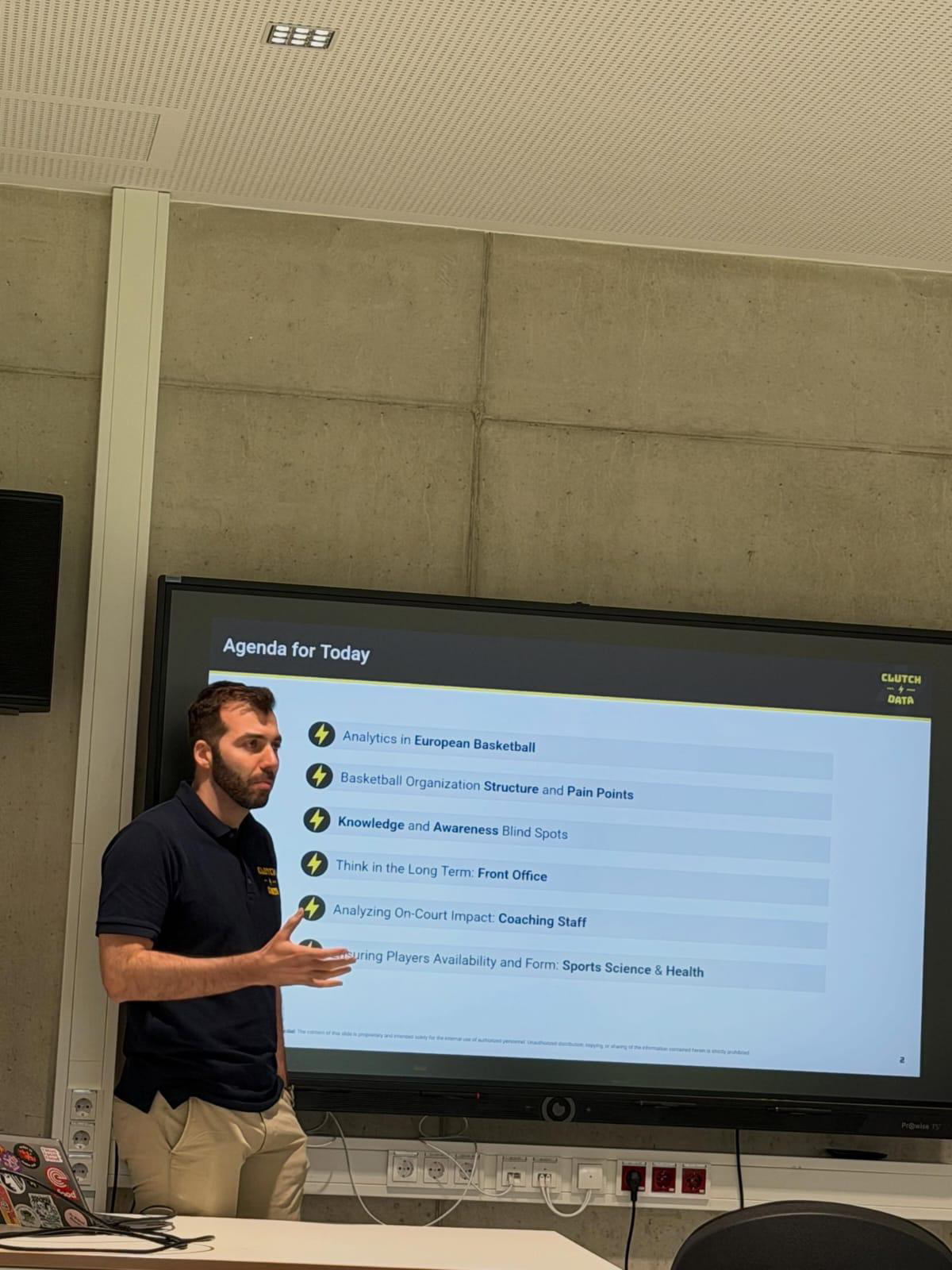
In the NBA, which is far more advanced than Europe, analytics are heavily leveraged across all three areas—from draft projections and self-scouting to opponent preparation and even live, in-game decision-making. Everyday operational and strategic decisions heavily rely on data.
In Europe, unfortunately, analytics are not used with the same depth, and adoption varies wildly. Currently, they are primarily used by assistant coaches for self and opponent scouting. However, severe time constraints during the season and a lack of technical expertise often prevent teams from diving deeper.
Can you give us a real-world example where analytics changed a team’s decision?
A macro example occurred a few years ago when analytics reshaped the entire NBA. Data models proved the vastly superior value of the 3-pointer compared to mid-range shots. This had a global impact, permanently altering playstyles, skill development, and roster construction strategies worldwide.
On a micro level, we have directly seen this with teams we’ve partnered with. One team was struggling significantly with their 3-point efficiency. Our analysis revealed that the issue escalated when two specific players, who usually played together, were off the floor at the same time. Whenever at least one of them was on the court, the team’s shooting percentage surged. By making a slight adjustment to lineup rotations to ensure at least one of them remained on the floor for most of the game, the team resolved the issue. That’s a clear example of how data-driven insights—combined with coaching trust—can solve concrete problems.
How differently does a scout view a player compared to a data model?
The human element remains crucial in scouting because it captures player intangibles—unquantifiable traits like attitude, intensity, focus, bench energy, and emotional responses on the court. Scouts also excel at evaluating how a player adapts in real-time to defensive coverage shifts and overall decision-making.
A data model, on the other hand, objectively quantifies elements a scout might miss, such as a player’s exact playstyle profile, line-up chemistry with specific teammates, or how their performance translates when scaling up to higher competition levels (e.g., College to the NBA). It serves to either validate or challenge a scout’s eye-test observations.
What are “player archetypes,” and why are we moving away from traditional positions (PG, SG, SF, PF, C)?
Player archetypes are defined by how a player actually plays. Modern basketball is shifting toward a positionless style, with players possessing skill sets that transcend traditional roles. Think of Nikola Jokić playing as a primary playmaker, undersized players guarding bigs, or Victor Wembanyama, who is a complete anomaly on his own. Moreover, two players listed at the same position can have vastly different playstyles, like Kostas Sloukas versus Thomas Walkup.
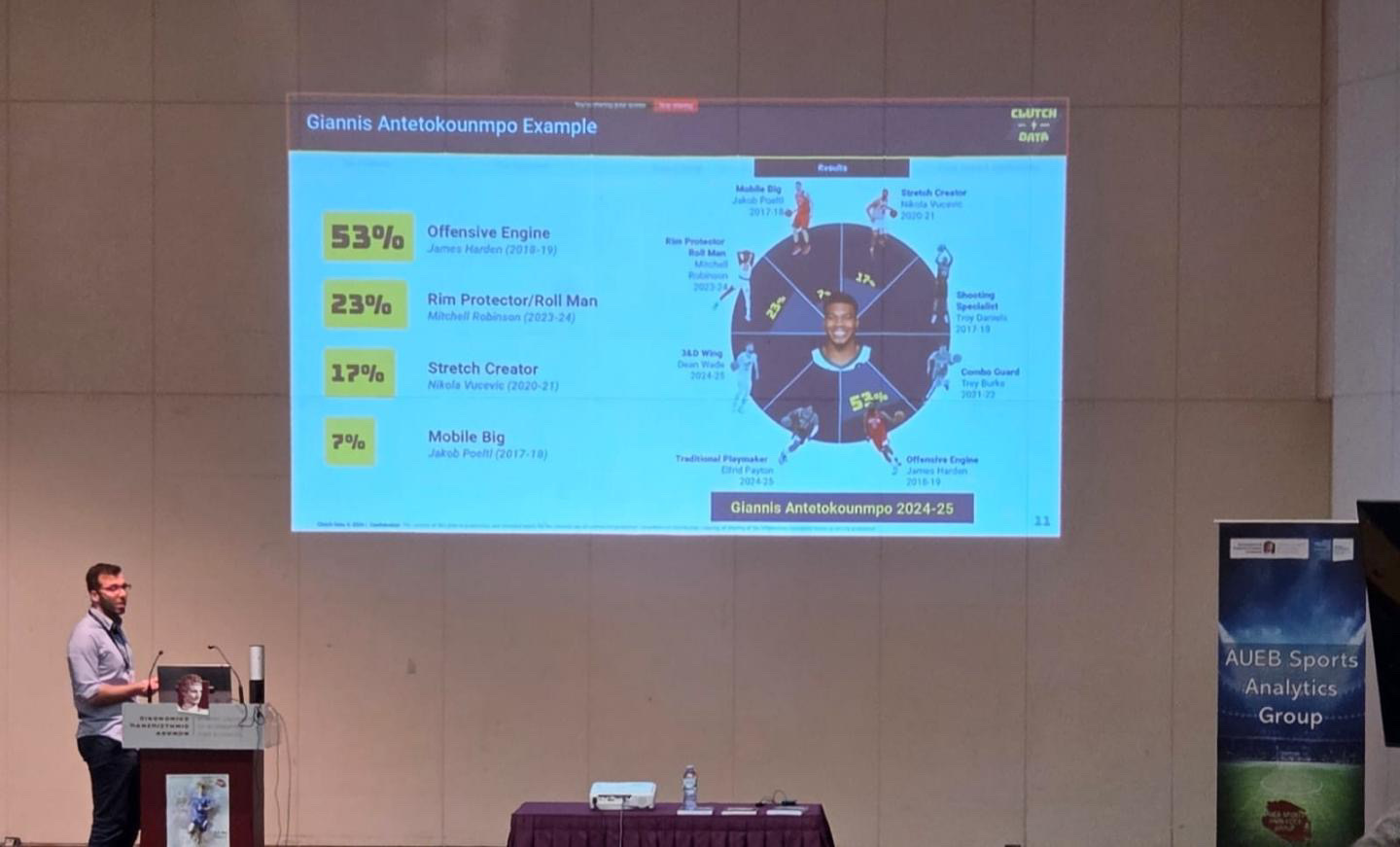
Most modern players are versatile and multifaceted, though some remain highly specialized outliers. We have mapped out these core positional building blocks (archetypes) and use our models to define every other player as a combination of them. For instance, our model identifies James Harden as an “Offensive Engine” archetype and Nikola Vučević as a “Stretch Creator.” It then projects that Giannis Antetokounmpo’s playstyle is roughly 53% similar to Harden and 17% similar to Vučević. This makes player comparisons far more precise and helps front offices make smarter roster construction decisions.
Can analytics ever replace a head coach’s experience?
Absolutely not, and this is something we emphasize to every organization we consult with. Data can never replace a coach’s ability to read team chemistry, manage locker room dynamics, or navigate a player through a high-pressure moment. Ideally, the two should complement each other. Analytics serve as a tool for coaches to test their hypotheses, eliminate blind spots, and make better-informed decisions. The most successful coaches use analytics as a decision-support system, not a substitute for judgment, especially given the overwhelming number of decisions they face throughout a season. Analytics are there to reduce risk and add clarity.
Are there cases where the data contradicts the eye test?
It happens all the time. A classic example is a player who looks mediocre in the basic box score but boasts an elite net on/off rating over a large sample of games, meaning the team performs significantly better whenever they are on the floor, even if their impact isn’t flashy.
These disconnects are often amplified by human cognitive biases. In basketball, small sample bias is very common, where people rush to conclusions after just a few games early in a season. Recency bias is another factor, where recent events overweight judgment, as well as confirmation bias—such as holding a preconceived notion that “Player X can’t switch on defense” and only noticing the plays that support that belief.
Are there aspects of the game that still cannot be measured?
Beyond intangibles like leadership and vocal communication, defensive impact remains the hardest thing to measure accurately. Analytics track events that occur, whereas elite defense is often defined by preventing things from happening in the first place. For example, a sharp closeout that deters a wide-open 3-pointer and forces a pass, or textbook pick-and-roll coverage that denies an opponent their primary option—these won’t show up on a stat sheet, even though they are vital. That said, advanced estimation models are constantly improving to capture these hidden impacts.

How far behind is European basketball compared to the NBA?
We often say that European basketball currently sits where the NBA was in the early 2010s—a period when NBA teams were just beginning to adopt analytics and build out dedicated data departments. This gap comes down to two factors: technology and culture.
Technologically, the NBA relies on advanced optical tracking cameras in every arena that capture real-time spatial data for all players and the ball. Analysts can measure exact spacing, defensive contest distances, player speed, and player movement, unlocking deep contextual insights. In Europe, we are largely restricted to basic play-by-play data—which varies in detail across leagues—and offers no visibility into off-ball action. Even basic play-by-play data can sometimes be hard to acquire. The upside is that once tracking technology is deployed in Europe, the analytics gap can close rapidly.
The second, and more significant barrier, is cultural. European basketball remains traditional and old-school. Decision-makers (coaches, GMs) rely heavily on experience and remain hesitant to embrace data-driven approaches, despite their proven track record elsewhere.
What is the biggest evolution you foresee in the next 5 years?
The biggest leap will come from a convergence of the factors mentioned above. A new generation of tech-savvy coaches and executives who embrace data is stepping up, driving the demand for better technology. Simultaneously, initiatives like NBA Europe, increased investment in European basketball, and the influx of talent with NBA experience will significantly accelerate this transition.
Do you believe every EuroLeague team will eventually rely on dedicated data departments?
That is certainly the hope, and two or three teams have already started building them. Analytics provide a massive competitive advantage. Once that edge is consistently demonstrated on the court, every team will inevitably be forced to adapt and establish their own analytics operations.
What is the next goal for Clutch Data?
Our main goal is to play a leading role in modernizing European basketball. We’ve noticed that one of the biggest bottlenecks is a general lack of understanding regarding analytics and their practical value among both organizations and fans. We want to show teams how data can be used strategically to gain an edge. Through our public analyses, keynote speeches, and presentations, our mission is to educate and elevate everyone who loves watching and understanding the game at a deeper level.