









The events now known as “windows,” which are simply the qualifiers for tournaments—in this case, the Mundobasket 2027—include surprise players or simply… unique cases, whom we might never have seen if the “good” players weren’t resting during the summer break.


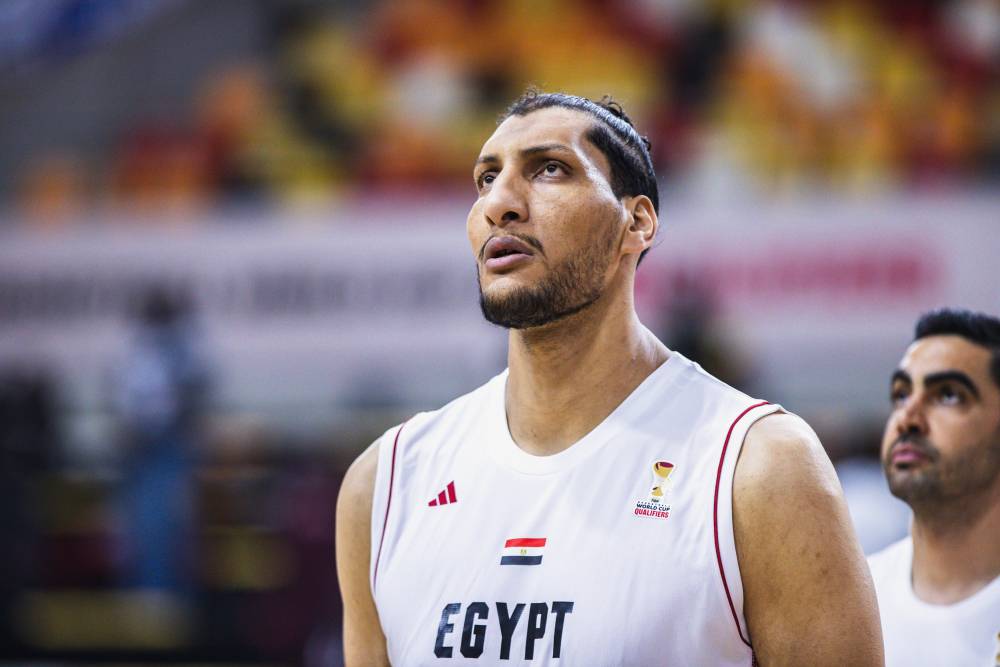
One of them is Hamad Abouelrish, the center for the Egyptian national team, who appeared in the 2027 World Cup qualifiers and… stands at 2.35m. That’s even taller than two legendary NBA figures, Gheorghe Mureșan and Manute Bol, who were listed at 2.31m. The 34-year-old Egyptian played for seven minutes in his country’s 78-70 loss to Mali, without scoring and grabbing just… one rebound.
Egypt’s 🇪🇬 Hamad Abouelrish is standing at 2.35 cm (7’8’’) 😨#FIBAWC pic.twitter.com/esGxUXAYS7
— FIBA Basketball World Cup 🏆 (@FIBAWC) July 2, 2026
He raised many questions about his basketball abilities, as well as quite a bit of… laughter. He seemed to struggle significantly to follow plays, contest for the ball, and defend. As we say, he can’t… turn. Many were quick to point out that this case serves as evidence for the view that just being tall is not enough to play and perform in basketball.
This is not just a basketball sentiment, but something that has also been shown in research. The study by Ivan Zarić, Filip Kukić, Nemanja Jovićević, Milan Zarić, Milan Marković, Lazar Toskić, and Milivoj Dopsaj, titled “Body Height of Elite Basketball Players: Do Taller Basketball Teams Rank Better at the FIBA World Cup?”, examined 960 players from the 2010, 2014, and 2019 FIBA World Cups. The conclusion was that the higher-finishing teams had significantly taller players in specific positions, mainly guards and small forwards, which shows that height continues to play a serious role at the top level.
A similar picture is painted by the research of Yixiong Cui, Fuzheng Liu, Dapeng Bao, Haoyang Liu, Shaoliang Zhang, and Miguel-Ángel Gómez, titled “Key Anthropometric and Physical Determinants for Different Playing Positions During National Basketball Association Draft Combine Test.” It analyzed 3,610 players who participated in the NBA Draft Combine from 2000 to 2018, with drafted players being superior overall in height, wingspan, reach, jump, agility, and sprint compared to those who were not selected. Simply put, in modern basketball, it’s not enough just to be tall; that height must also be accompanied by athleticism.
Furthermore, when we talk about extreme heights, such as 2.20m and above, the conversation changes slightly. The body carries a much greater burden, especially on the knees, ankles, and feet. In a study by John Orchard and Jennifer Hayes, titled “Using the World Wide Web to Conduct Epidemiological Research: An Example Using the National Basketball Association,” which studied NBA player injuries in the 1999-2000 and 2000-01 seasons, the category of players 2.20m and taller showed an injury prevalence of 22.9%, the highest percentage among the height categories recorded.
So yes, being very tall in basketball is a huge advantage. But at 2.20m and above, we’re not just talking about height. We’re talking about a body that has to endure, move, change directions, absorb contact, and stay healthy through an intense season. That’s where the truly rare cases stand out: not just the giants, but the giants who can play basketball like regular athletes.