

Four seconds remained.


Dejan Tomašević made the second free throw.
Manu Ginóbili caught the ball, threw up an off-balance shot from an impossible angle and watched it drop through the net.
Argentina 83. Serbia and Montenegro 82.
“When I caught the ball, I didn’t even want to hold it because I knew there wasn’t enough time,” Ginóbili later recalled.
“I somehow just threw it up… and it went in. I ended up lying on the floor because I couldn’t move. Then everybody jumped on top of me. I was somewhere between ecstasy and death. At one point, I couldn’t even breathe.”
The Shot That Started Everything
It was only the opening game of the Athens Olympics.
It felt much bigger.
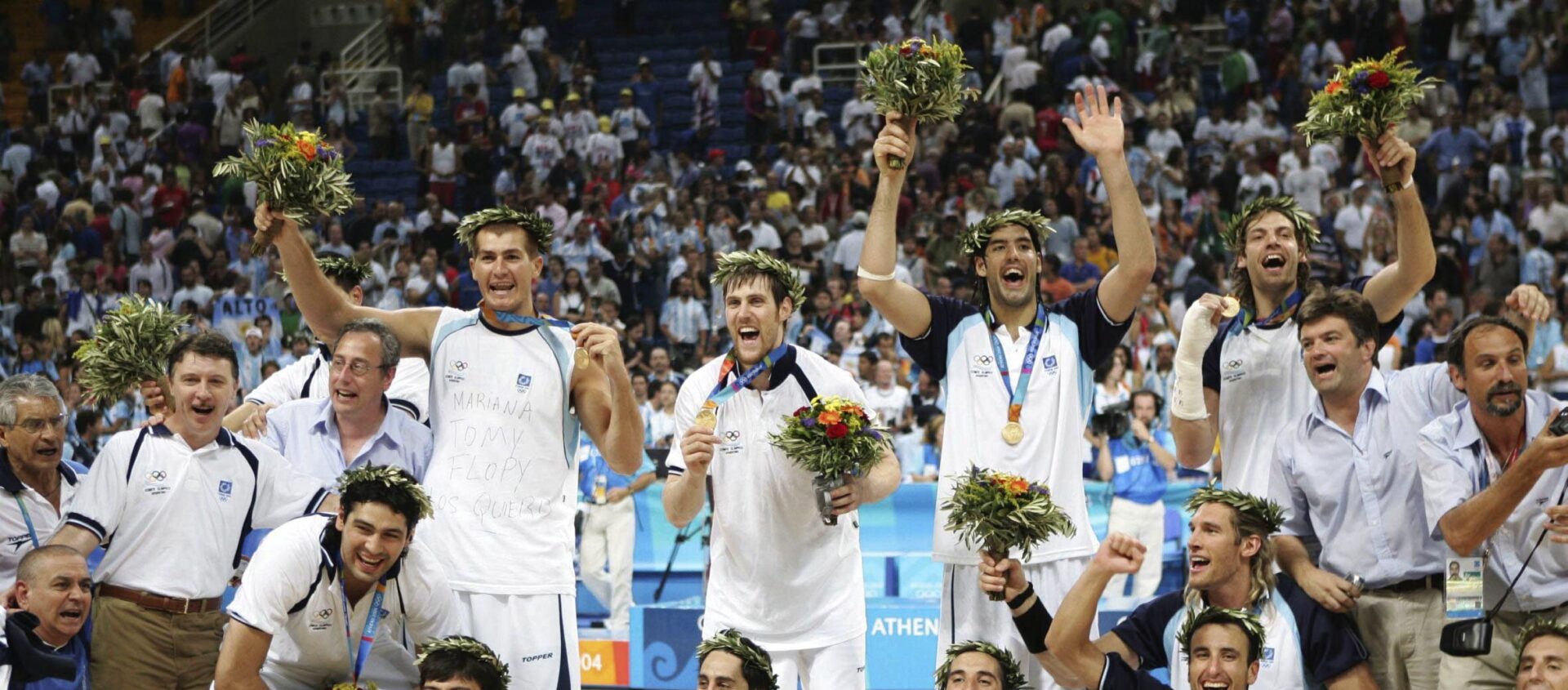
That victory became the fuel for a generation that had already captured the imagination of basketball fans around the world. A few weeks later, it captured something even greater – the Olympic gold medal.
Anyone who truly loved basketball had to smile when Argentina climbed to the top of the podium.
It simply felt right.
The 33-Hour Trip to Indianapolis
A talented, fearless group of players who trusted one another completely had finally been rewarded for years of sacrifice. The feeling was similar to Lithuania’s unforgettable EuroBasket triumph a year earlier. Now it was Argentina’s turn.
And nobody embodied that team better than Manu Ginóbili.
He was their best player, but he also represented everything they stood for.
Off the court, humble despite being an NBA star. On it, he competed with the intensity of a defensive specialist fighting for his few minutes on the floor.
When your leader behaves like that, nobody else has an excuse to do otherwise.
Not that anyone in that Argentine locker room wanted to.
They always had dinner together, regardless of whether they had won or lost. On more than one occasion, they even reached into their own pockets when the Argentine Basketball Federation couldn’t cover expenses.
Nothing illustrates that bond better than the story of their trip to the 2002 World Championship in Indianapolis.
The federation booked an itinerary so chaotic that the journey from Buenos Aires lasted nearly 33 hours.
Actually, it could have lasted 32 hours and 40 minutes.
But several players liked the idea of arriving after exactly 33 hours.
So they asked the bus driver to keep driving around Indianapolis for another twenty minutes, synchronized their watches and counted down until the moment they officially reached the hotel.
“Friendship. Above everything else,” Pepe Sánchez would later say when asked what defined that team.
Argentina’s Greatest Weapon: Each Other
The foundations had been laid years earlier.
Back in 1998, Argentina had already pushed eventual world champion Yugoslavia to the limit in the World Championship quarterfinals. They failed to qualify for the Sydney Olympics two years later, but the Golden Generation was quietly taking shape.
Everything changed in 2001.
Argentina became champion of the Americas for the first time in its history, winning all ten games. Canada was crushed by 21 points in the semifinals. Brazil lost the final by 19.
Ginóbili was named tournament MVP.
On the bench sat Rubén Magnano, a coach who, until then, had built his reputation almost exclusively inside Argentina.
It proved to be the perfect combination – and the first real glimpse of what the basketball world was about to witness.
The roster itself was unusual.
Ginóbili was the engine on both ends of the floor.
Fabricio Oberto was an old-school center playing the best basketball of his career.
Andrés Nocioni brought toughness, physicality and a willingness to do every dirty job imaginable.
Captain Hugo Sconochini provided leadership and, in many ways, became the bridge between generations.
Players like those would fit into any team.
What made Argentina different were everyone else.
Walter Herrmann, whose game often looked awkward but somehow always worked.
Gabriel Fernández and his unconventional shooting motion.
Rubén Wolkowyski, the blue-collar big man who wasn’t afraid to step outside and shoot.
Leonardo Gutiérrez, who looked more like a boxer than a basketball player.
Point guards Pepe Sánchez and Alejandro Montecchia, creative enough to run the offense but always protected by teammates who understood exactly where help was needed.
“Sometimes Manu would take only two shots all game and still be the happiest guy in the locker room. Maybe I wouldn’t even take one, and I’d be just as happy. We simply loved being together,” Oberto once said.
That was Argentina’s greatest weapon.
Not talent.
Not tactics.
Each other.
The Gold That Slipped Away
Argentina rolled through the 2002 World Championship. Russia came closest, losing by “only” 19 points. Dirk Nowitzki was held to just 3-of-17 shooting.
Then came history.
Argentina became the first team ever to defeat a United States squad made up entirely of NBA players, winning 87-80 behind another brilliant performance from Ginóbili. It was also the tournament that introduced the basketball world to Luis Scola, who quietly announced that the keys to the team would soon be his.
Brazil fell comfortably in the quarterfinals.
Sconochini and Oberto held off Germany in the semifinals, limiting Nowitzki once again despite Ginóbili playing only 15 minutes because of injury.
The final against Yugoslavia felt like destiny.
Ginóbili lasted just 12 minutes. He was nowhere near healthy and barely resembled himself.
Even without their best player, Argentina had one hand on the gold medal.
They simply couldn’t finish the job.
Standing in their way was one of the greatest national teams ever assembled – and Dejan Bodiroga.
Even today, many Argentinians insist Sconochini should have been awarded a foul on the final possession of regulation.
Maybe he should have been.
What nobody disputes is that Argentina had the gold medal in its hands and let it slip away.
Football Inside A Basketball Arena
That is precisely why beating Serbia and Montenegro in the opening game of the Athens Olympics meant so much two years later.
It wasn’t revenge.
It was confirmation. Confirmation that their time had finally arrived.
The core of the team remained unchanged, but one player had grown tremendously.
Luis Scola.
By then he had become the definition of a veteran before even turning 25. Brilliant footwork with his back to the basket, impeccable mid-range touch, endless patience and a unique ability to play at his own rhythm while remaining impossible to stop.
He dominated Spain with 28 points and nine rebounds, but Pau Gasol carried the Spaniards to victory against an emotionally drained Argentina.
China and New Zealand were beaten without much drama.
Then came another warning. Italy defeated Argentina in the final game of the group stage.
As the players would later admit, they had relaxed a little.
It made the road to gold significantly harder. Looking back, perhaps it made the story even better.
Waiting in the quarterfinals was host nation Greece.
“Greeks are hot-blooded too. They’re basically Latins,” Carlos Delfino joked.
One of Argentina’s greatest strengths was adaptability.
They could speed the game up and score in bunches. They loved sharing the ball and sacrificing for one another.
But they were equally happy to play ugly.
To fight.
To survive.
Oberto later described that quarterfinal as “football inside a basketball arena” because of the unbelievable atmosphere.
Argentina played one of its worst halves in years.
Turnovers piled up. Midway through the third quarter, they trailed by 11.
Then Magnano played his joker. Walter Herrmann entered the game.
He brought calm.
He brought energy.
Argentina never looked back.
The hosts suddenly felt the pressure, and Alejandro Montecchia buried one of the biggest shots of the tournament to seal a 69-64 victory.
“We Smelled Blood”
Next came the United States.
How realistic was it for Argentina to beat an NBA All-Star team twice in consecutive major tournaments?
Allen Iverson.
Tim Duncan.
LeBron James.
Dwyane Wade.
Carmelo Anthony.
Lamar Odom.
Stephon Marbury.
Shawn Marion.
The names alone were intimidating.
“Nocioni walked into the locker room and simply said: ‘Tomorrow we’re beating the United States,'” Oberto later remembered.
Argentina had lost to the Americans 106-73 in Olympic qualifying.
Even after defeats to Puerto Rico and Lithuania earlier in the tournament, Team USA remained the overwhelming favorite.
Before tip-off, the Argentinians stood in the tunnel singing loudly just a few meters away from the Americans.
They wanted them to hear. More importantly, they wanted themselves to hear.
Magnano’s scouting report was flawless.
Argentina controlled the game almost from the opening tip. Early in the third quarter, Ginóbili scored nine of his 29 points and suddenly the lead was 16.
The Americans fought back.
Argentina never panicked.
“We smelled blood,” Ginóbili later said.
They sensed the opportunity and understood that focus could not drop for a single second.
It never did.
89-81.
Another upset.
Another final.
As the buzzer sounded, Scola dunked the ball and turned toward his teammates, gesturing:
“The medal is ours.”
One Last Step
Most expected the final to be against Lithuania. Instead, the biggest surprise of the tournament awaited them.
Italy.
Gianluca Basile produced one of the greatest shooting performances in Olympic history, knocking down seven three-pointers – including one from nearly half-court – as Italy stunned Lithuania 100-91.
“It was the biggest game of our lives,” Montecchia would later say.
“I don’t know how we would have lived with ourselves had we lost both the World Championship final and the Olympic final,” admitted Pepe Sánchez.
“The night before the final was one of the longest of my life,” Wolkowyski recalled.
Oberto was unavailable after suffering an injury against the United States.
As always, somebody else stepped forward.
This time it was Wolkowyski with 13 points.
Scola delivered one of the finest performances of his career with 25 points and 11 rebounds. Ginóbili played all 40 minutes, finishing with 16 points, six rebounds and six assists.
Italy stayed close until midway through the third quarter. Then Argentina exploded. Montecchia buried consecutive three-pointers.
The dream became reality.
84-69.
Olympic champions.
“We’d been playing together since we were 15 or 16 years old,” Scola later reflected.
“We grew up together, overcame every obstacle together, and ended up winning Olympic gold. Honestly, if someone had told us in 1999 that this would happen, we would all have laughed.”
The celebrations looked like something out of a movie.
Not because Argentina had won.
Because a family had.
“What truly amazes me is the humility, the work ethic and the friendship of a group of people who kept growing stronger with time. They became one spirit, and decades later they’re still friends,” said Juan José Campanella, director of the documentary about the Golden Generation and the Oscar-winning film The Secret in Their Eyes.
A Football Country Finds Basketball Heroes
Athens was their peak.
They finished fourth at the 2006 World Championship and won Olympic bronze in Beijing two years later.
The flame never completely went out.
Years later, a 40-year-old Luis Scola carried Argentina all the way to silver at the 2019 World Cup, offering one final reminder of what that generation had built.
In 2004, the country of football found its basketball heroes.
And it will never forget them.