





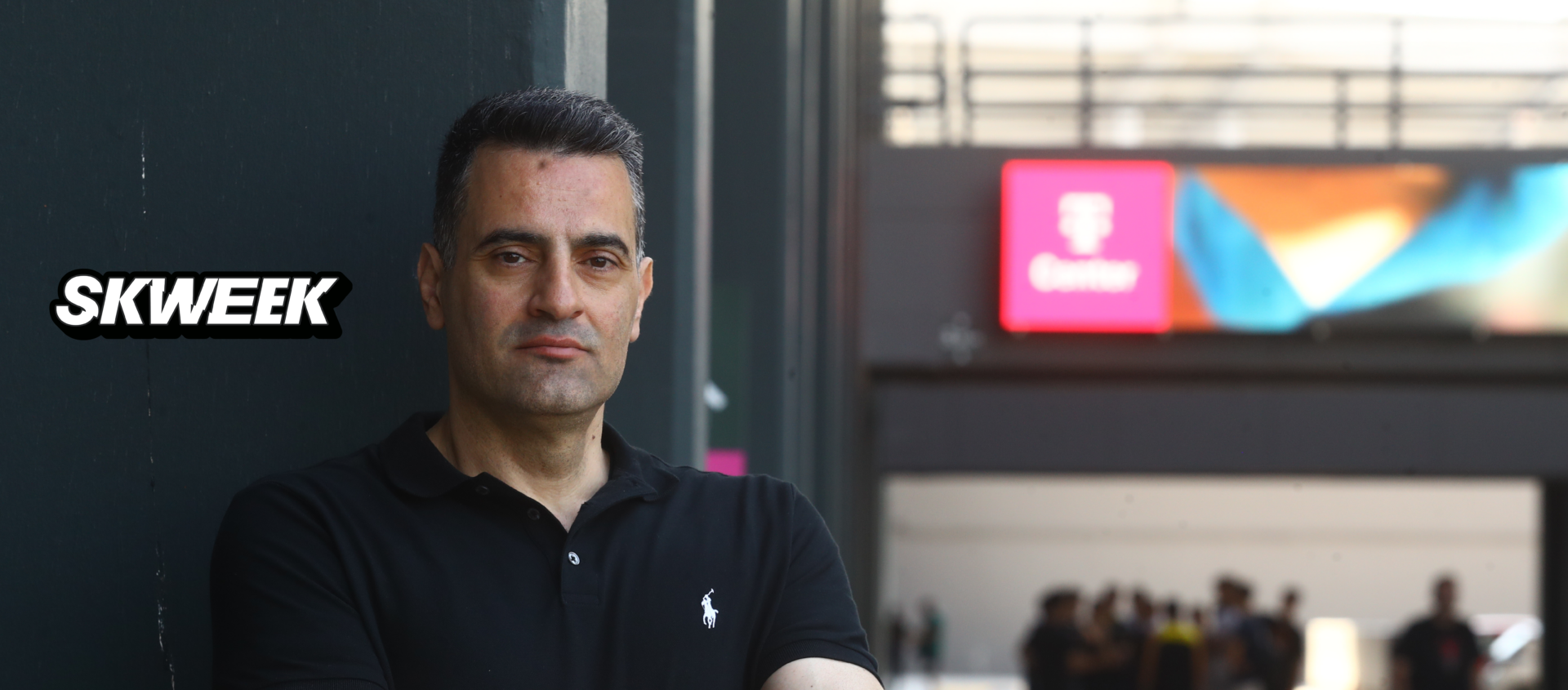
As European basketball continues to evolve at a rapid pace, CSKA Moscow finds itself in an unusual position—outside the EuroLeague spotlight for the past four years, yet still carrying the weight and expectations of one of the continent’s most historic and demanding clubs.


In this SKWEEK interview, Andreas Pistiolis opens up about what it means to operate in this environment of isolation and transition, where the challenge is no longer just about winning, but about preserving identity, standards, and mentality without the stage CSKA was built for.
From managing expectations in an organization where success was once measured almost exclusively by EuroLeague titles, to building continuity, stability, and belief in a new reality, the CSKA head coach reflects on what it takes to preserve the team’s DNA while adapting to a fundamentally different competitive landscape.

A conversation about identity, standards, and adaptation—and what it takes for a great organization to remain true to itself when everything around it is changing.
I caught myself going down paths that weren’t right for me
Have you ever felt like you were losing yourself in the pace and demands of this profession?
I wouldn’t say I’ve ever felt like I was losing myself. I’d say I’ve been evolving and changing, and I’ve always tried to make sure those changes are for the better.
There have been times when I caught myself going down paths that, in the end, I realized weren’t right for me. I gave them a chance, but I realized that wasn’t the kind of person—or the kind of coach—I wanted to be. So, I adjusted and changed course.
There’s definitely been a lot of growth and change along the way. I’ve also gone through difficult periods, both psychologically and professionally, facing some very challenging dilemmas, including ethical ones.
But looking back, I feel that throughout the entire journey I’ve managed not to lose myself. Instead, I’ve evolved, I’ve changed, and I’ve kept moving forward. I think that’s only natural.
What is the biggest insecurity a head coach at a club like CSKA Moscow deals with that people never get to see?
I think the biggest challenge—and the biggest source of insecurity—is that, in the end, you’re judged by the result. And the result is never guaranteed.
Most of the time, your job is to focus on what you can actually control and make sure you’ve done everything possible. But the outcome often depends on factors that are completely outside your control, and that’s where the real pressure comes from.
I see it in other coaches as well. When you start relying too much on things you can’t control, that’s when anxiety, pressure, and insecurity begin to creep in.
Over the years, the biggest lesson I’ve learned is to focus only on what I can control, to make sure I’ve done everything within my power as well as I possibly can, and to accept that sometimes the things outside my control won’t go my way—and there’s nothing I can do about that.
And all of this at a club where, in previous years, winning the EuroLeague defined whether a season was successful or not…
You know, one of CSKA’s mottos is that CSKA will always be first. There is always pressure that comes with results. However, I have to stress that, compared to other teams with similar expectations of winning, there is also a strong sense of understanding.
I think that over the years at CSKA, there have been certain internal standards that define what is considered a failure. The title is always the goal—the absolute success—but there are also different levels in between, where results can still be accepted, and from there your work is judged: the difficulties you faced and how you handled them.
When you win with CSKA, is it relief or expectation fulfilled? And when you lose, is it just a defeat—or something heavier?
This is something I’ve worked on a lot throughout my life. I grew up in clubs where winning was self-evident. At Panathinaikos it was the same, at CSKA the same, and even at Galatasaray—regardless of the circumstances—the expectation was always to win. In big clubs, with big expectations, that pressure is always there.
Through all of this, I’ve learned that the healthy approach is to be grateful for victory. You have to appreciate it and allow yourself to celebrate it, otherwise you don’t truly give it its value.
At the same time, you need balance, otherwise things can easily go wrong. A defeat is not a disaster. It’s not a sign that you are useless, and it is certainly not the end of the world. It’s part of the game. A loss alone has never taken me out of my “zone.” Depending on the team you are in and the level of competition, you will naturally have more or fewer defeats. Of course, after a loss, something has gone wrong—but the most difficult part for me has always been learning how to manage that situation, especially in clubs where winning feels like a given.
I’ve also learned to truly appreciate victory, because many times we would win games—sometimes against opponents considered weaker or stronger—and almost treat them like a training session that’s just finished. That is not healthy. Every win has to be respected and valued, regardless of the context.
At the same time, you cannot be blinded by victory. You have to manage good results properly and not let them hide your weaknesses or the things you still need to improve from a game.
But again, the hardest part has always been managing that emotional balance. Especially in our environment, there is often a tendency to see defeat as something catastrophic or as a sign of incompetence, which is not true. Losing is part of the game—you cannot avoid it.
I don’t want victories at any cost
What kind of coach do you never want to become, even if it brings results?
This is something I’ve been thinking about since the very first day I became a head coach.
We all make compromises, but what I’ve come to realize is that I don’t just want to win games—I want to deserve to win them. I don’t want victories at any cost. I want to win in a way that I can be proud of.
I want to be able to look my players in the eye after a game, to look at the management, to look at myself in the mirror, and even to speak to my daughter without feeling like a hypocrite or like I did something wrong. That’s why it’s important for me not just to win, but to win the right way. This is something that matters deeply to me.
I also want to treat the people I work with properly. The most important relationship is always with the players. During games, I make a real effort not to disrespect them—not to show frustration in a way that exposes them when they make mistakes, but instead to show respect to everyone: those on the court and those on the bench.
Of course, in a competitive sport like basketball, sometimes you succeed and sometimes you don’t. We are human, we have strengths and weaknesses, and we all make mistakes. But overall, I want to be a coach who deserves to win and who respects everyone around him.
Things should not be easy—but they should be done the right way, at least in the way I believe is right.
What was the moment that “broke” you as a coach—not as a failure, but as a turning point that changed your way of thinking?
Look, I think the most decisive period of my life was my first season at Galatasaray, which was also my first season as a head coach.
At that time, especially during a strong run of results, my priority and focus became managing success. I often told myself not to get carried away—not to let it distract me, to stay grounded, not to overinterpret things, and not to suddenly believe I was something more than what I was.
The following season was very difficult, with a lot of pressure. I tried hard as a person to deal with it, but no matter how challenging it was, I think it helped me learn many important lessons.
Looking back, I’m glad I went through it. I can say that I’m proud of the way I handled those difficult moments and everything I had to face.
Τhe biggest challenge for CSKA today
CSKA remains one of the biggest brands in European basketball, but for the past four years it has effectively been outside the European map. How does an organization deal with that contradiction?
Τhere are realities that have changed. There are things that need to be adjusted, such as the financial structure of the team and the level of players you can attract today. In the past, CSKA was the main destination for the best players in Europe. That is no longer the case.
But what has remained—and what we are focused on—is that CSKA must preserve its championship DNA and continue with the same seriousness and commitment it showed in the EuroLeague.
Right now, our only goal is to compete and to fight for the regional titles and championships we are part of. That is our daily work: trying to do things in the best possible way, in the most professional and committed manner, so that when the time comes to return to Europe, we are ready to carry that mentality with us.
What is the biggest challenge for CSKA today: winning titles or maintaining EuroLeague-level standards on a daily basis without actually competing in the EuroLeague?
I would say that, in a way, these two things are compatible.
Maintaining the club’s structure and organization at EuroLeague level is something that is fully under our control—and it is being done properly. CSKA remains the same top-level organization it has always been.
Internally, the standards are very high. I would even say the environment, the facilities, and the overall organization are at an ideal level. Of course, like in any structure, there are always areas that can improve, but it is unquestionably EuroLeague level. Even within the EuroLeague today, in terms of organization and know-how, there are only a few clubs that can match what we have here.
To do things properly, however, you need the mentality of a team that expects to win titles. As I said before, you need to operate as if the first step is always toward winning. That mindset is different from the EuroLeague environment itself.
The difficulty is that when the level of competition is not the same, you don’t always have that external pressure that forces you to evolve, to push further, and to constantly innovate.
Is there a danger that the organization can “get used” to being out of the EuroLeague? Or does CSKA operate every day as if it could return tomorrow?
Both are true. It is a reality that this danger exists, and it’s something we must always keep in mind so it doesn’t become our reality.
But CSKA, as I mentioned, has certain standards within the club and we always operate within them. As a team, we approach every game with full attention, proper preparation, excellent training conditions, and professional players who are committed to doing more for the team. The club provides the best possible environment so that players and coaches can focus only on basketball and their work.
At the same time, if at some point you lose sight of what you are working towards—if you forget the goal and what you are trying to achieve—there is always the danger of falling behind and losing what we’ve worked hard to maintain over the years.
It is a real danger, and one we must never forget.
How difficult is it to convince a player to join a top-level club when you cannot offer him the biggest European stage?
I’ve had players with whom I’ve had very good discussions during the recruitment process. It’s a process I actually enjoy—before bringing a player into the team, or when we talk about a potential move, I like to explain things very clearly: the role he will have, what is expected of him, and what awaits him here.
In some cases, I’ve been fortunate to have very positive conversations that left both sides satisfied. In other cases, even after very good discussions, players have chosen to go elsewhere—not only to EuroLeague teams, but sometimes even to EuroCup teams—because they felt it was the right step for their career. I respect that.
I’ve also dealt with players who had doubts about coming into this environment, or who simply didn’t fully understand what Russia is like and had misconceptions, thinking it is a place where a player can “disappear,” which is not the case. Over the years, we’ve seen many transfers of players moving from the VTB to the EuroLeague, so that perception is often not accurate.
In any case, we understand that every player makes decisions based on his life, his family, and his career. We respect those decisions, even when we feel the reasoning is not always valid.
But the key point is this: in the situation we are in today, we do not see a player joining CSKA as a “gift.” So, for those who have many doubts or feel uncertain about the decision, we prefer to avoid them. We want players who come here fully committed, with clarity and conviction.
If a player is not 100% committed to being part of this team, then it is better for both sides not to proceed.
What has the team improved over these years, precisely because it has had to operate under different conditions?
The biggest difference, in my opinion, is the stability we now have in the roster. Over the last years, we have learned to appreciate the value of continuity: players staying together for a long time, the team staying together for a long time.
So, we have moved away from what we often see across Europe, where every summer brings major changes. I don’t take that for granted. For me, the ideal situation is not to rebuild every year, but to have a team so well-structured, and such good conditions, that constant rebuilding is not necessary.
That is something we have done differently compared to the past. We don’t make big changes anymore—only small adjustments when needed. We also have a very strong group of Russian players, which I have tried to connect well, in terms of my coaching approach and philosophy, across different profiles.
We have experienced veterans with EuroLeague experience, like Nikita Kurbanov and Semen Antonov, alongside players who have been in the system for years and grew up within it—like Anton Astapkovich and Ivan Ukhov—who now have important roles while also being in their early thirties. And then we have a new generation coming through, learning from them, absorbing the team’s DNA, so that there is a proper cycle and a long-term structure that preserves identity and continuity. In my opinion, this is something we didn’t have in the past, and it is one of the biggest gains for CSKA, especially in terms of developing local players.
Last season, for the first time, CSKA also played with fewer foreign players. Six foreigners are allowed in the league, and we played with five—not because of injuries or necessity, but because the team was intentionally structured that way.
We trust our Russian core, and it is promoted not because of nationality, but because it is a fundamental part of the team we believe in and want to build around.
Outside Russia, there is a perception that the level has dropped due to isolation. From your daily experience, do you feel that this view is fair, or does it differ from reality?
We certainly lack the big names and the top-level players we used to have. Not that the players we have now are not high-level—Russian basketball is still competitive and the athletes are strong—but if you compare it to the years when CSKA, Zenit, or UNICS were in the EuroLeague, with the players and coaches we had back then, then yes, we are below that level.
But that doesn’t mean the level is low. It’s one thing to say we are not where we used to be, and another to say the level is poor. Those who have played against us in preparation games, or have watched us closely, I think they understand that.
From the outside, many judge only the names on paper. But when you actually watch the basketball and the competitiveness on the court, the picture is different.
At the same time, I want to emphasize that the VTB League has grown as a competition. Because it is now the main focus for all its teams, the level of commitment is very high. Especially in the top group—four, maybe six teams—there is strong competition.
No game is taken for granted anymore, and we often see very competitive games with big swings and real intensity. These are games that bring fans into the arena. So yes, compared to the past the level has dropped in some sense—but the league has also become more balanced and highly competitive.
If today’s CSKA returned to the EuroLeague, would it be immediately competitive—or would it need a period of adjustment?
I think it would definitely need a period of adjustment. A certain level of rebuilding would be required, especially given how competitive the EuroLeague has become and how quickly the financial landscape in European basketball is evolving.
We certainly cannot assume that CSKA would return tomorrow and immediately be the same team everyone used to expect to see in the Final Four conversation at the start of every season.
That position has been lost over the past few years, and it has to be rebuilt. And that takes time. It’s a process that cannot be rushed.
In a club with such a heavy legacy, how much room does a coach really have to impose his own philosophy?
There is definitely space. It is the coach’s responsibility to invest time and energy into his own philosophy.
In this particular club, I would say it is actually easier, because our philosophies align. At the core, they have evolved together.
I first joined the club in 2013, so we are talking about many years now. We have all developed together, and as a result there is a shared mentality and a common direction.
Of course, some things change over time, and some things I adapt myself. There is always an overlap. When you work with someone for a long time, it’s never a one-way process—you don’t change the club alone, and the club doesn’t change you alone.
So, I would say it’s not even about change anymore. It’s about evolving together—the club and me as a coach, moving in the same direction.
The VTB League titles are probably the most meaningful achievement of my career
Andrey Vatutin is one of the longest-serving and most influential figures in European basketball. What is the biggest lesson you have learned working alongside him?
Andrei is a man who, despite his great passion for basketball and how deeply he loves what he does, always keeps his composure. Unlike many people in European basketball, he never makes decisions in haste.
Whatever the situation—pressure, difficulty, or even moments of excitement—he always takes a step back to see things objectively. And in today’s European basketball environment, that is rare and extremely valuable.
For us as a club, that is a major advantage. We don’t react emotionally; we don’t swing from one extreme to another. There is stability, trust, and a clear understanding of the plan.
We don’t lose sight of our goals as a team or change direction because of a single result or a moment of frustration. Everything is done with clarity and consistency, and that is very important.
It is a real privilege for a coach to work in such an environment. Unfortunately, not many coaches in Europe have that kind of stability. For me, that is the most important lesson.
What makes CSKA different as an organization compared to every other club you’ve worked for?
If I had to sum it up in one word, I’d say balance.
I’ve spent my career in Greece and Turkey, where passion is part of basketball’s DNA. That passion can be your greatest strength—it drives you, pushes you forward, and raises expectations. But it can also become destructive. It affects the club, the players, the coach. Passion always cuts both ways.
At CSKA, and in Russia more broadly, things are different. There’s a greater sense of balance. You won’t become a legend because you win a title, but you also won’t be destroyed because you lose a game. Personally, I think that’s a much healthier environment.
Of course, there are moments when I miss that Balkan fire, that raw emotion around the game. But I also know the price that often comes with it. And that makes me appreciate even more what we have here.
Every basketball culture has its strengths and its weaknesses. The key is understanding the environment you’re in, knowing what it demands, and learning how to thrive within it.
Six trophies in two years, including three straight VTB League titles, two Super Cups and one Russian Cup. Do you feel those achievements get the recognition they deserve, or are they inevitably overshadowed by CSKA’s absence from European competition?
I can’t speak for how other people see it. I don’t know what the fans think or how our success is perceived from the outside. I can only tell you what it means to me.
One thing I’ve learned over the years is to respect every title. If you think a championship doesn’t matter because of the circumstances or the level of competition, then you probably don’t understand what it takes to win one.
Whether it’s the NBA Finals or a domestic league, lifting a trophy always requires the same qualities: discipline, consistency, resilience and the ability to overcome adversity. Those principles don’t change.
I’ve been fortunate enough to win the EuroLeague as an assistant coach, along with many other trophies. But these VTB League titles, as a head coach, are probably the most meaningful achievement of my career.
Maybe people on the outside don’t fully appreciate it. But I know what it demanded from all of us—the sacrifices, the setbacks, the uncertainty, and the character this club had to show every single day.
That’s why I’m so proud of it. Not just because we won, but because of everything we had to become in order to get there. Those two years have shaped me as much as any trophy ever could.
How different is it to build motivation when the EuroLeague is no longer the ultimate goal of the season?
For me, motivation is everything. It’s what drives everything. Talent alone means nothing if there isn’t that internal drive to compete and to win.
That’s why I always try to build teams with players who have that mindset—players who are driven, who compete the same way every single day. Whether it’s the EuroLeague, the VTB League, or even a casual game with friends, that fire has to be there. It doesn’t change.
Motivation, in my view, is not external. It doesn’t come from the competition or the stage you’re on. It comes from inside. If you want to be the best at whatever you do, then it doesn’t matter where you are playing—the mindset must remain the same.
In the end, it’s not about the level of the competition. It’s about the standards you set for yourself.
If you look back at your career in 10 years, where do you think CSKA will stand? Is it already the most important chapter of your coaching journey?
CSKA is definitely the club where I have developed the most. Where I’ve taken the biggest steps, lived the most intense moments, and where I was trusted at a very important point in my career.
At the same time, I have to mention Panathinaikos, where I started. I grew up in the club—literally. I first stepped onto the basketball court at the Apostolos Nikolaidis stadium as a five-year-old kid, and I stayed there until I was in my 30s. That kind of continuity is something you can’t take for granted.
Without that base, I wouldn’t have been ready for what followed.
But in the end, every step counts. You can’t isolate one moment and say this is what defines your career. It’s the entire journey that makes you who you are.
Panathinaikos and the awareness of my own ignorance
Have you worked alongside Zeljko Obradovic and now built your own path. What is the biggest difference between Andreas Pistiolis in 2005, and the coach you are in 2026?
I would like to believe I am wiser now, and that’s an important part of it. I’ve accumulated experience and knowledge over the years—things I didn’t even realise I needed to learn back then.
Basketball is never static. It’s not one-dimensional. The way you are as a person—your philosophy, your personality—everything shapes how you coach and how you see the game.
I feel like I’m a very different person now. I’ve evolved in a way that I’m happy with, and I’m also glad about the things I’ve managed to keep unchanged in me.
The biggest advantage I had when I first arrived at Panathinaikos was knowing what I didn’t know—that awareness of my own ignorance. I never came in thinking I had all the answers or that I was there to impose a philosophy. I came to learn—what I could do, and what I needed to improve.
And that mindset hasn’t changed. I still don’t believe I’ve reached the limit of what I can learn, or some final ceiling in terms of knowledge or development. That awareness is something I realised early, and I’ve tried to keep it with me ever since.
Is there a sense of loneliness in being the head coach of CSKA today, without the international stage as a benchmark?
Obviously, there is a certain sense of loneliness.
In general, the job of a head coach is a lonely one. There are many competitions, many games, but in the end, when decisions have to be made—that’s your responsibility. And that’s the essence of the role: decision-making.
You have to make quick decisions. Difficult decisions. And you need the courage to stand by them, whether they turn out right or wrong. It’s not a simple matter of good or bad—it’s about taking responsibility.
In that sense, it is a lonely process. It’s an internal one, and whether you are coaching in the VTB or in the EuroLeague, that doesn’t really change.
What can be missing, perhaps, is that extra level of challenge that comes with the highest competition. And that matters. That’s why it’s important to constantly test yourself against the best, and in the most demanding conditions.
What have you learned about yourself during this unique period—something you might not have discovered at any other club?
I wouldn’t say I wouldn’t have learned it anywhere else. But for sure, the biggest difference is that I’ve been given the freedom to work the way I want.
In a sense, that has allowed me to evolve through my own choices, rather than being shaped by external conditions.
That’s probably the biggest advantage CSKA has given me—they’ve allowed me to grow in the direction I believe in.
As for what I might have learned elsewhere, we can never really know. And that, in itself, is also an important lesson.
You follow the EuroLeague now as a spectator. Do you see anything changing in European basketball, and do you think CSKA will need to adapt when it returns?
Look, the more games you have, and the more athletic the players become, the less time a coach really has for traditional game preparation.
What I see in the EuroLeague is that coaching has shifted. It’s less about detailed, day-to-day preparation, and more about building a strong philosophy in advance—and then managing the game through player interaction. The preparation phase, which used to be huge, is still there, but it’s clearly shrinking.
There’s simply no time. The schedule is packed; the demands are constant.
And I think basketball is changing in another big way: the ecosystem around the players is becoming just as important as the coaching itself. You’re talking about physios, strength coaches, psychologists, nutritionists—everything that supports performance off the court.
If you go back 15–20 years, it was completely different. The focus was mainly on coaches and basketball decisions. Today, the support staff is massive—sometimes even bigger than the roster itself.
In many ways, we’re moving toward an NBA model, or even football. Clubs are building full performance centres, medical departments… almost mini-hospitals around their teams.
And I think that’s where it’s going. The more you invest in players, the more you have to invest in protecting them. It’s simple: what you invest in, you protect.
Because now, one injury can change everything. One player can shift a whole season. So the environment around the team is becoming more and more crucial—and in some cases, just as important as the coaching.
I believe CSKA will return to Europe
Is the biggest success of these two years not a title, but the fact that CSKA managed to preserve its identity? Do you agree with that, or do you feel the team was forced to become something different?
I agree with that. At some point, there was a real risk of losing sight of what CSKA stands for—and why this club has always been associated with titles and consistent Final Four presence. That didn’t happen, and that’s very important.
We’ve managed to keep that know-how of winning and success.
Of course, change is inevitable. But change is not something negative—it’s evolution. The key is not to lose your identity in the process, and I believe we haven’t.
We’ve changed many things, but building something is a continuous process. It never really stops. Losing it, though, can happen in a moment.
That’s why you always have to stay alert, and protect what you’ve built.
Do you truly believe we will see CSKA back in the EuroLeague? And if it happens, will it be a simple return or will the team need to reintroduce itself to European basketball?
I believe CSKA will return to Europe. We may need to wait and see how European basketball itself evolves, but I am convinced that at some point it will happen. There may be difficulties at the beginning, of course, but adaptation always follows.
In the end, we shouldn’t forget that for thousands of years, the idea of humanism has been about unity—overcoming differences and focusing on what brings people together. That, in theory, is also what sport is supposed to represent: bringing together people from different countries to share and celebrate the same game.
We don’t know whether this will be the EuroLeague or another competition, or whether it will happen in one year or in five. But I am certain that the time will come when CSKA—and Russian basketball in general—will return to Europe.
Because ultimately, sport is about finding common ground. About resolving differences in a peaceful way, and celebrating what unites us rather than what divides us.
Of course, how that reintegration will look is difficult to predict right now. Logic suggests it will take time and a rebuilding process. But there is a will, there is movement—and that is always the starting point.
PHOTO CREDITS: Markos Chouzouris – EUROKINISSI.