







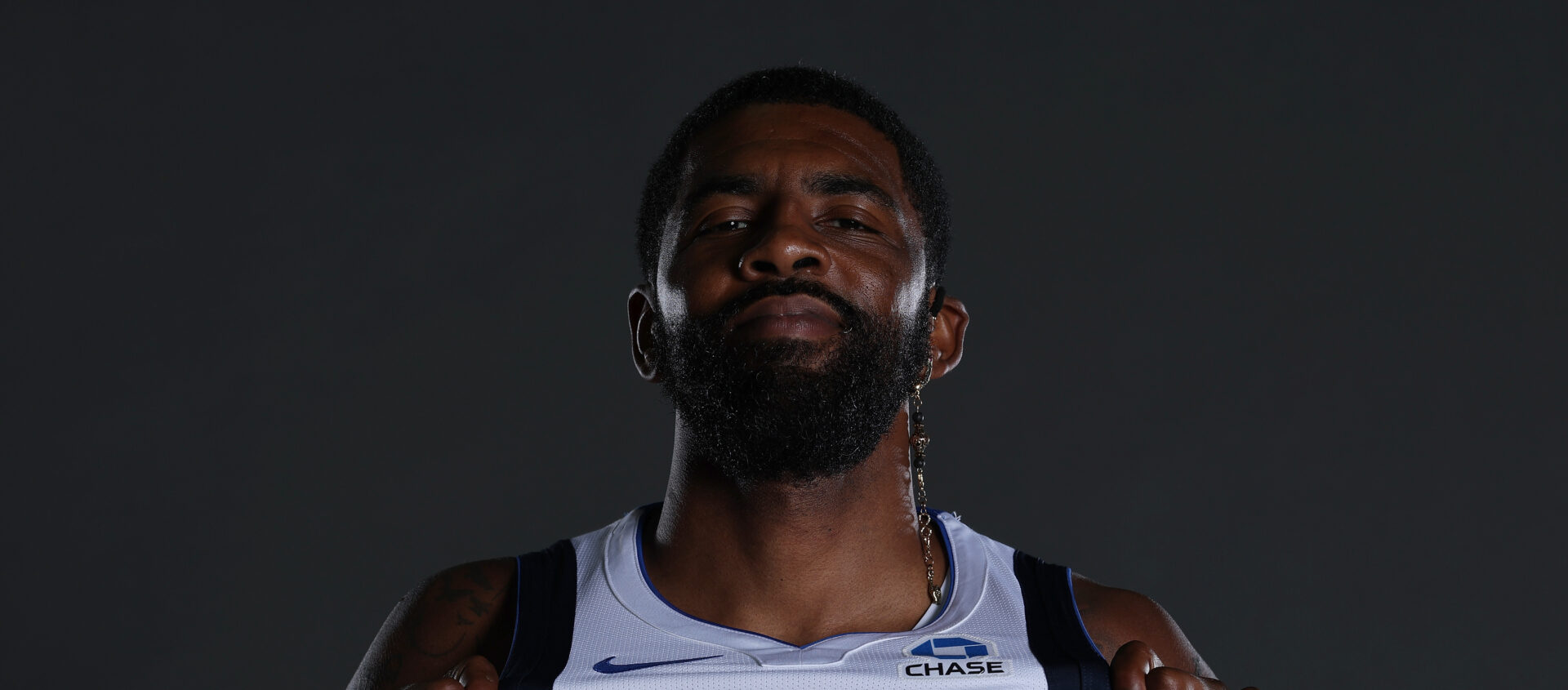

His last NBA game ended in a way that is hard to forget. After a drive against Sacramento, he stayed down on the floor holding his left knee, then, with tears in his eyes, made two free throws and walked to the locker room. It was March 3, 2025. Nineteen months have passed since then.


Kyrie Irving now says he is ready. At Dallas’ Media Day, he spoke to reporters for the first time since the injury, confirmed that he no longer has any physical restrictions and said he cannot wait to play again.
“I’m ready to get back out there and kick some butt”, the 34-year-old guard said, adding that he understands the questions about how much of the old Kyrie is still there.
If he plays against Houston on October 21, it will be his first NBA game in 598 days.
For Irving, 598 Days Away Means More Than Simple Rust
For a player entering his 16th NBA season, 598 days without a game is a serious layoff. In Irving’s case, it carries even more weight because of the way he has made his living for years. His game has never depended only on shooting or court vision, but also on sudden stops, changes of direction, re-acceleration and body control in very tight spaces. That’s what made him special. Few guards have changed pace more often within the same drive, and those movements demand complete trust in the knee after ACL reconstruction.
Irving also was not a player whose career had already started trending downward when he got hurt. Quite the opposite. In the 2024/25 season, he averaged 24.7 points, 4.8 rebounds and 4.6 assists in 36.1 minutes, while shooting 47.3 percent from the field, 40.1 percent from three and 91.6 percent from the free-throw line. As a shooter, he was still operating close to the level of his best years.
After Luka Dončić left, with injuries also decimating the roster, Irving took on a huge share of Dallas’ playmaking and late-possession responsibilities. He was no longer simply the secondary creator next to the player drawing the most defensive attention. He had to become the first option, control the team’s rhythm and solve a large number of difficult possessions. His body was reaching an age when that kind of workload could no longer be treated lightly, and then one play ended his season.
Dallas Chose Patience Over a Faster Return
He underwent surgery on March 26, 2025, and Dallas did not rush him back. For much of the following season, a return remained possible, but in February 2026 the decision was made to shut him down and allow him to complete the rehabilitation process without the pressure of results. The team said at the time that he was making progress, but that Irving would spend the rest of the year working with the medical and performance staff.
What followed was an unusually long stretch without competitive basketball. A professional player who returns after ACL reconstruction typically does so after about a year. A systematic review of eight studies published last year found a return-to-sport rate of 86.8 percent, with an average of 367 days before players competed again. Among those who returned, 97.2 percent played again at their previous competitive level.
If Irving is ready for opening night, nearly 20 months will have passed between his last game and his return. That gives him more recovery time than usual, but it does not guarantee that the first few months will look anything like February 2025.
A study of 26 players who underwent ACL reconstruction between 2010 and 2019 found that 84 percent returned to the league, but their PER in the first season after surgery was, on average, 19.3 percent lower than before the injury. By the second season, that difference was no longer statistically significant. The same study also found that younger age and less NBA experience were associated with a greater likelihood of a successful return. Irving is 34 and has more than a decade and a half of professional mileage on his legs, which means his case cannot be judged simply by the fact that his rehabilitation lasted long enough.
His Skill Set Gives Him a Better Chance to Age Through the Injury
The way he plays, however, gives him a better chance than guards whose value is tied almost entirely to speed and explosiveness to soften the effects of both age and injury. His first step is an important part of his game, but it has never been the only one. Irving is one of the best pull-up shooters of his generation, has punished defenses from the midrange for years, can play off the ball and understands the game well enough that he does not have to reach the rim on every possession. His advantage often comes not from moving faster than his defender, but from reading that defender’s balance earlier, changing pace and forcing a bad step.
Much will depend on how much he trusts his left knee once real games begin. Controlled summer workouts are one thing. Stopping from a full sprint while a defender is trying to knock him off his line, then doing it again two days later, is something else. It is not enough for the ligament to be healed. For a player like Irving, the movement also has to become automatic again.
Naji Marshall said after their shared summer workouts that Irving looks like himself again. Kyrie says he has no restrictions, while new Dallas president of basketball operations Masai Ujiri has kept the appropriate level of caution: practice and an NBA game are not the same thing.
Dallas No Longer Needs Him to Carry the Entire Offense
Dallas also no longer needs him to carry the same workload he had before the injury. Cooper Flagg became the central figure of the new team during his first NBA season and won Rookie of the Year. Irving spent much of his rehabilitation around him and the Mavericks’ other young players, and this summer they finally began playing together more seriously. Both say their games fit naturally. Flagg can take on some of the more physically demanding possessions, push in transition and create off the drive, while Irving once again has the freedom to choose when to take over instead of having to solve every problem himself.
Dallas no longer needs a guard playing nearly 40 minutes and receiving the ball every time the offense breaks down. It needs an Irving who can still bend a defense in the pick-and-roll, make a difficult shot when the action stalls and take over late in games, without the same workload he carried immediately before the injury.
His comments and his behavior throughout the rehabilitation process leave little reason, at least for now, to question his motivation. Irving spent last season around the team, helping younger players and describing his role as an injured leader as something close to coaching. At Media Day, he admitted that the injury forced him to slow down for the first time in a long while and even called it “probably the best thing that ever happened to me.” He also spoke about the fear that comes with rehabilitation and the question of whether he would be the same player, or perhaps even better, when he returned. He no longer wants to watch from the sideline.
The Important Signs Will Go Beyond Points Per Game
The first few months probably will not provide an answer through scoring numbers alone. More revealing will be how often Irving gets to the rim, how he looks when he has to change direction twice in the same possession, whether he can stop and rise into a pull-up without hesitation and how his body responds as the games pile up.
At 34, he does not have to be the same player he was in Cleveland, nor does he have to prove that he can play like he did at 25. Dallas only needs him to preserve the parts of his 2025 game that tend to age more slowly: the shooting, ball control, ability to read defenses and capacity to create an advantage in a few moves that most players never see.
Still, we’d all love to see the famous Uncle Drew cooking his opponents again…