












At first glance, Enes Kanter Freedom declaring himself eligible for the 2027 WNBA Draft sounds less like a basketball transaction than a provocation.


The former NBA center announced that, after what he described as a review of the WNBA’s current eligibility framework, he was formally declaring himself a prospect for the April 2027 draft. His argument was deliberately simple: if self-identification is sufficient to determine who qualifies for inclusion in women’s basketball, then the same principle should be applied to him.
“After careful consideration and reviewing the current eligibility guidelines, I’m officially declaring myself a WNBA prospect,” Kanter wrote.


He went further.
“If simply declaring who you are is all that’s required, then I meet every single requirement necessary to compete in the WNBA.”
Kanter said that he and his team had examined the league’s eligibility criteria and the broader framework surrounding self-identification and inclusion, concluding that he could formally declare himself eligible for the upcoming draft.
He also anticipated the obvious criticism.
“I know my presence on the court will stir up strong opinions,” he wrote, insisting that his intention was not to mock or disrespect any community or individual choice.
Instead, he framed the move as a demand for consistency.
“I’m simply asking that the current rules be applied equally to everyone,” he said, before closing with the deliberately theatrical line: “See you at training camp.”
After careful consideration and reviewing the current eligibility guidelines,
I’m officially declaring myself a @WNBA prospect.If simply declaring who you are is all that’s required, then I meet every single requirement necessary to compete in the WNBA.
My team and I have… pic.twitter.com/msncUZUT1J
— Enes Kanter FREEDOM (@EnesFreedom) August 7, 2026
The statement immediately became part of a much larger debate that has little to do with Kanter’s actual basketball future and far more to do with a question the WNBA has so far not answered publicly in precise regulatory terms: Who, exactly, is eligible to play in the WNBA?
Even though the question sounds straightforward, the answer is not.
What the WNBA’s collective bargaining agreement actually says
The central provision is contained in Article XIII, Section 1(a) of the WNBA’s collective bargaining agreement.
Its wording is brief: “Only players who are women are eligible to play in the WNBA.”
The complication is that the agreement, as described in the material surrounding the controversy, does not publicly define the term “woman” for eligibility purposes. Nor does it set out a detailed transgender-athlete policy based on biological sex, gender identity, hormone levels, transition status or any comparable criteria.
The terms “transgender” and “gender identity” do not appear in the agreement’s eligibility language, despite the document offering detailed definitions and provisions in many other areas.
That omission is the foundation of Kanter’s argument. The absence of a detailed public definition does not mean that the WNBA has written a rule saying that anyone who self-identifies as a woman is automatically eligible.
The CBA says that players must be women. However, what it does not explain publicly, at least in the material at issue here, is precisely how that category would be applied to a transgender applicant.
Kanter is therefore not pointing to a rule that clearly makes him eligible. He is pointing to an unresolved—or at minimum publicly unexplained—part of the rulebook and using it to challenge the league to explain where the line is.
Why Kanter made the statement now
The timing is not accidental.
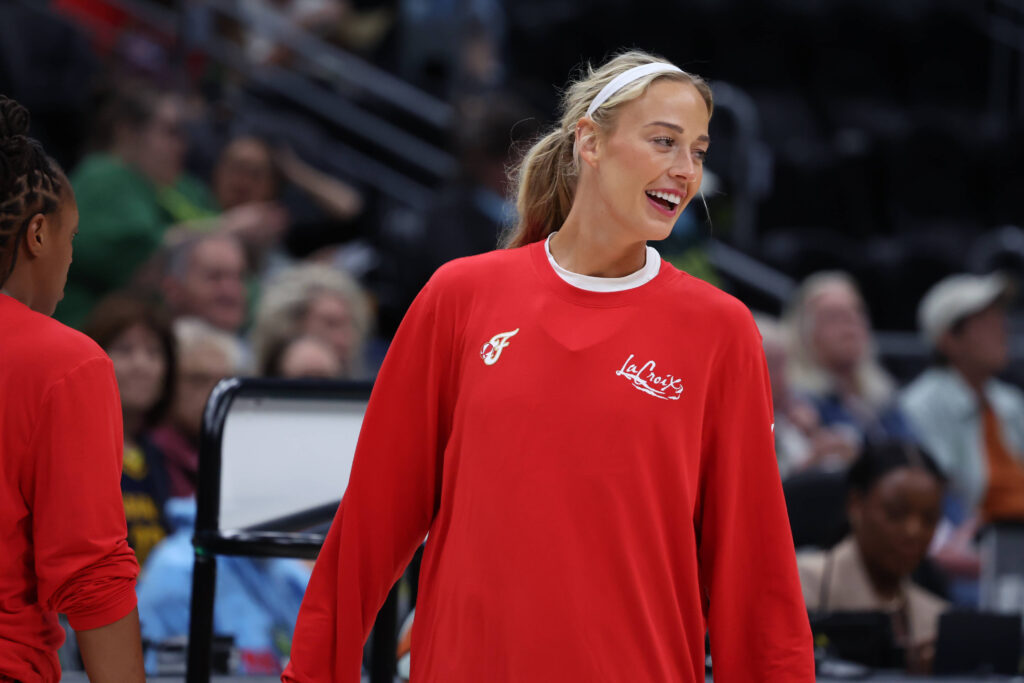
Gender eligibility in women’s sport has become a major issue around the WNBA after Indiana Fever guard Sophie Cunningham spoke publicly against transgender athletes competing in women’s categories.
Cunningham said she had received criticism from people accusing her of hostility toward transgender people, something she rejected.
She argued instead that her position was about what she considers competitive fairness and the protection of girls in sport.
“I am here to extend love,” Cunningham told ESPN. “But I also think with that love is truth, being honest. And I want to protect young girls in a locker room, or young girls in sport who shouldn’t have to go against biological men.”
Her remarks triggered a much wider debate.
Small demonstrations appeared around several Indiana Fever road games, including in Seattle, Portland and Minnesota, involving both supporters of Cunningham’s position and counter-protesters advocating transgender inclusion.
Minnesota Lynx coach Cheryl Reeve emerged as one of the most prominent voices on the other side, emphasizing inclusion and publicly wearing a shirt reading “Trans kids belong.”
The wider argument increasingly became about what the WNBA means when it describes itself as an inclusive space and how that principle should interact with competitive eligibility in a women’s professional league.
Caitlin Clark, Cunningham’s teammate in Indiana, largely declined to enter the substance of the debate. Her position was that eligibility decisions should be handled by leagues and governing bodies together with athletes, while the players themselves remained focused on basketball.
That response was cautious, but it also indirectly highlighted the exact regulatory question Kanter is now trying to force into public view.
Kanter’s argument is rhetorical, not yet regulatory
Kanter’s announcement should therefore be understood for what it is.
It is not evidence that he has been declared eligible by the WNBA; nor does it mean that the league recognizes self-identification alone as sufficient. It’s highly doubtful if he has found a technical loophole guaranteeing him entry into the 2027 draft.
What he has found is a rhetorical opening. His logic takes a principle of gender self-identification, applys it without additional conditions, and follows it to what he presents as its logical extreme.
If gender identity alone determines eligibility, he argues, then why should that principle not apply to him as well?
The problem is that the publicly available language cited in this controversy never actually says gender identity alone determines WNBA eligibility. That is the leap in Kanter’s reasoning. His statement is therefore less a literal application of an existing rule and more a challenge directed at the WNBA to define the rule more precisely.
That is why his claim is simultaneously more serious and less legally decisive than it first appears.
He may be exaggerating what the current wording alloww, but he is also drawing attention to a genuine lack of public clarity.
The Julie Tétart case makes the question much less theoretical
There is another reason the issue can no longer be treated as purely hypothetical.
Julie Tétart, a transgender basketball player competing for Monaco in France’s second-tier women’s league, has already created a concrete eligibility question.
According to the source material, Tétart averaged 21 points and 20 rebounds during the 2025-26 season, leading the league in both categories. She was also named the league’s Player of the Year, Defensive Player of the Year and Domestic Player of the Year by Eurobasket.com.
More importantly for the WNBA debate, Tétart has publicly expressed interest in playing in the United States, describing the WNBA as a childhood dream and saying she would not turn down an opportunity if contacted.
Reporters subsequently asked both the WNBA and the Women’s National Basketball Players Association whether Tétart would be eligible under the current agreement.
According to the material provided, neither organization answered that specific question. Before a player such as Tétart existed as a plausible professional candidate, the eligibility issue could be discussed almost entirely in theoretical terms. Now there is an actual player competing in a women’s professional league, producing elite numbers, and openly expressing interest in the WNBA.
At that point, “only players who are women are eligible” becomes less of a slogan and more of a regulatory standard that at some stage may have to be applied to a real individual.
What the WNBA actually has to decide
The fundamental question is how eligibility is determined. The collective bargaining agreement, as presented in the material, does not answer the question. That is the gap Kanter is exploiting.
It would be wrong to say that Kanter has definitely found a loophole allowing him to play in the WNBA.
It would also be incomplete to dismiss his statement as entirely meaningless, because the league’s publicly stated eligibility framework does appear to leave unanswered questions about how the word “women” is operationally defined in transgender cases.
There are multiple layers of eligibility involved in the WNBA draft process, including age, amateur or professional status and international-player provisions.
Kanter’s age would obviously not be an obstacle. But those secondary draft conditions are irrelevant unless he first clears the threshold issue: whether he is considered eligible to compete in the WNBA as a player who falls within the CBA’s definition—or application—of “women.”
And based on the public information available in the source material, there is no evidence that the WNBA has accepted his interpretation.
Kanter has not demonstrated that he can legally or contractually force his way into the WNBA Draft simply by declaring himself eligible.
What he has demonstrated, though, is that the league has not publicly articulated, in the cited framework, a sufficiently detailed standard to make every transgender-eligibility scenario immediately obvious.
The real target is the WNBA, not a roster spot
Taken literally, Kanter’s announcement is difficult to imagine becoming a conventional basketball story.
A former NBA center announcing a WNBA Draft bid is not realistically being presented as a normal late-career comeback strategy.
The point is political. Kanter is challenging the WNBA to reconcile three things:
- its identity as a women’s professional league;
- its long-standing culture of LGBTQ+ inclusion;
- and the absence, in the material being debated, of a detailed public rule explaining exactly how transgender eligibility is determined.
That is why his statement matters more as a regulatory provocation than as a roster move. If the WNBA says only women are eligible, what exactly does that mean for transgender athletes? And if gender identity is part of the answer, what other criteria apply?
The issue the league may eventually have to address
The WNBA has historically operated in an environment where questions of identity, LGBTQ+ rights and athlete activism are far more visible than in many other major American sports leagues. That history is part of its culture and part of its appeal.
But inclusion as a social principle and eligibility as a competition rule are not identical concepts. A professional league eventually needs a standard capable of determining who can and cannot play.
Kanter’s declaration deliberately collapses those two conversations together. The WNBA may ultimately reject his premise completely. It may already possess internal criteria that would make his supposed eligibility impossible.
But unless and until such criteria are clearly explained publicly, cases such as Tétart’s — and rhetorical provocations such as Kanter’s — will continue to expose the gap between broad statements about inclusion and the precise mechanics of sporting eligibility.
Enes Kanter has not proven that he belongs in the WNBA. He has challenged the WNBA to explain, with greater precision, who does.