










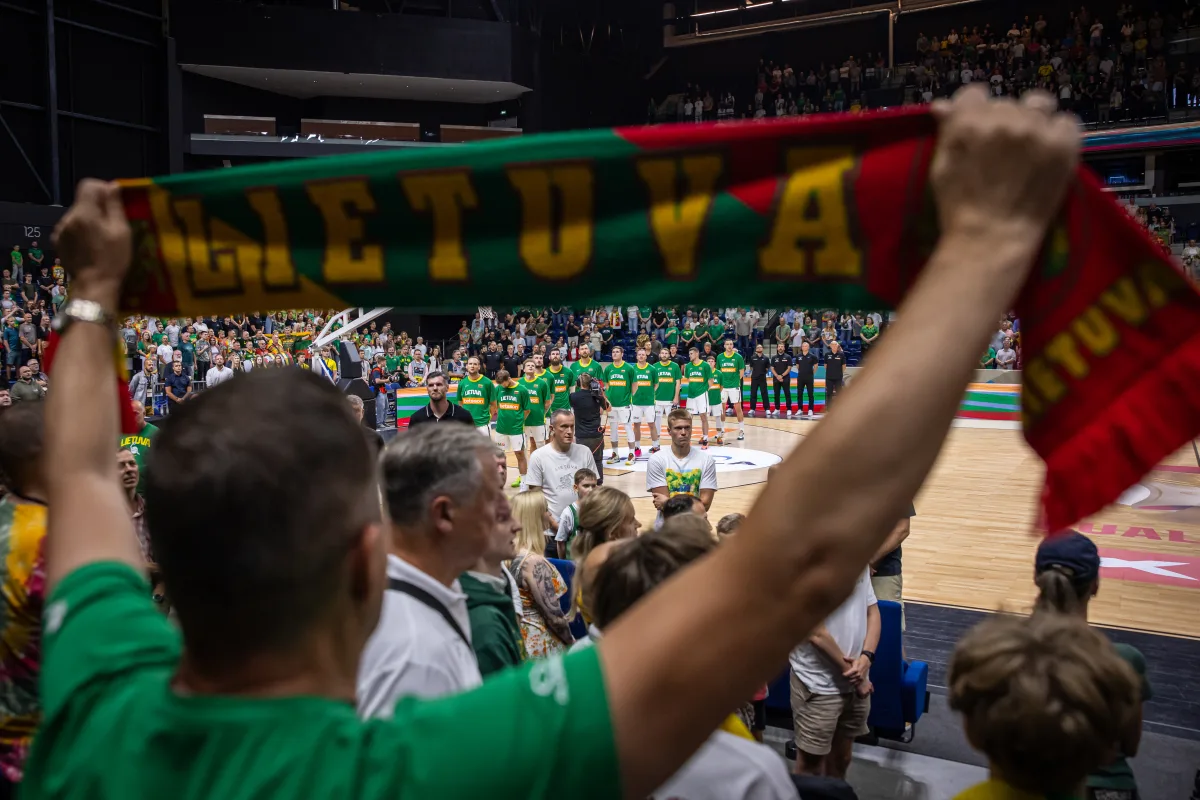

Two days before Mindaugas Balčiūnas announced that he was stepping down as president of the Lietuvos krepšinis association, an empty chair remained in the studio of Lithuania’s national broadcaster. It was supposed to be occupied by Jonas Miklovas, director of BasketNews, but Balčiūnas refused to take part in the program if one of his most vocal critics remained at the same table.


LRT and Miklovas agreed to change the format so the federation president could still be questioned about the problems surrounding Lithuanian basketball, particularly the case of Rimantas Grigas, the former women’s national team coach whom FIBA suspended for five years following an investigation into inappropriate behavior toward players. Two days later, Balčiūnas stepped down halfway through his term.
The empty chair did not cause his departure, but it captured the state Lithuanian basketball had reached. Dissatisfaction with the leadership had been building for months. The men’s national team was repeatedly missing many of its best players, head coach Rimas Kurtinaitis resigned and then returned after no suitable replacement was found, former internationals began speaking publicly about organizational problems, and more than 8,300 people signed a petition in early September calling for Balčiūnas to leave.

There Was No Organized Player Boycott
The simplest explanation was that the players were boycotting the national team. The people at the center of the situation, however, did not support that claim. Jonas Valančiūnas, a longtime pillar of the national team who had been part of Lithuania’s national-team system since 2007, explicitly rejected the idea of an organized boycott. Ahead of the August qualifying window, Lithuania was without nearly 20 players who under normal circumstances would have been serious candidates for the roster, but their reasons were not the same. Rokas Jokubaitis, Tadas Sedekerskis and Domantas Sabonis had health issues, Kasparas Jakučionis had obligations with his NBA team, while Valančiūnas, after 14 years in the NBA, wanted to go through a full preseason with Žalgiris.
“Nobody is boycotting”, Valančiūnas said, stressing that he had not encouraged any teammate to turn down the national team.
Valančiūnas Questioned Whether the Leadership Could Be Trusted
He did acknowledge, however, that his return to Žalgiris was not the only reason for his absence. His decision, he said, was also influenced by information he was receiving from inside the national team. He was particularly bothered by the way absent players were portrayed as insufficiently patriotic, prompting him to publicly raise the question of accountability among those running the program.
Valančiūnas pointed to the communication surrounding the coaching situation as one example. After Kurtinaitis resigned, he was told by the federation that Dainius Adomaitis was essentially set to become the new head coach. When Valančiūnas later spoke directly with Adomaitis, he realized the deal was nowhere close to being completed. The issue was no longer only who would coach the national team, but how much the information coming from the leadership could be trusted.
Kurtinaitis Left, Then Returned Because There Was No Replacement
Kurtinaitis’ situation further showed how complicated things had become. Lithuania finished the first stage of World Cup qualifying at 3-3, including a particularly painful loss to Italy in Bologna after surrendering a double-digit lead late in the game. Kurtinaitis then resigned. Balčiūnas spoke with other coaches, but no agreement was reached, so Kurtinaitis returned and openly explained that he did not want to leave the national team without a solution for the next window after no other candidate had been found.
Lithuania played in August without a single NBA player and with only two EuroLeague players. Turkey routed them 94-66, before Lithuania stayed alive in the World Cup race three days later with a 78-73 win over Bosnia and Herzegovina in Vilnius. After eight games, its record stood at 4-4.
Mačiulis Described a Loss of Authority, Not a Revolt
Jonas Mačiulis offered even stronger criticism. The former international, who for years had been an almost automatic presence with the national team, said that based on what he was hearing from current players, he was not sure he would accept a call-up himself under those circumstances.
He spoke about poorly organized practices, unclear training plans and players arriving from well-structured club environments only to enter a setup where, according to his account, too much was being improvised. He also pointed out that Lithuanian players have represented the national team for years without significant financial compensation, accepting the risk of injury and giving up part of their offseason, and therefore expect a professionally run environment in return.
Mačiulis did not describe the situation as a boycott, but as a loss of authority. To illustrate the problem, he referred to previous generations and questioned how many players would have turned down call-ups in the same way if they had been dealing with figures such as Arvydas Sabonis, Jonas Kazlauskas or Dainius Adomaitis.
Motiejūnas Added Another Layer to the Tension
Donatas Motiejūnas also appeared in Mačiulis’ account. Mačiulis said he had heard from players that Motiejūnas’ return was one of the reasons at least two of them declined invitations. He connected that to older tensions following the Olympic qualifying tournament in Puerto Rico and information that emerged from inside the locker room at the time. It remains Mačiulis’ account of what he heard rather than an independently confirmed fact, but it adds another layer to how strained relationships within the national-team circle had become.
According to the available information, there was no formal boycott. Players had different reasons for being absent, but behind those individual decisions a shared problem was becoming increasingly visible: a lack of trust in the way the national team and the federation were being run.
The Grigas Case Deepened the Crisis
The Rimantas Grigas case then added another problem. In early 2025, several Lithuanian women’s basketball players, speaking with their identities protected, described inappropriate behavior and unwanted touching by the then-head coach of the women’s national team. The federation opened an internal investigation. Its disciplinary and ethics commission concluded that the testimony it collected did not establish sexual harassment, but Grigas was given a warning over problems in his communication with players and the organization of the team. He stepped down as national team coach in the meantime.
FIBA later reached a much more serious conclusion. Its disciplinary panel suspended Grigas from all basketball activities for five years, through October 27, 2030, fined him 12,000 Swiss francs and made any potential return conditional on completing a specific safeguarding program.
FIBA’s Decision Raised Questions About the Federation’s Investigation
The outcome reopened questions about how the Lithuanian federation had handled the case and why its internal investigation had produced such a different result. Balčiūnas addressed exactly that issue on LRT on September 9, in the program where he declined to debate Miklovas directly. At a time when greater transparency was being demanded from the federation, its president refused to sit at the same table with a representative of one of the country’s most influential basketball media outlets.
Two days later, he announced his departure. Balčiūnas will be replaced on an interim basis by longtime Lithuanian league president Remigijus Milašius, while early elections are expected to be called. Žalgiris’ Paulius Motiejūnas and Mačiulis immediately called for an independent review of the organization’s operations.
Balčiūnas Had Already Left the Federation Once Before
Balčiūnas had already left the top level of Lithuanian basketball once before following a serious internal dispute. After EuroBasket 2013, where Lithuania won the silver medal, the federation entered a major crisis. President Arvydas Sabonis, vice president Antanas Guoga, executive director Paulius Motiejūnas and head coach Jonas Kazlauskas all announced plans to leave. Kazlauskas openly identified Balčiūnas, then the federation’s secretary general, as someone he did not want to continue working with and accused him of harming the national team, a claim Balčiūnas rejected.
A compromise was reached a week later. Balčiūnas left his position as secretary general, Sabonis withdrew his resignation and Kazlauskas decided to remain as head coach. Balčiūnas said at the time that stepping down had not been a difficult decision if it allowed Sabonis to continue leading the federation.
The Next President Has to Rebuild Trust
Thirteen years later, his second spell at the top of Lithuanian basketball has also ended, this time as president. The circumstances are different, but once again the situation reached a point where his position was no longer merely about one executive. It had become a problem affecting the wider system.
The players did not organize a revolt to remove the federation president. Many had legitimate sporting, health or professional reasons not to play. Balčiūnas’ position became untenable when those absences were combined with Kurtinaitis’ resignation and return, Valančiūnas’ public dissatisfaction, Mačiulis’ claims about conditions around the national team, the supporters’ petition and the outcome of the Grigas case.
In a country where the national team occupies a special place in sporting and public life, the problem could no longer be reduced to a handful of declined call-ups or one poor qualifying window. Balčiūnas stepped aside after it became clear that trust in the leadership had been seriously damaged. His successor will inherit more than a position. The next president will also have to rebuild the relationship with the players, clubs and public that Lithuanian basketball depends on.