


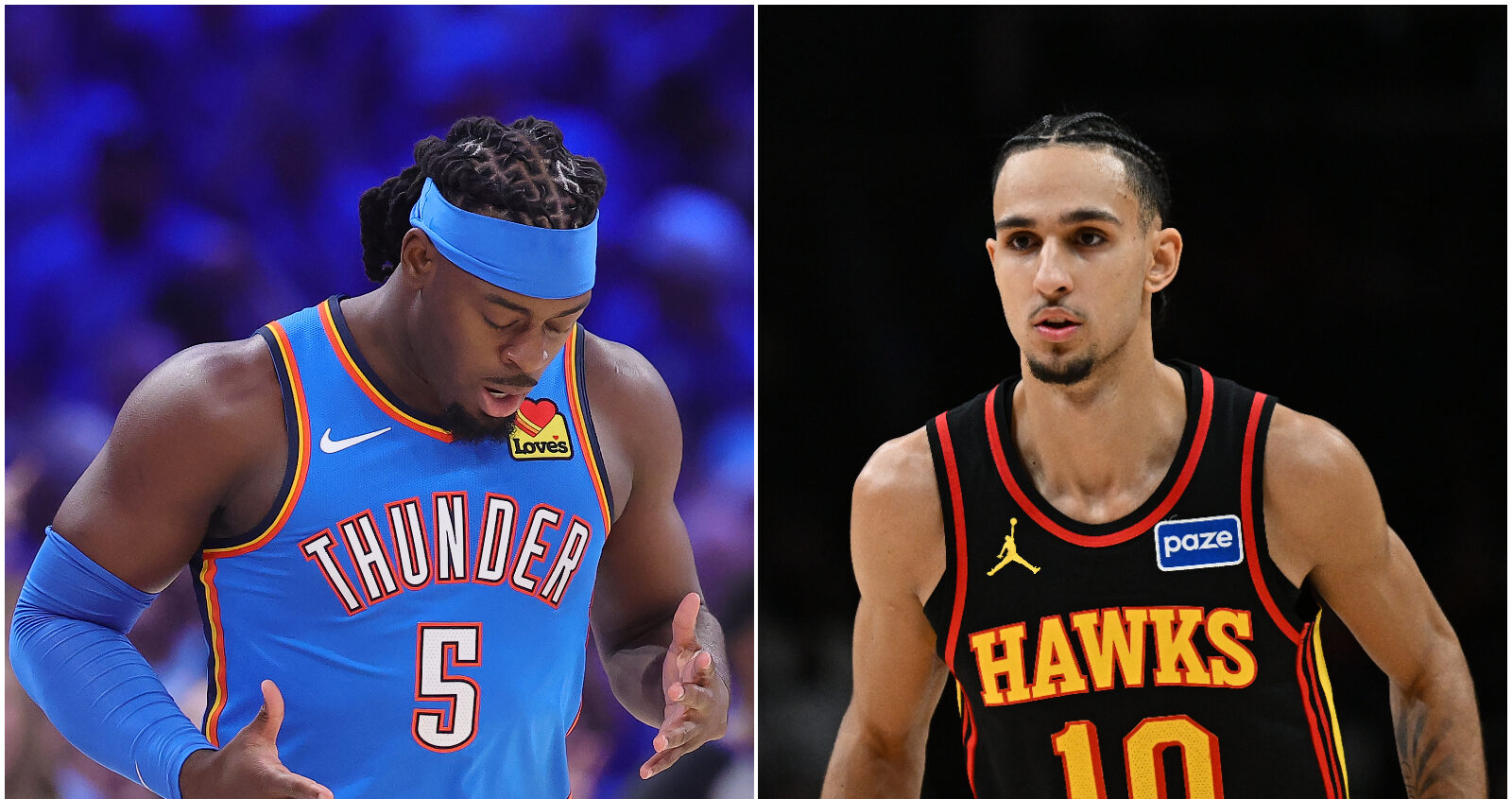

While the NBA waits for LeBron James to decide what will likely be the final stop of his remarkable career, the trade market produced a three-team deal that once again put a former No. 1 overall pick at the center of the conversation.


The Atlanta Hawks sent Zaccharie Risacher to Dallas and received Lu Dort and Ryan Nembhard. Oklahoma City came away with more second-round picks, but the more important part of the deal was getting another substantial contract off its books and moving below the second apron.
Dort went from undrafted free agent to starter, primary perimeter stopper and one of the players who helped establish the Thunder’s identity before they grew into the best team in the league. He is now headed to Atlanta, a team clearly trying to become a factor in the Eastern Conference. Risacher, the first pick in the 2024 draft, leaves the Hawks after only two seasons for a Dallas team that acquired him without giving up a major piece of its future. Oklahoma City added draft capital and made its payroll easier to manage.

One Trade, Three Different Priorities
All three teams got something that fits their current situation, which is why the deal cannot be reduced to who landed the best player. Dort can help the Hawks right away. The Mavericks can afford to be patient with Risacher and find out whether he can settle into a useful role on a competitive team. Oklahoma City gave up an important piece of its championship rotation to address an immediate financial issue, preserve flexibility for future moves and collect three second-round picks: Chicago’s 2027 pick through Dallas, the more favorable of Atlanta’s and Houston’s picks in 2031, and the more favorable of Atlanta’s and the Lakers’ picks in 2032.
Oklahoma City Chose Flexibility Over Continuity
By trading Isaiah Joe, Aaron Wiggins and Lu Dort, the Thunder collected seven second-round picks this summer and moved below the second apron. Estimates put the combined salary and luxury-tax savings at more than $200 million, but this was about more than cutting costs. Sam Presti also gave the Thunder more freedom to combine salaries in trades, use exceptions and act if a player who could strengthen the playoff rotation becomes available.
Moving Dort bought that freedom, but it cost Oklahoma City a player with an established role. The Thunder have already lost several useful rotation pieces. Cason Wallace has shown that he can handle more responsibility, while Ajay Mitchell and the other young players need additional minutes, but that does not guarantee a smooth transition. Oklahoma City may be able to replace much of the production, but the effect of these decisions will not be clear until the roster is tested in the postseason.
The bet is that the depth built over several years can absorb the losses. Some of Dort’s assignments can be divided among younger and cheaper players without dramatically lowering the team’s level. That is a reasonable approach for a franchise trying to contend over a long period rather than protecting one version of the roster at any cost. The remaining players, however, will have less margin for injury, poor form or an unfavorable playoff matchup.
Atlanta Is Building a New Defensive Identity
Atlanta is dealing with a different set of questions. The Hawks are still defining what they want to become after Trae Young’s departure. Adding Dort continues their move toward a stronger, more dependable defensive team that will not be built so heavily around one player controlling the ball.
Dyson Daniels, Nickeil Alexander-Walker and Lu Dort give Atlanta several perimeter defenders who can pressure the ball and take on different matchups. With Jalen Johnson as the central figure of the new group, the Hawks now have a clearer foundation than they did in recent seasons.
Giving Up on the No. 1 Pick
Trading Risacher shows that they were no longer prepared to wait simply because they had selected him first overall. His development had not moved quickly enough, and the direction of the team changed around him. Atlanta accepted the possibility that the young French wing could take a major step elsewhere in exchange for a player whose role and value are already well established.
Dort’s contract also fits the plan. He can improve the defense immediately, and his deal expires next summer. With several other contracts coming off the books, Atlanta could soon create considerable cap space. The Hawks can extend him, use his salary in another trade or let the contract expire and take the flexibility into the offseason.
A better defense does not answer every question on the other end. Daniels, Dort and Alexander-Walker can make opponents work through possessions, but none is a reliable late-game organizer. Johnson’s development becomes even more important in that context, as does Atlanta’s eventual use of its cap space. The Hawks have started to define how they want to defend. They still need to determine who will consistently run the offense when the game slows down.
Nembhard can help without being expected to solve that problem by himself. As a rookie, he showed poise with the ball and posted a strong assist-to-turnover ratio. His size will make him a defensive target, but Atlanta is not overloaded with natural point guards. On a small contract, he gives the Hawks someone who can run the second unit and take some of the playmaking burden off their main creators.
Dallas Buys Low on Risacher
Dallas took on a more limited and manageable gamble. The Mavericks used an existing trade exception to absorb Risacher’s contract without sending out a similar salary. Nembhard and one second-round pick is a reasonable price for the chance to see whether a 21-year-old wing can find a place next to Cooper Flagg.
Risacher’s first two seasons did not match the expectations attached to a No. 1 pick. He did not develop into a primary creator, his influence varied from game to game and his role became smaller when the stakes rose. Risacher still has size, mobility and the ability to defend several positions, along with enough shooting ability that opponents cannot simply leave him alone.
He will not be asked to become the face of the Mavericks, and the reduced expectations may help him. Dallas needs him to make open shots, defend wings and take advantage of the space his teammates create. If he develops into a dependable 3-and-D player, the Mavericks will have added a valuable piece at a modest price. If the move does not work, the team options in his contract keep the commitment from becoming a long-term problem.
The Real Verdict Will Come Later
Oklahoma City’s side of the trade will ultimately be judged by what Presti does with the added flexibility and whether the Thunder still have enough perimeter toughness when the playoffs arrive. Atlanta has made its defensive direction clearer, although the roster still needs more offensive creation. Dallas can be patient because it paid little for the opportunity to find out whether Risacher needed a new environment or whether the Hawks correctly evaluated where his development was heading.
The trade addressed a current need for all three teams. Whether it becomes a good deal for any of them will depend on what happens next.